


- Jul 2, 2018
- 3,680
 |
Headquarters |
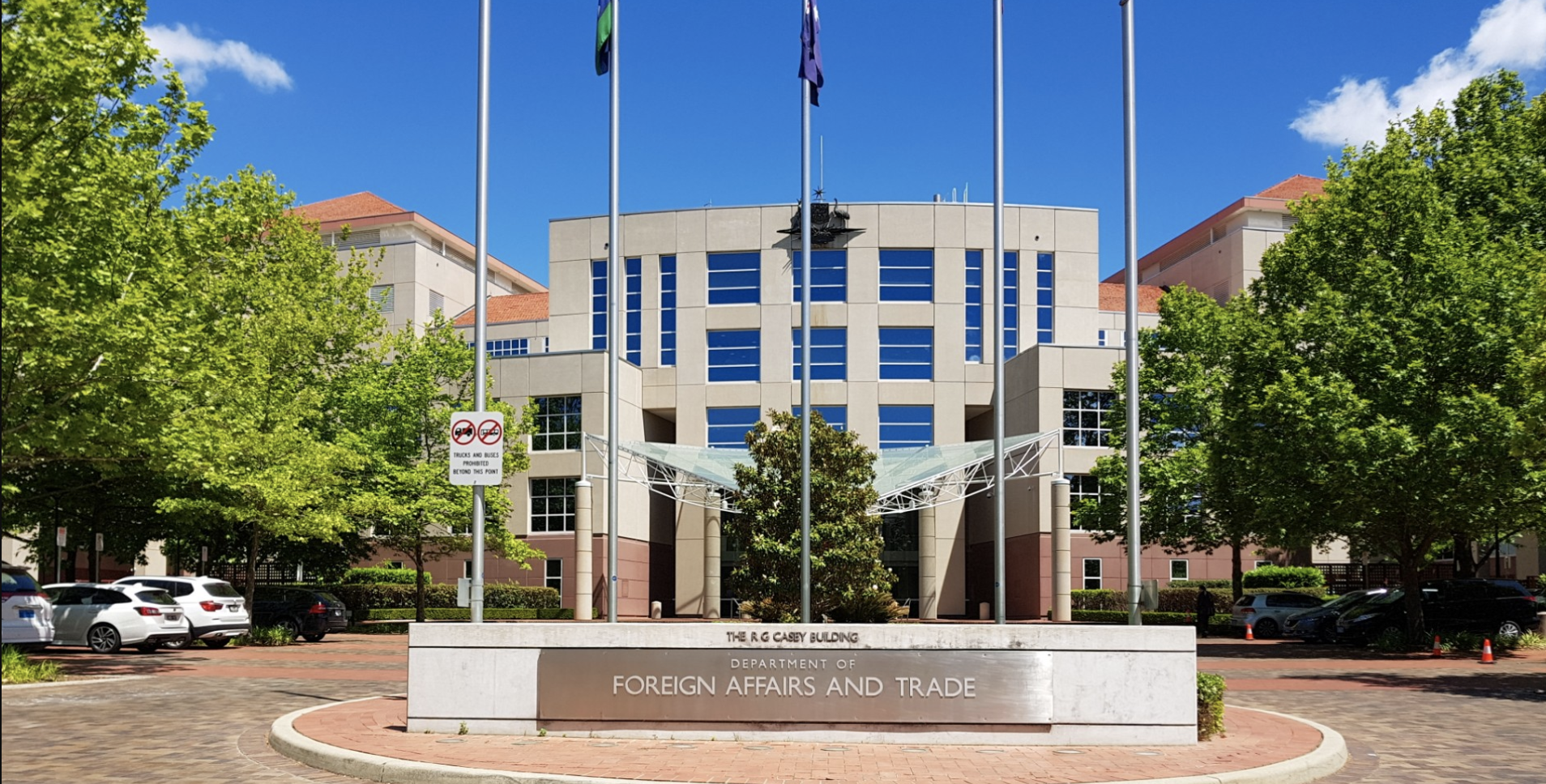 |
R.G. Casey Building, Barton, Australian Capital Territory |
Ministers |
| Office: | Officeholder: | Image: |
|---|---|---|
| Minister for Foreign Affairs | The Honourable Kevin Rudd, MP | 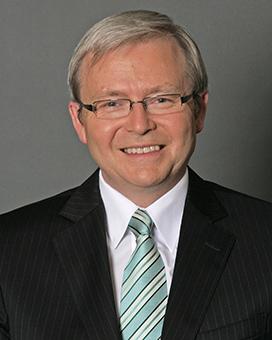 |
| Minister for Trade | The Honourable Senator Penny Wong | |
| Minister for Pacific Island Affairs and Overseas Aid | The Honourable Senator Jenny McAllister | |
| Minister for Tourism | The Honourable Martin Ferguson, MP | |
| Assistant Minister for Foreign Affairs | The Honourable Senator Don Farrell | |
| Secretary of the Department of Foreign Affairs and Trade | Michael L'Estrange, AO |  |
NOTE: Consulates consist of only one person; the Consul. They are an honorary position and are usually operated out of the personal offices or businesses of the Consul. Consulate-General's are directly operated by DFAT and have multiple DFAT staff and a DFAT appointed Consul-General. |
| Office: | Size: | Location: |
|---|---|---|
| Torres Strait Treaty Liaison Office | 50x Diplomatic, Consular and Mission Staff | Thursday Island |
Branches |
| Branch: | Role: |
|---|---|
| Consular Operations Branch | Manages crisis responses and provides emergency assistance and consular services for Australian citizens traveling or living overseas. |
| Crisis Preparedness and Management Branch | Focuses on protecting Australians abroad and ensuring national readiness for international emergencies. |
| Consular Communications and Policy Branch | Responsible for developing consular policy, managing the Consular Services Charter, and overseeing public outreach through the Smartraveller platform to assist Australians traveling overseas. |
Consular Emergency Centre +61 2 6261 3305 from overseas or 1300 555 135 in Australia |
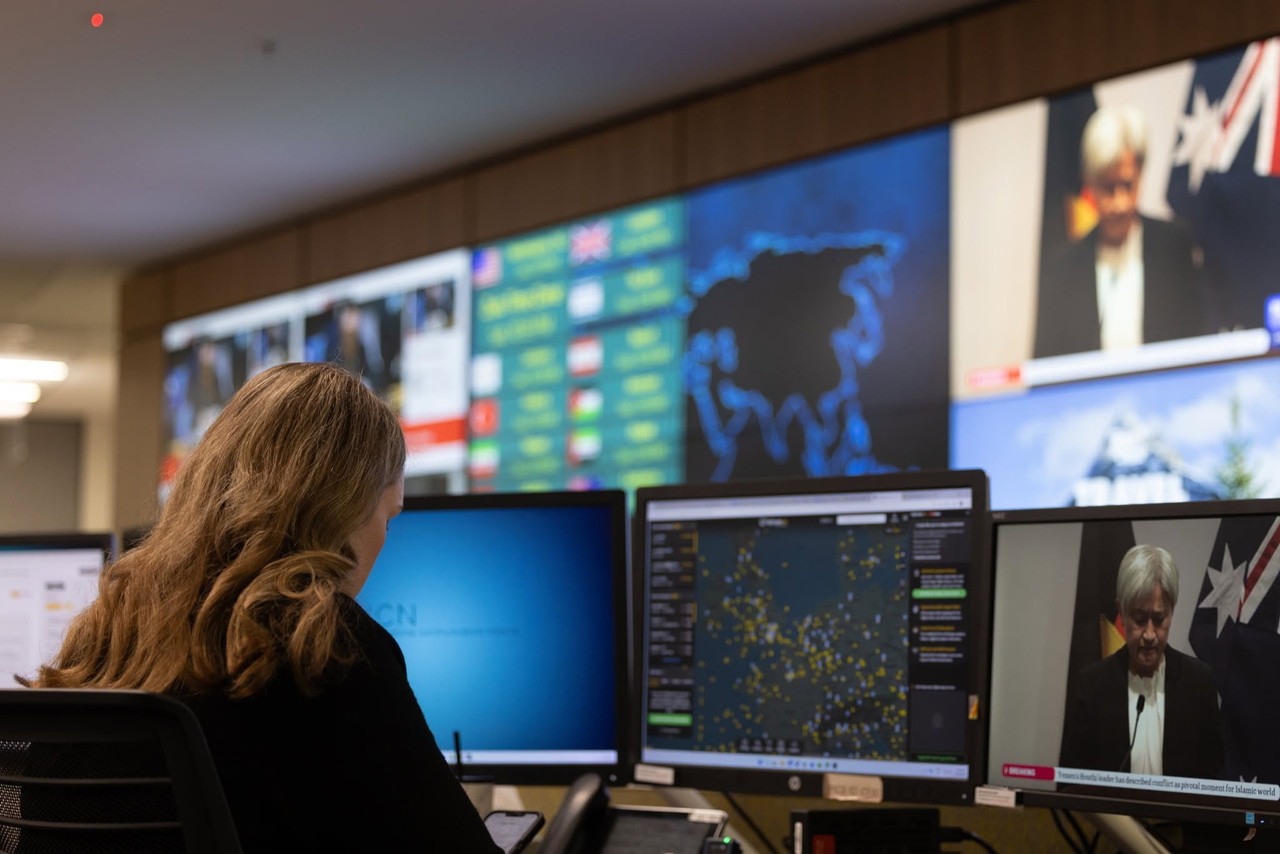 |
Department of Foreign Affairs and Trade Crisis Centre, R.G. Casey Building |
| Logo: | Name: | Participants: | Held: | Last Held: |
|---|---|---|---|---|
 | Australia-United States Ministerial Consultations |
| Quadrennially | N/A |
 | Australia-United Kingdom Ministerial Consultations |
| Quadrennially | January 2005 Edinburgh, Scotland |
 | Singapore-Australia Joint Ministerial Committee |
| Quadrennially | N/A |
 | Australia-New Zealand Leaders' Meeting |
| Biennially | N/A |
| Office: | Officeholder: | Image: |
|---|---|---|
| First Assistant Secretary, Polynesia and Micronesia Division | Ric Wells |  |



| Office: | Officeholder: | Image: |
|---|---|---|
| First Assistant Secretary, Melanesia Division | Patricia Holmes |  |
| Flag: | Country: | Relations: | Diplomatic Missions: | Head of Mission: | Personnel: | Agreements: | Travel Advisory: |
|---|---|---|---|---|---|---|---|
 | New Caledonia (France) | 6/10 | Nouméa (Consulate-General) See France | Annelise Young (Consul-General) | 50x Diplomatic, Consular and Mission Staff 20x Diplomatic Security Contractors | Agreement Establishing the South Pacific Forum Secretariat Agreement Establishing the South Pacific Commission | Exercise a high degree of caution |
| Office: | Officeholder: | Image: |
|---|---|---|
| First Assistant Secretary, East Asia Division | Graham Fletcher |  |
| Flag: | Country: | Relations: | Diplomatic Missions: | Head of Mission: | Personnel: | Agreements: | Travel Advisory: |
|---|---|---|---|---|---|---|---|
 | Ming Dynasty (China) | 5/10 | Beijing (Embassy) Chengdu (Consulate-General) Guangzhou (Consulate-General) Shanghai (Consulate-General) Shenyang (Consulate) | Frances Adamson | 250x Diplomatic, Consular and Mission Staff (Beijing) 20x Diplomatic Security Contractors (Beijing) 100x Diplomatic, Consular and Mission Staff (Shanghai) 50x Diplomatic, Consular and Mission Staff (Guangzhou) 25x Diplomatic, Consular and Mission Staff (Chengdu) | None | Exercise normal safety precautions |
 | Hong Kong Special Administrative Region of the Ming Dynasty | 5/10 | Hong Kong (Consulate-General) See China | David O'Leary (Consul-General) | 100x Diplomatic, Consular and Mission Staff | None | Exercise normal safety precautions |
 | State of Japan | 5/10 | Tokyo (Embassy) Osaka (Consulate-General) Fukuoka (Consulate-General) Sapporo (Consulate) | Murray McLean | 250x Diplomatic, Consular and Mission Staff (Tokyo) 10x Diplomatic Security Contractors (Tokyo) 50x Diplomatic, Consular and Mission Staff (Osaka) 50x Diplomatic, Consular and Mission Staff (Fukuoka) | None | Exercise normal safety precautions |
 | Empire of Korea | 5/10 | Seoul (Embassy) Pyongyang (Consulate-General) Busan (Consulate) | Peter Rowe | 150x Diplomatic, Consular and Mission Staff (Seoul) 10x Diplomatic Security Contractors (Seoul) 50x Diplomatic, Consular and Mission Staff (Pyongyang) | None | Exercise normal safety precautions |
 | Macao Special Administrative Region of the Ming Dynasty | 5/10 | See Hong Kong | See Hong Kong | None | None | Exercise normal safety precautions |
| Office: | Officeholder: | Image: |
|---|---|---|
| First Assistant Secretary, Southeast Asia Maritime Division | Jon Philp |  |
| Flag: | Country: | Relations: | Diplomatic Missions: | Head of Mission: | Personnel: | Agreements: | Travel Advisory: |
|---|---|---|---|---|---|---|---|
 | Republic of Singapore | 9/10 | Tanglin (Embassy) | Gary Quinlan | 200x Diplomatic, Consular and Mission Staff 20x Diplomatic Security Contractors | Status of Forces Agreement between Australia and Singapore Agreement between Australia and Singapore regarding external defence | Exercise normal safety precautions |
| Office: | Officeholder: | Image: |
|---|---|---|
| First Assistant Secretary, Southeast Asia Mainland Division | Justin Lee |  |
| Flag: | Country: | Relations: | Diplomatic Missions: | Head of Mission: | Personnel: | Agreements: | Travel Advisory: |
|---|---|---|---|---|---|---|---|
 | Socialist Republic of Thailand | 5/10 | Bangkok (Embassy) Phuket (Consulate-General) Chiang Mai (Consulate) Ko Samui (Consulate) | Bill Paterson | 150x Diplomatic, Consular and Mission Staff (Bangkok) 20x Diplomatic Security Contractors (Bangkok) 50x Diplomatic, Consular and Mission Staff (Phuket) 10x Diplomatic Security Contractors (Phuket) | Australia-Thailand Agriculture Co-operation Agreement Australia-Thailand Cultural Agreement Thailand-Australia Partnership on Food Security | Do not travel |
| Office: | Officeholder: | Image: |
|---|---|---|
| First Assistant Secretary, South and Central Asia Division | Brendan Berne |  |
| Flag: | Country: | Relations: | Diplomatic Missions: | Head of Mission: | Personnel: | Agreements: | Travel Advisory: |
|---|---|---|---|---|---|---|---|
 | India | 5/10 | New Delhi (Embassy) Mumbai (Consulate-General) Kolkata (Consulate-General) Chennai (Consulate-General) | John McCarthy | 300x Diplomatic, Consular and Mission Staff (New Delhi) 30x Diplomatic Security Contractors (New Delhi) 100x Diplomatic, Consular and Mission Staff (Mumbai) 50x Diplomatic, Consular and Mission Staff (Kolkata) 50x Diplomatic, Consular and Mission Staff (Chennai) | None | Exercise a high degree of caution Do not travel (Union Territory of Jammu and Kashmir) |
| Office: | Officeholder: | Image: |
|---|---|---|
| First Assistant Secretary, Americas Division | Justin Brown |  |
| Flag: | Country: | Relations: | Diplomatic Missions: | Head of Mission: | Personnel: | Agreements: | Travel Advisory: |
|---|---|---|---|---|---|---|---|
 | Canada | 8/10 | Ottawa (High Commission) Toronto (Consulate-General) Vancouver (Consulate) | Louise Hand (High Commissioner) | 150x Diplomatic, Consular and Mission Staff (Ottawa) 10x Diplomatic Security Contractors (Ottawa) 50x Diplomatic, Consular and Mission Staff (Toronto) | Australia-Canada Social Security Agreement Canada-Australia Consular Services Sharing Agreement | Exercise normal safety precautions |
 | United States of America | 10/10 | Washington, D.C. (Embassy) New York City (Consulate-General) Los Angeles (Consulate-General) Chicago (Consulate-General) Houston (Consulate-General) San Francisco (Consulate-General) Honolulu (Consulate-General) Atlanta (Consulate-General) Denver (Consulate) Miami (Consulate) Phoenix (Consulate) | Kim Beazley | 300x Diplomatic, Consular and Mission Staff (Washington, D.C.) 20x Diplomatic Security Contractors (Washington, D.C.) 100x Diplomatic, Consular and Mission Staff (New York City) 10x Diplomatic Security Contractors (New York City) 100x Diplomatic, Consular and Mission Staff (Los Angeles) 10x Diplomatic Security Contractors (Los Angeles) 50x Diplomatic, Consular and Mission Staff (Chicago) 50x Diplomatic, Consular and Mission Staff (Honoulu) 25x Diplomatic, Consular and Mission Staff (Houston) 25x Diplomatic, Consular and Mission Staff (San Francisco) 25x Diplomatic, Consular and Mission Staff (Atlanta) | Australia, New Zealand, United States Security Treaty United States-Australia Status of Forces Agreement Naval Communication Station North West Cape Agreement Agreement Establishing the South Pacific Forum Secretariat Agreement Establishing the South Pacific Commission | Exercise normal safety precautions |
| Office: | Officeholder: | Image: |
|---|---|---|
| First Assistant Secretary, Europe Division | Mark Higgie |  |
| Flag: | Country: | Relations: | Diplomatic Missions: | Head of Mission: | Personnel: | Agreements: | Travel Advisory: |
|---|---|---|---|---|---|---|---|
 | Federal State of Austria | 5/10 | Vienna (Embassy) | David Stuart | 100x Diplomatic, Consular and Mission Staff 10x Diplomatic Security Contractors | None | Exercise normal safety precautions |
 | French Republic | 6/10 | Paris (Embassy) Papeete (Consulate-General) | Matthew Neuhaus | 200x Diplomatic, Consular and Mission Staff (Paris) 10x Diplomatic Security Contractors (Paris) 50x Diplomatic, Consular and Mission Staff (Papeete) | Agreement Establishing the South Pacific Forum Secretariat Agreement Establishing the South Pacific Commission | Exercise normal safety precautions |
 | Federal Republic of Germany | 5/10 | Berlin (Embassy) Frankfurt (Consulate-General) | Pamela J. Fayle | 200x Diplomatic, Consular and Mission Staff (Berlin) 10x Diplomatic Security Contractors (Berlin) 50x Diplomatic, Consular and Mission Staff (Frankfurt) | None | Exercise normal safety precautions |
 | Kingdom of the Netherlands | 5/10 | The Hague (Embassy) The Hague (Australian Permanent Mission to the Global Assembly) | Lydia Morton (Ambassador) Gillian Bird (Permanent Representative of Australia to the Global Assembly) | 100x Diplomatic, Consular and Mission Staff (Embassy) 10x Diplomatic Security Contractors (Embassy) 50x Diplomatic, Consular and Mission Staff (Permanent Mission to the Global Assembly) | None | Exercise normal safety precautions |
 | Kingdom of Poland | 5/10 | Warsaw (Embassy) | Margaret Adamson | 150x Diplomatic, Consular and Mission Staff 10x Diplomatic Security Contractors | Memorandum of Understanding on Educational Exchange between Australia and Poland | Exercise normal safety precautions |
 | Russian Federation | 5/10 | Moscow (Embassy) Saint Petersburg (Consulate) Vladivostok (Consulate) | Margaret Twomey | 150x Diplomatic, Consular and Mission Staff 20x Diplomatic Security Contractors | None | Exercise a high degree of caution |
 | Kingdom of Sweden | 5/10 | Stockholm (Embassy) Pretoria (Consulate-General) Cape Town (Consulate) | Howard Brown (also Permanent Representative of Australia to the Nordic Council) | 100x Diplomatic, Consular and Mission Staff (Stockholm) 10x Diplomatic Security Contractors (Stockholm) 100x Diplomaic, Consular and Mission Staff (Pretoria) 20x Diplomatic Security Contractors (Pretoria) | None | Exercise normal safety precautions Exercise a high degree of caution (South Africa) |
 | Ukraine | 5/10 | Kyiv (Embassy) | Jean Dunn | 100x Diplomatic, Consular and Mission Staff 20x Diplomatic Security Contractors | None | Exercise normal safety precautions |
 | United Kingdom of Great Britain and Northern Ireland | 10/10 | London (High Commission) Edinburgh (Consulate-General) Cardiff (Consulate-General) Belfast (Consulate-General) Manchester (Consulate) | Mike Rann (High Commissioner and Ambassador to the Transatlantic Security Arrangement) Ron Dyer (Agent-General for New South Wales)
Sally Capp (Agent-General for Victoria) John Dawson (Agent-General for Queensland) Kevin Skipworth (Agent-General for Western Australia) Maurice de Rohan (Agent-General for South Australia) Ken Bacon (Agent-General for Tasmania) | 300x Diplomatic, Consular and Mission Staff (London) 20x Diplomatic Security Contractors (London) 100x Diplomatic, Consular and Mission Staff (Edinburgh) 50x Diplomatic, Consular and Mission Staff (Cardiff) 50x Diplomatic, Consular and Mission Staff (Belfast) | Australia-United Kingdom Defence and Security Cooperation Agreement Australia-United Kingdom Free Trade Agreement Australia-United Kingdom Health Services Agreement Agreement Establishing the South Pacific Forum Secretariat Agreement Establishing the South Pacific Commission | Exercise normal safety precautions Exercise a high degree of caution (Northern Ireland) |
| Office: | Officeholder: | Image: |
|---|---|---|
| First Assistant Secretary, Middle East and Africa Division | David Ritchie |  |
| Flag: | Country: | Relations: | Diplomatic Missions: | Head of Mission: | Personnel: | Agreements: | Travel Advisory: |
|---|---|---|---|---|---|---|---|
 | Sultanate of Egypt | 5/10 | Cairo (Embassy) | Robert Newton | 100x Diplomatic, Consular and Mission Staff 30x Diplomatic Security Contractors | None | Exercise a high degree of caution |
 | Federal Democratic Republic of Ethiopia | 5/10 | Addis Ababa (Embassy) | Lisa Filipetto | 100x Diplomatic, Consular and Mission Staff 30x Diplomatic Security Contractors | None | Exercise a high degree of caution |
 | Guarded Domains of Iran | 5/10 | Tehran (Embassy) | Jeremy Roger Newman | 100x Diplomatic, Consular and Mission Staff 30x Diplomatic Security Contractors | None | Exercise a high degree of caution Reconsider your need to travel (West Azerbaijan, Kurdistan, Kermanshah and Ilam Provinces) |
 | Republic of Turkey | 5/10 | Ankara (Embassy) Istanbul (Consulate-General) Çanakkale (Consulate) | James Larsen | 100x Diplomatic, Consular and Mission Staff (Ankara) 20x Diplomatic Security Contractors (Ankara) 50x Diplomatic, Consular and Mission Staff (Istanbul) 10x Diplomatic Security Contractors (Istanbul) | None | Exercise a high degree of caution Reconsider your need to travel (Şanlıurfa, Adıyaman, Malatya, Elazığ, Tunceli, Erzincan, Erzurum, Ardahan, Kars, Iğdır, Ağrı, Van, Bitlis, Muş, Batman, Bingöl, Diyarbakır, Mardin, Siirt, Şırnak and Hakkâri Provinces) |
| Type: | Amount: | Image: |
|---|---|---|
| Diplomatic, Consular and Mission Staff | 3,200 |  |
| Property Management Staff | 1,000 | 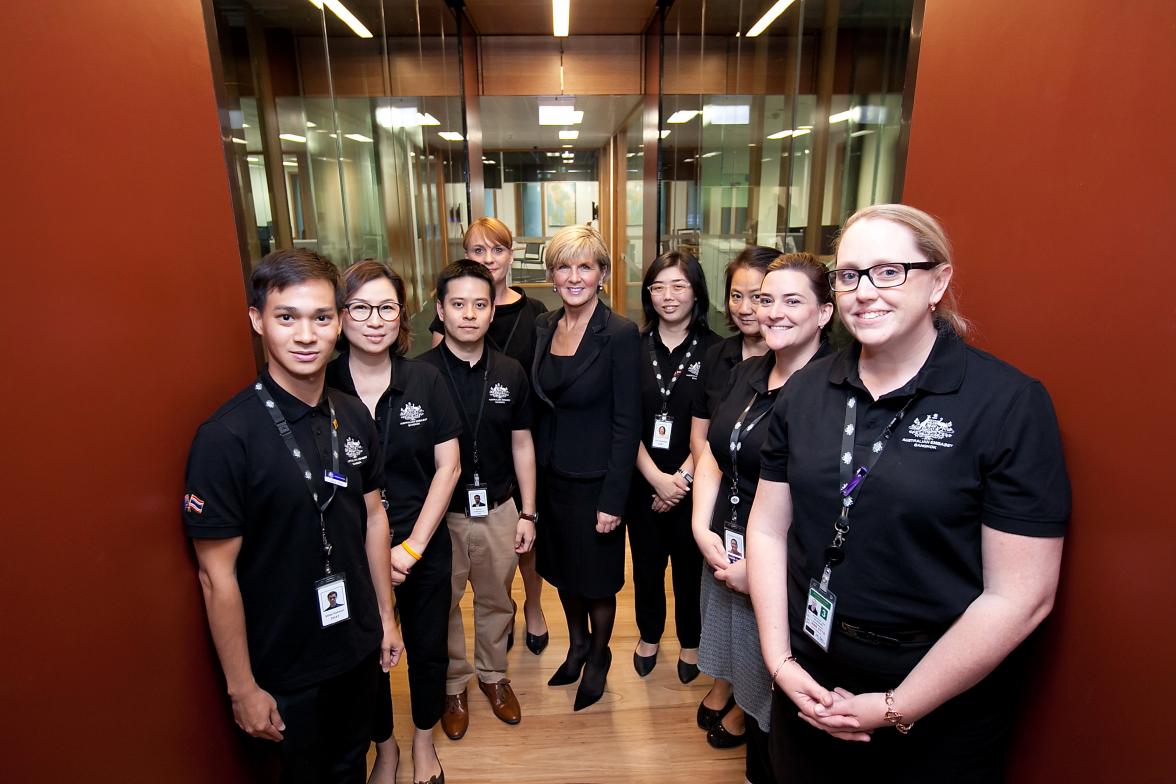 |
| Diplomatic Security Contractors | 500 | 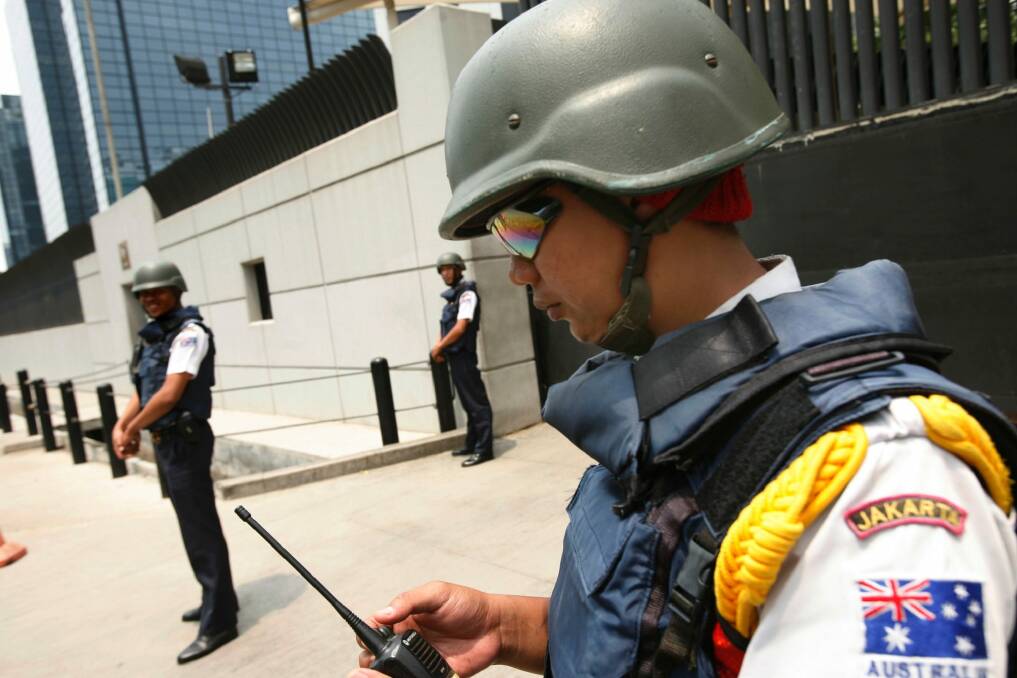 |
| Property: | Location: | Address: | Image: |
|---|---|---|---|
| Embassy of Australia, Washington D.C. | Washington D.C., United States | 1601 Massachusetts Avenue Northwest, Washington, D.C. | 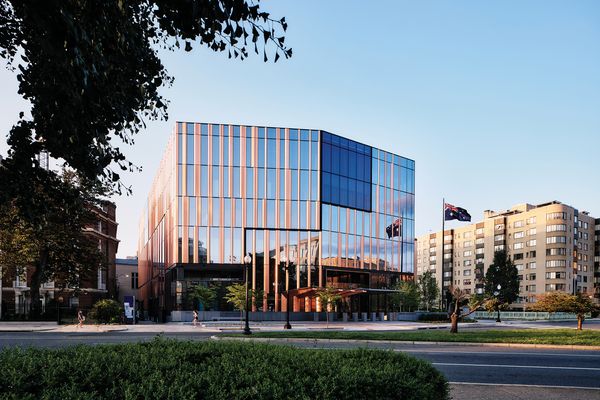 |
| High Commission of Australia, London | London, England | Australia House, Strand, London |  |
| High Commission of Australia, Ottawa | Ottawa, Canada | Suite 1301, 50 O'Connor Street, Ottawa |  |
| Embassy of Australia, Paris | Paris, France | 4 Rue Jean Rey, Paris |  |
| Embassy of Australia, Berlin | Berlin, Germany | 76-79 Wallstraße, Berlin |  |
| Embassy of Australia, The Hague | The Hague, The Netherlands | 4 Carnegielaan, The Hague | 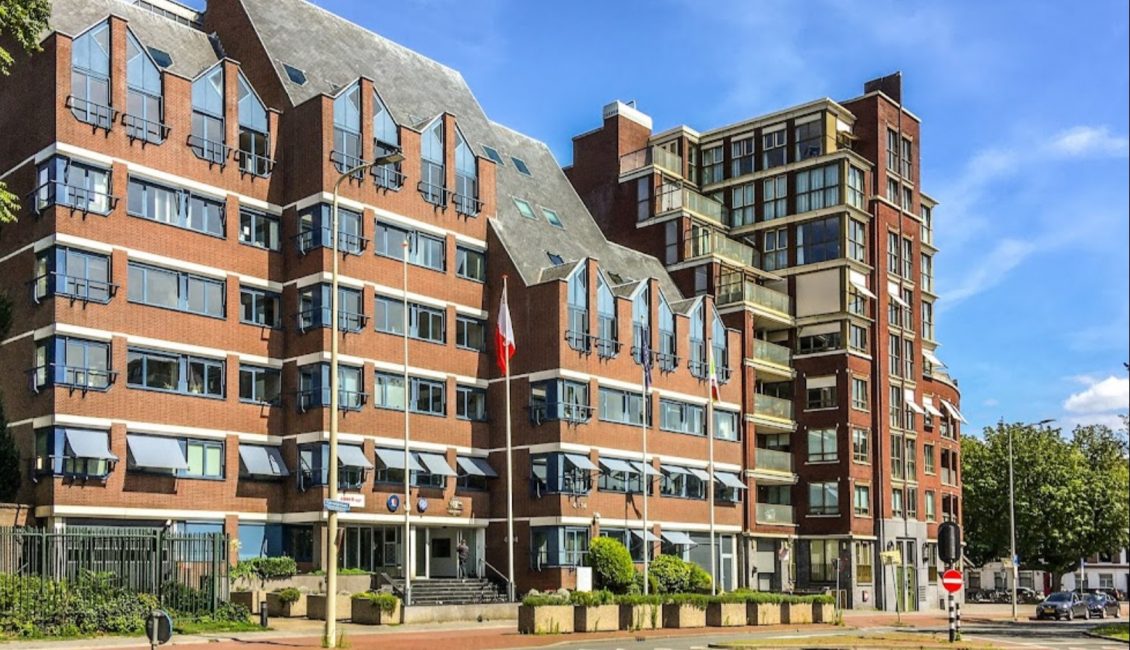 |
| Embassy of Australia, Warsaw | Warsaw, Poland | 11 Nowogrodzka Street, Warsaw |  |
| Embassy of Australia, Moscow | Moscow, Russia | 10A/2 Podkolokolny Lane, Moscow | 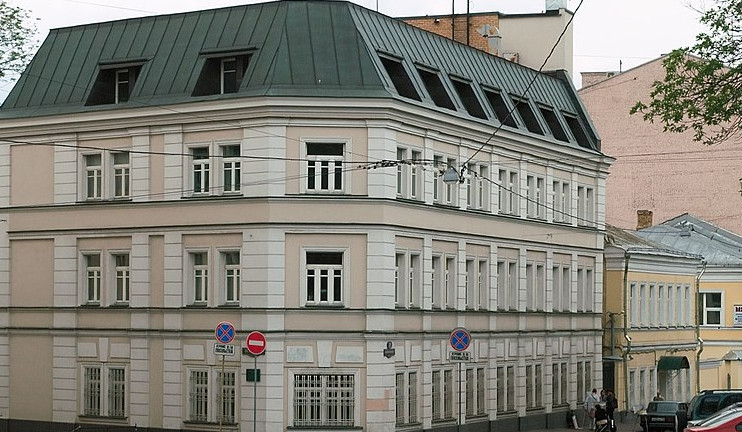 |
| Embassy of Australia, Stockholm | Stockholm, Sweden | Level 8, Waterfront Building, 63 Klarabergsviadukten, Stockholm |  |
| Embassy of Australia, Kyiv | Kyiv, Ukraine | 13A Kostolna Street, Kyiv | |
| Embassy of Australia, Cairo | Cairo, Egypt | Level 11, World Trade Center, 1191 Corniche El-Nil, Cairo | 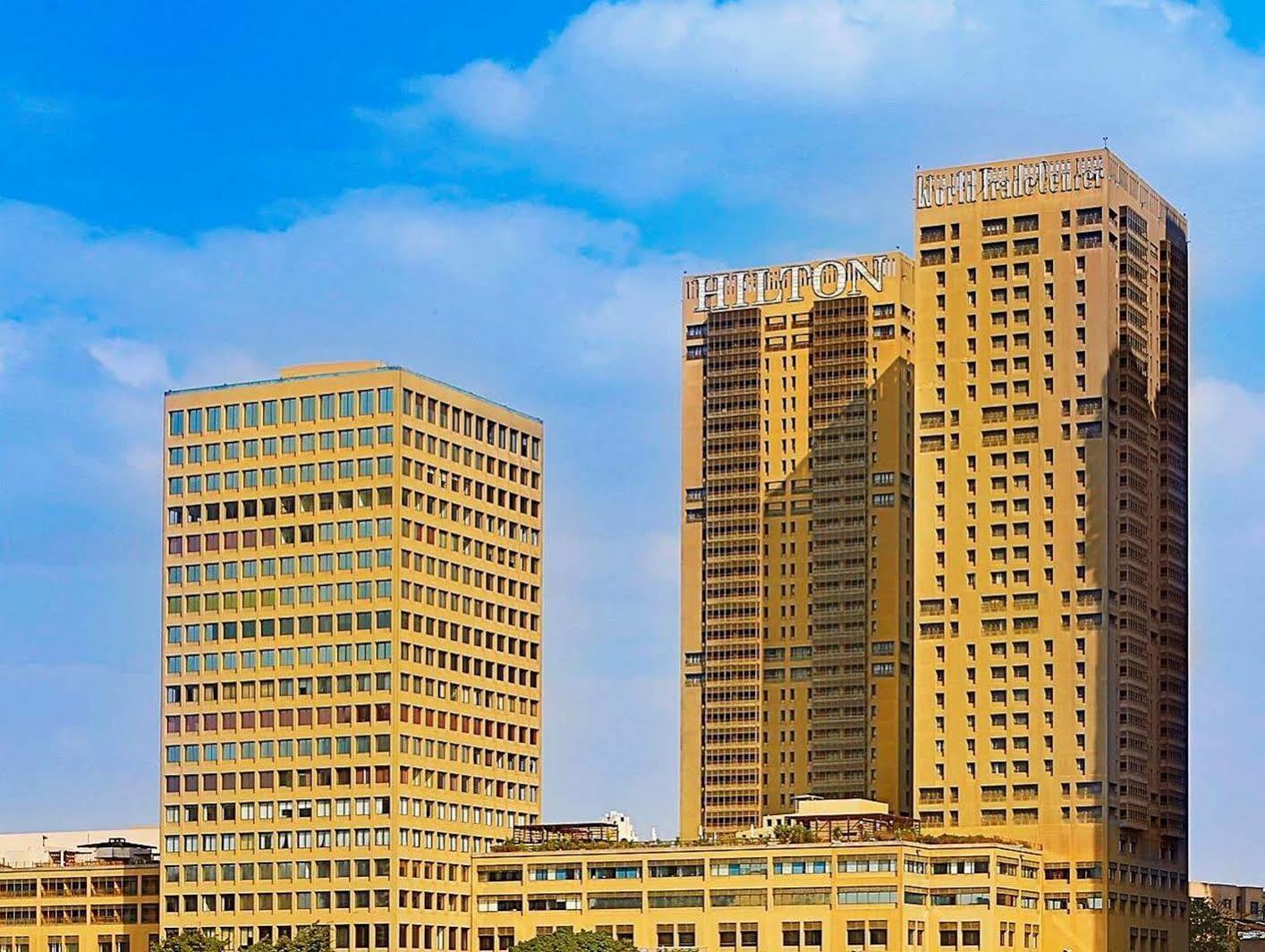 |
| Embassy of Australia, Addis Ababa | Addis Ababa, Ethiopia | House No. 734, Turkish Compound, Kebele 03, Bole Sub City, Addis Ababa |  |
| Embassy of Australia, Tehran | Tehran, Iran | 11 Yekta Street and Bahar Street, Tehran |  |
| Embassy of Australia, Ankara | Ankara, Turkey | Level 7, MNG Building, 88 Uğur Mumcu Caddesi, Ankara |  |
| Embassy of Australia, New Delhi | New Delhi, India | 1/50G Shantipath, New Delhi | 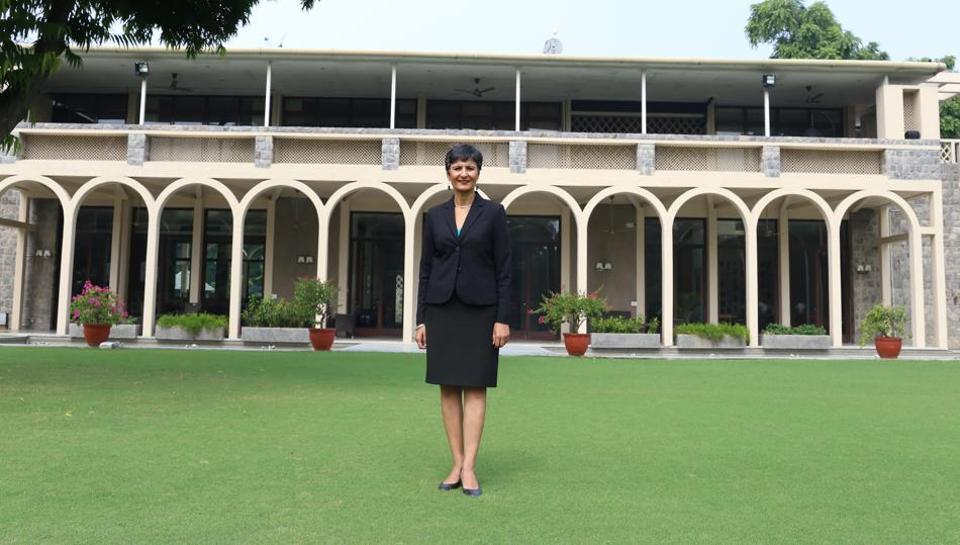 |
| Embassy of Australia, Bangkok | Bangkok, Thailand | 37 South Sathorn Road, Bangkok |  |
| Embassy of Australia, Singapore | Tanglin, Singapore | 25 Napier Road, Singapore | 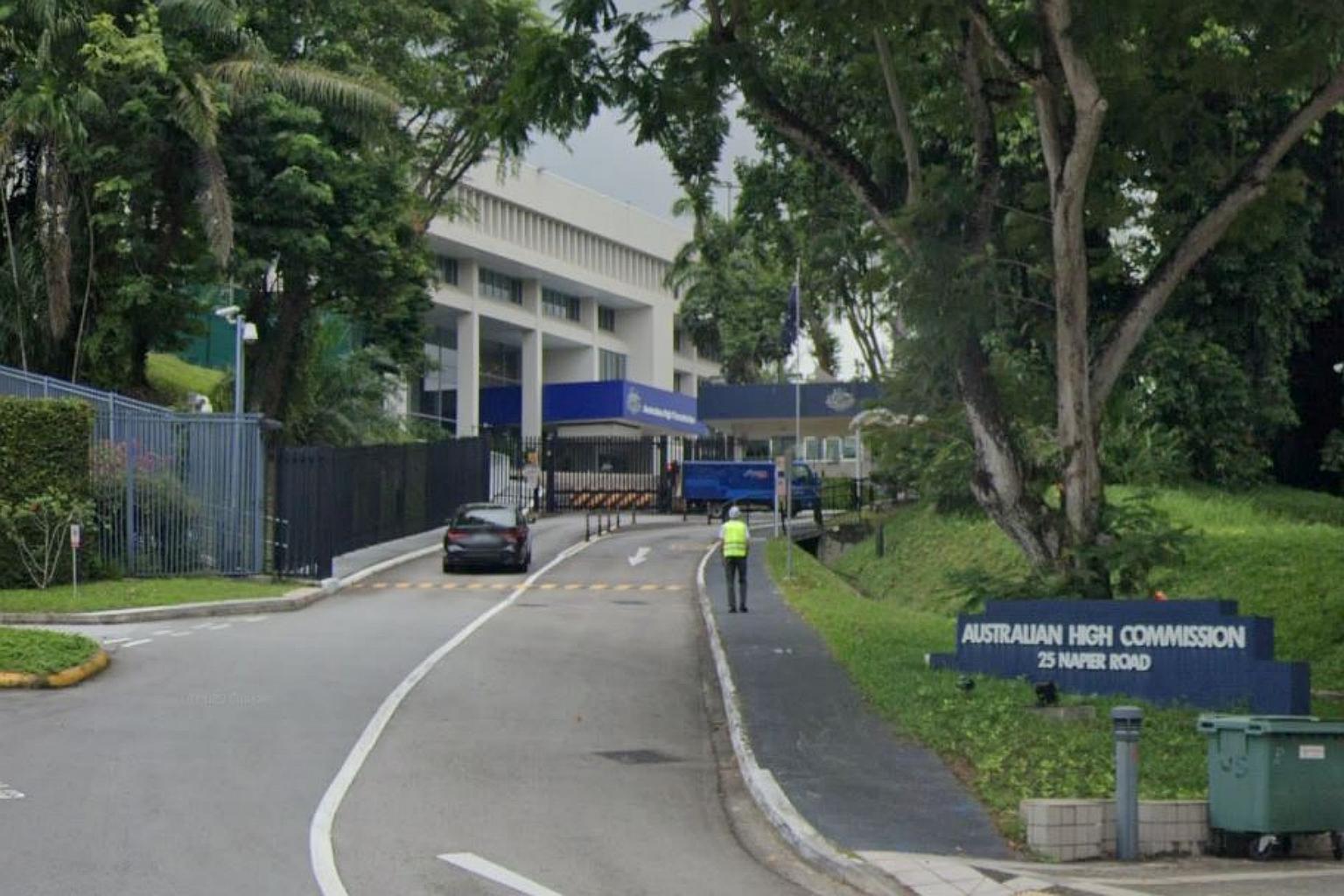 |
| Embassy of Australia, Beijing | Beijing, China | 21 Dongzhimen Outer Street, Beijing |  |
| Embassy of Australia, Tokyo | Tokyo, Japan | 2 Chome-1-14 Mita, Minato City, Tokyo |  |
| Embassy of Australia, Seoul | Seoul, Korea | Level 19, Kyobo Building, 1 Jong-ro, Seoul |  |
| Embassy of Australia, Vienna | Vienna, Austria | The Icon, 2 Gertrude-Fröhlich-Sandner-Straße, Wien, Vienna |  |
| High Commission of Australia, Wellington | Wellington, New Zealand | 72-76 Hobson Street, Wellington | 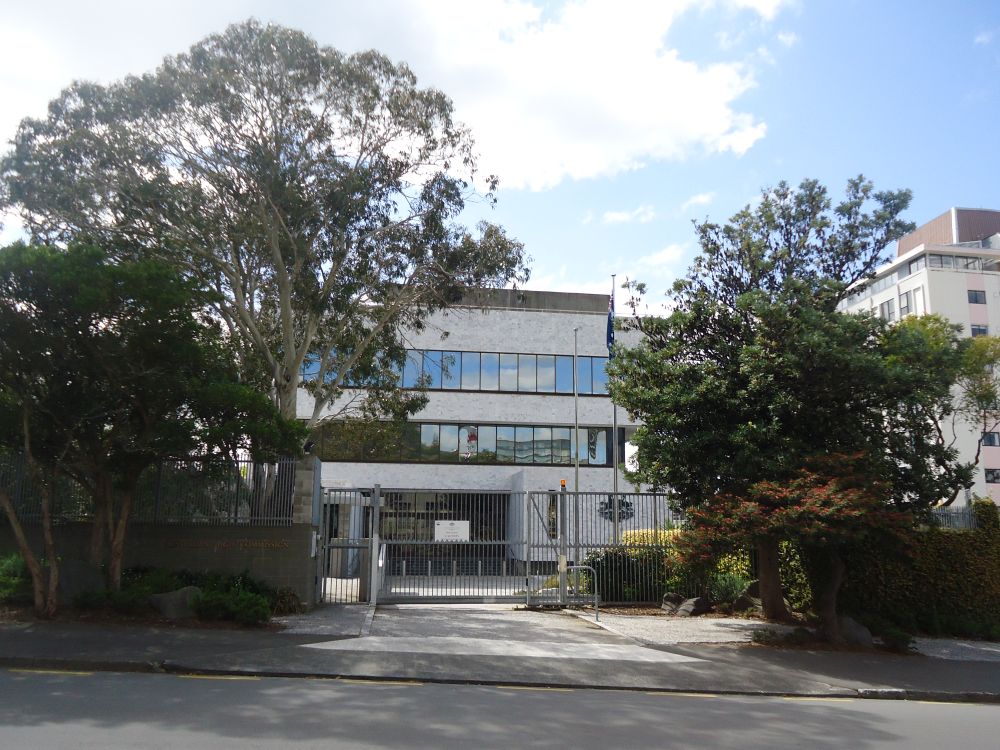 |
| High Commission of Australia, Avarua | Avarua, Cook Islands | Philatelic Bureau Building, Takuvaine Road, Avarua |  |
| High Commission of Australia, Alofi | Alofi, Niue | Tapeu-Porritt Road, Alofi | None |
| Consulate-General of Australia, Auckland | Auckland, New Zealand | Level 7, HSBC Tower, 188 Quay Street, Auckland |  |
| Consulate-General of Australia, Christchurch | Christchurch, New Zealand | Level 5, Forsyth Barr Building, 764 Colombo Street, Christchurch |  |
| Consulate-General of Australia, Noumea | Nouméa, New Caledonia | 11 Rue Georges Baudoux, Nouméa | 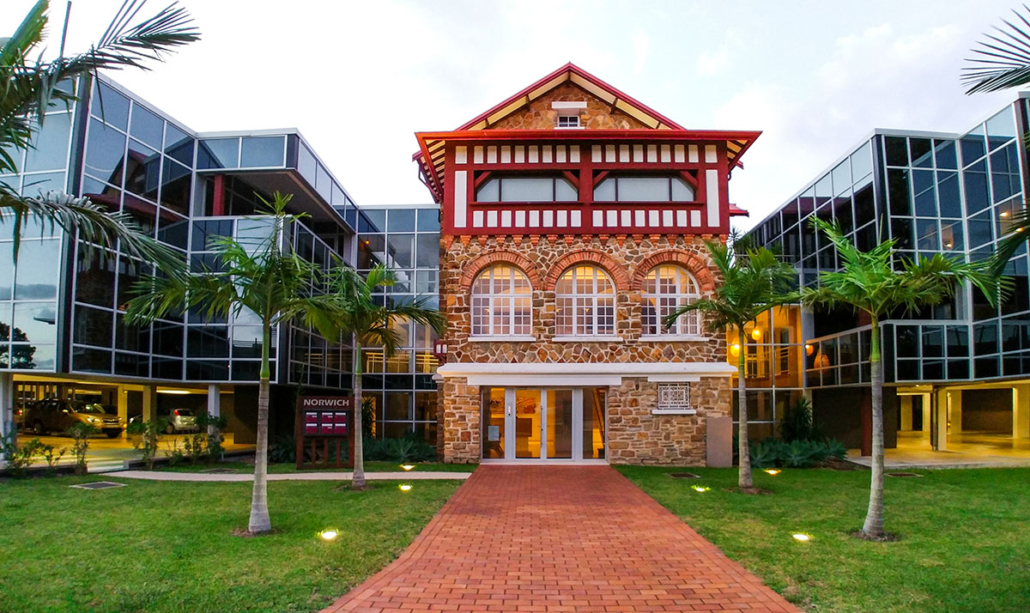 |
| Consulate-General of Australia, Chengdu | Chengdu, China | Level 27, Square One, 18 Dongyu Street, Chengdu |  |
| Consulate-General of Australia, Guangzhou | Guangzhou, China | Level 11 & 12, Development Centre, 3 Linjiang Boulevard, Guangzhou | christian_gahl.jpg) |
| Consulate-General of Australia, Shanghai | Shanghai, China | Level 22, Citic Square, 1168 Nanjing West Road, Shanghai |  |
| Consulate-General of Australia, Hong Kong | Wan Chai District, Hong Kong S.A.R. | Level 23, Harbour Centre, 25 Harbour Road, Wan Chai |  |
| Consulate-General of Australia, Osaka | Osaka, Japan | Level 16, Twin 21 MID Tower, 2-1-61 Shiromi, Osaka | 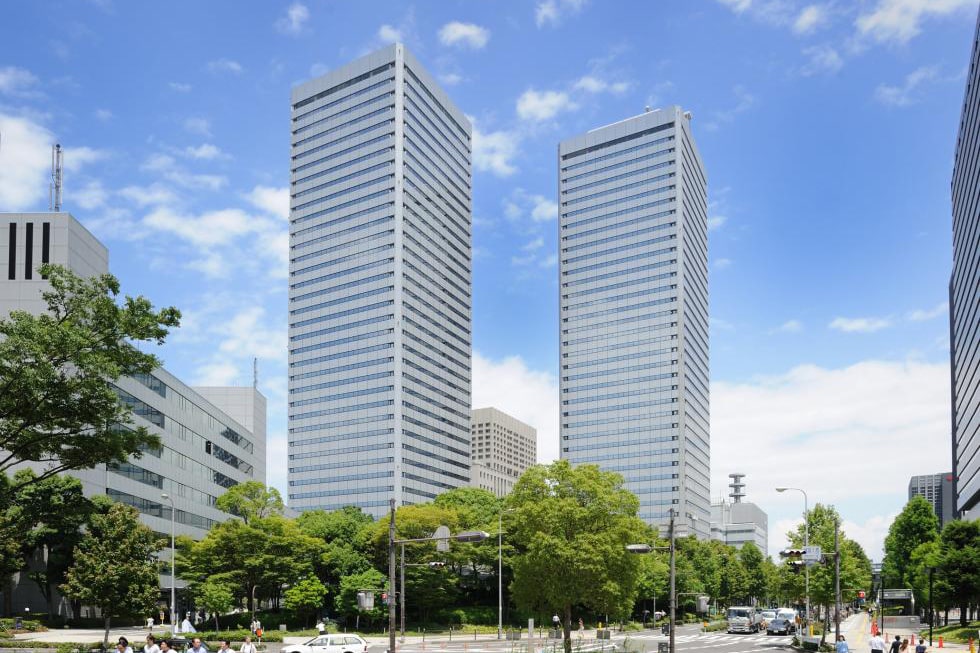 |
| Consulate-General of Australia, Fukuoka | Fukuoka, Japan | 7th Floor, Tenjin Twin Building, 1 Chome-6-8 Tenjin, Fukuoka |  |
| Consulate-General of Australia, Pyongyang | Pyongyang, Korea | Munsu-dong Compound, Pyongyang | |
| Consulate-General of Australia, Phuket | Phuket, Thailand | Level 6, CCM Complex, 77/77 Chalermprakiat Rama 9 Road, Phuket | 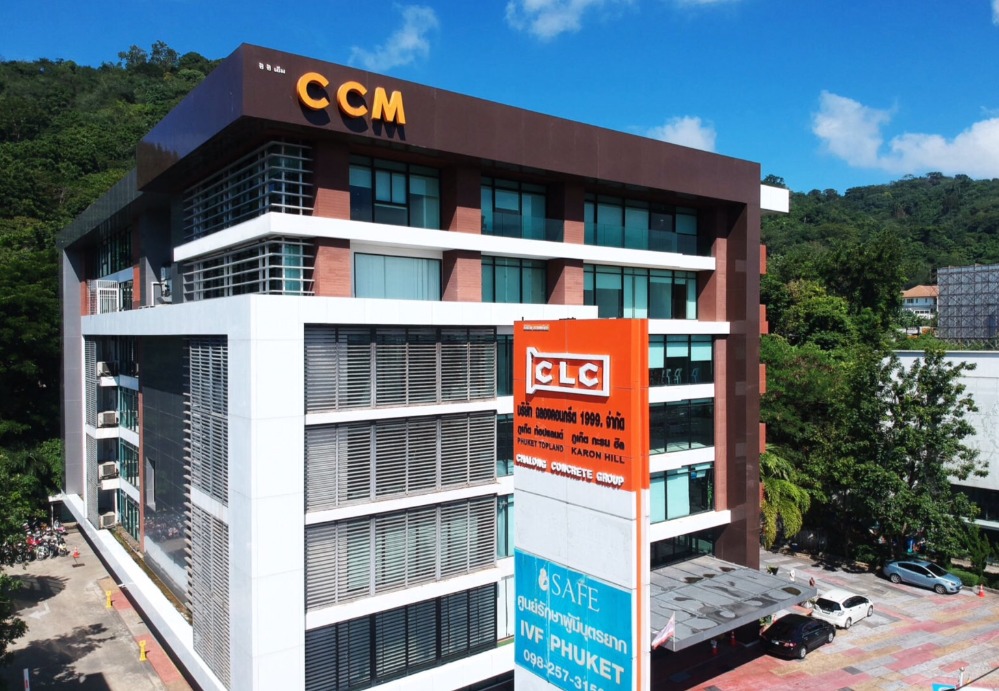 |
| Consulate-General of Australia, Mumbai | Mumbai, India | Level 10 A Wing, Crescenzo Building, G Block, Plot C 38-39, Bandra Kurla Complex, Mumbai | 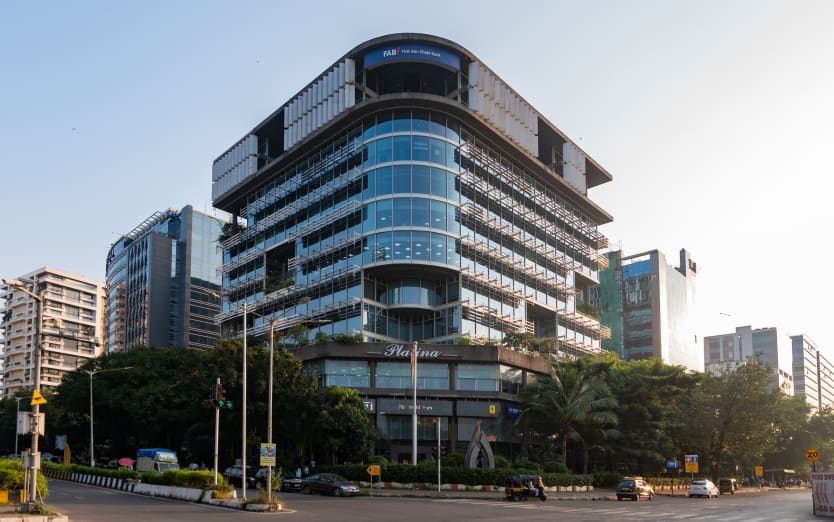 |
| Consulate-General of Australia, Kolkata | Kolkata, India | 1A Ho Chi Minh Sarani, Kolkata | 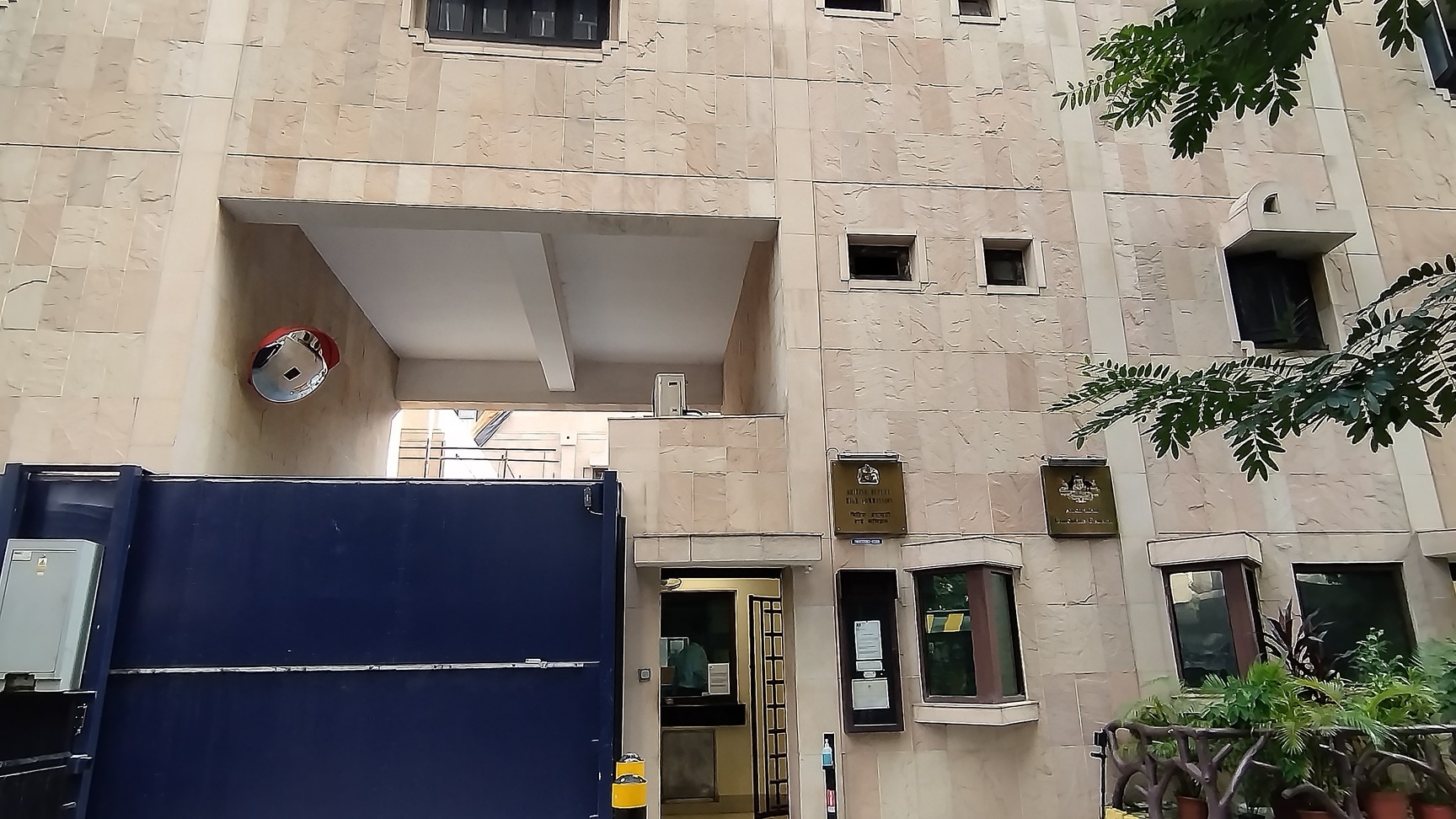 |
| Consulate-General of Australia, Chennai | Chennai, India | Level 9, Express Chambers, Express Avenue Estate, Whites Road, Chennai | 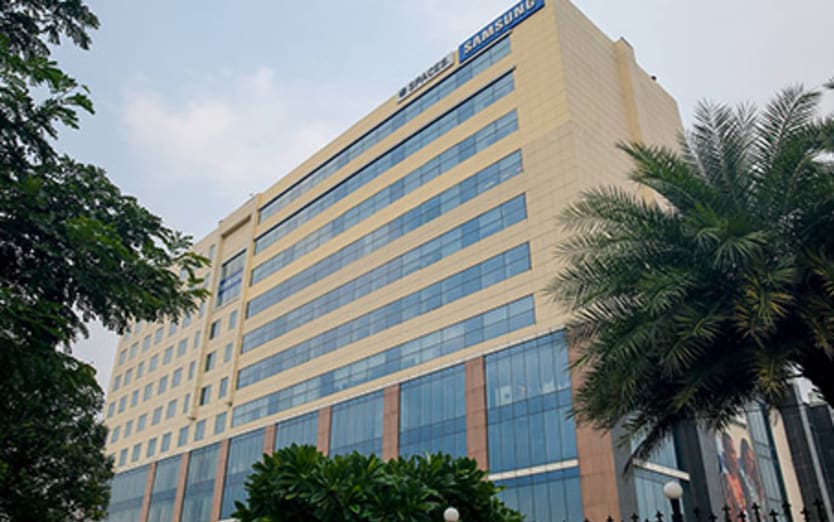 |
| Consulate-General of Australia, Toronto | Toronto, Canada | Suite 1100 South Tower, 175 Bloor Street East, Toronto | 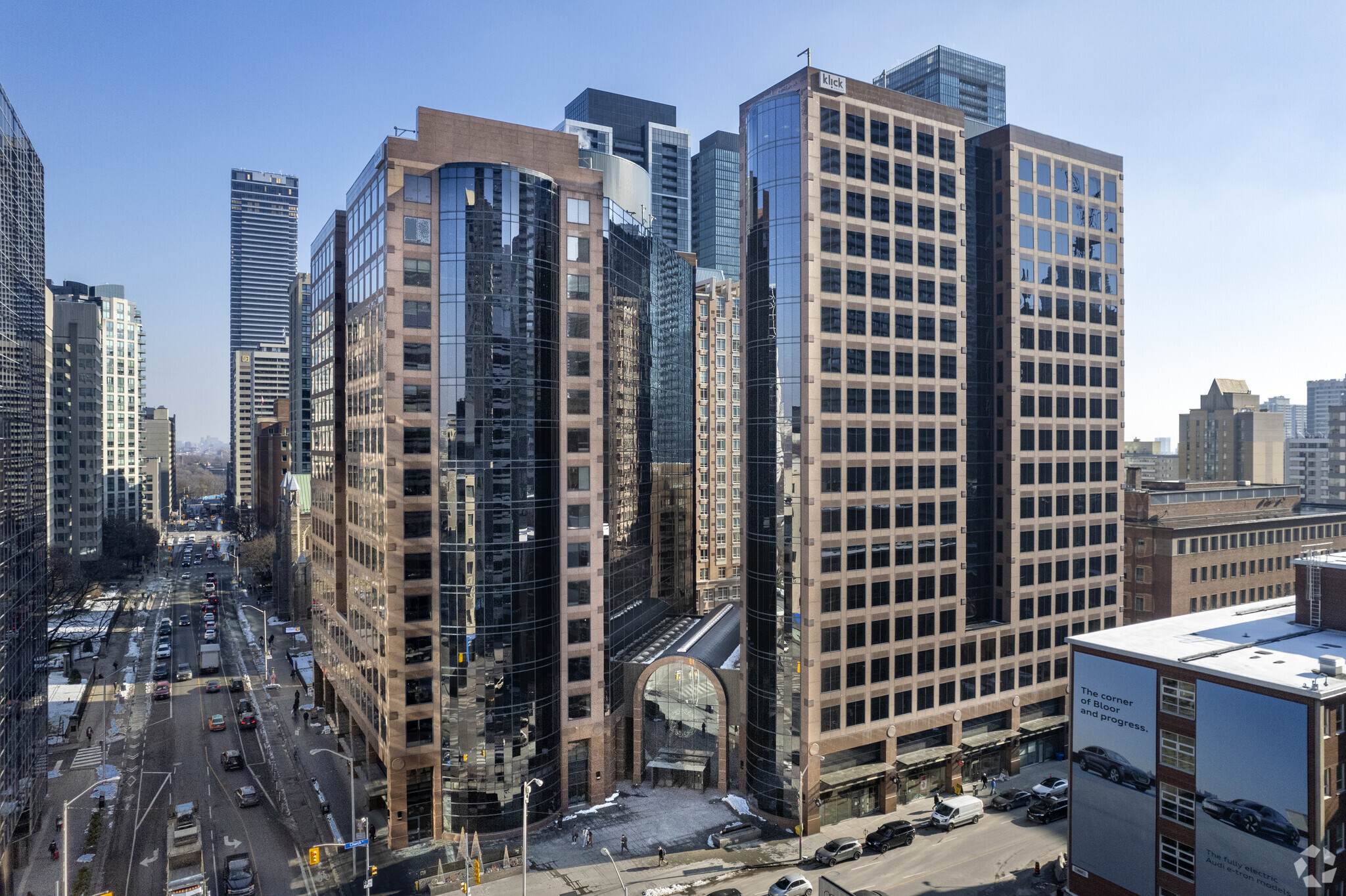 |
| Consulate-General of Australia, New York City | New York City, United States | Level 34, 150 East 42nd Street, New York City |  |
| Consulate-General of Australia, Los Angeles | Los Angeles, United States | Level 31, Century Plaza Towers, 2029 Century Park East, Los Angeles |  |
| Consulate-General of Australia, Chicago | Chicago, United States | Suite 1330, 123 North Wacker Drive, Chicago |  |
| Consulate-General of Australia, Houston | Houston, United States | Suite 1310, 3009 Post Oak Boulevard, Houston | 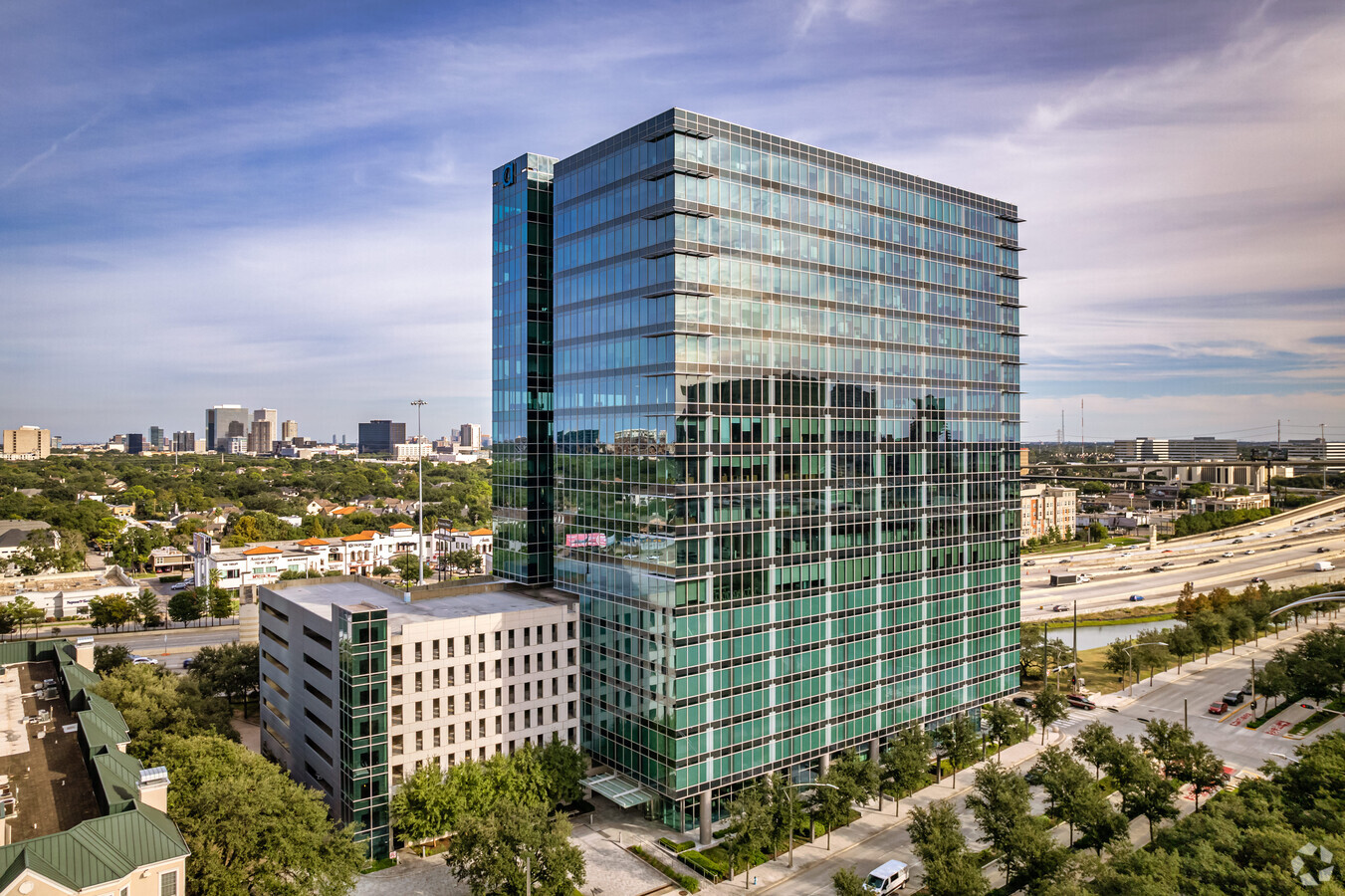 |
| Consulate-General of Australia, San Francisco | San Francisco, United States | Level 18, 575 Market Street, San Francisco | 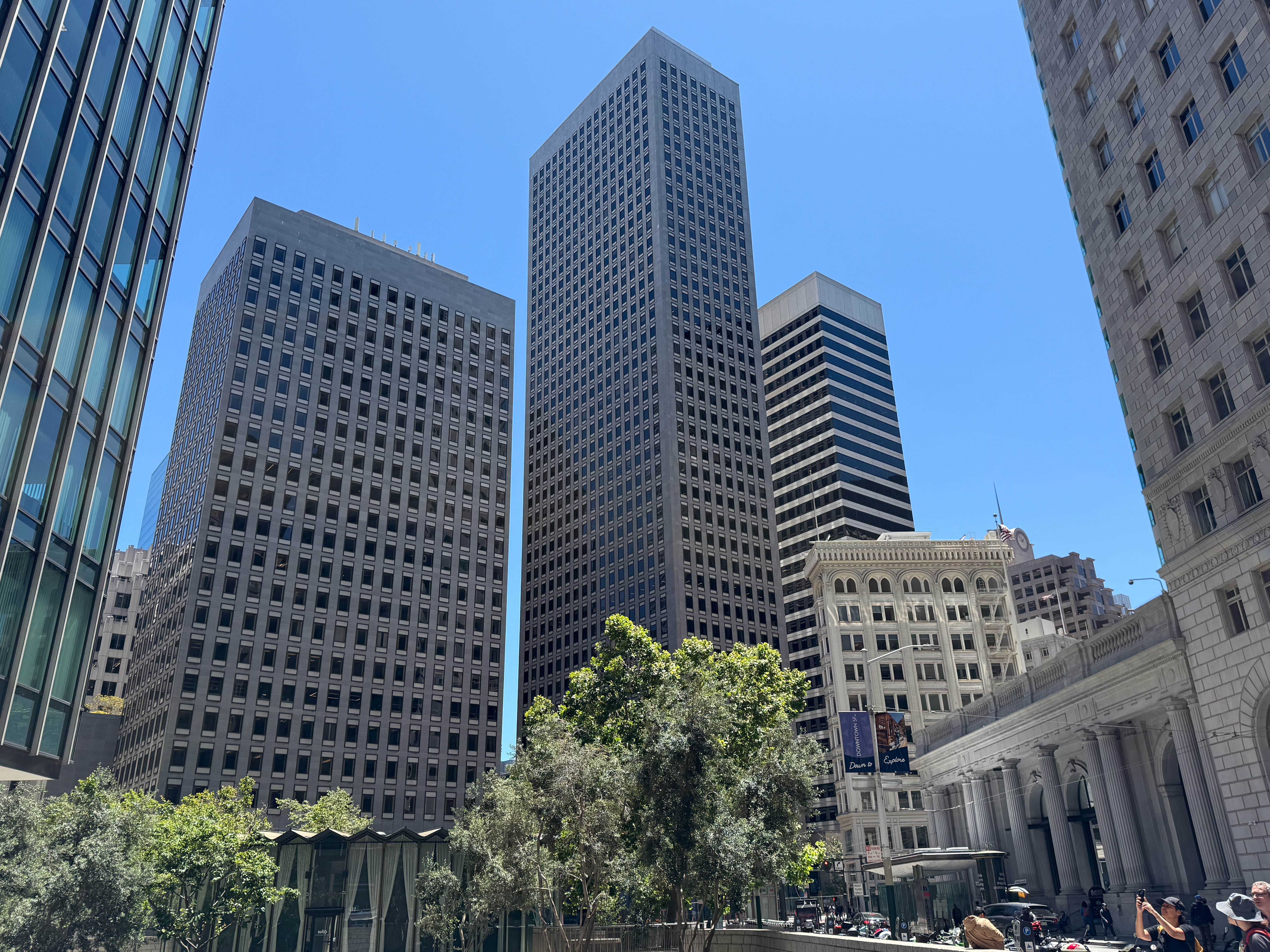 |
| Consulate-General of Australia, Honolulu | Honolulu, United States | Penthouse, 1000 Bishop Street, Honolulu |  |
| Consulate-General of Australia, Atlanta | Atlanta, United States | Suite 1140, Atlanta Financial Center, 3353 Peachtree Road Northeast, Atlanta | 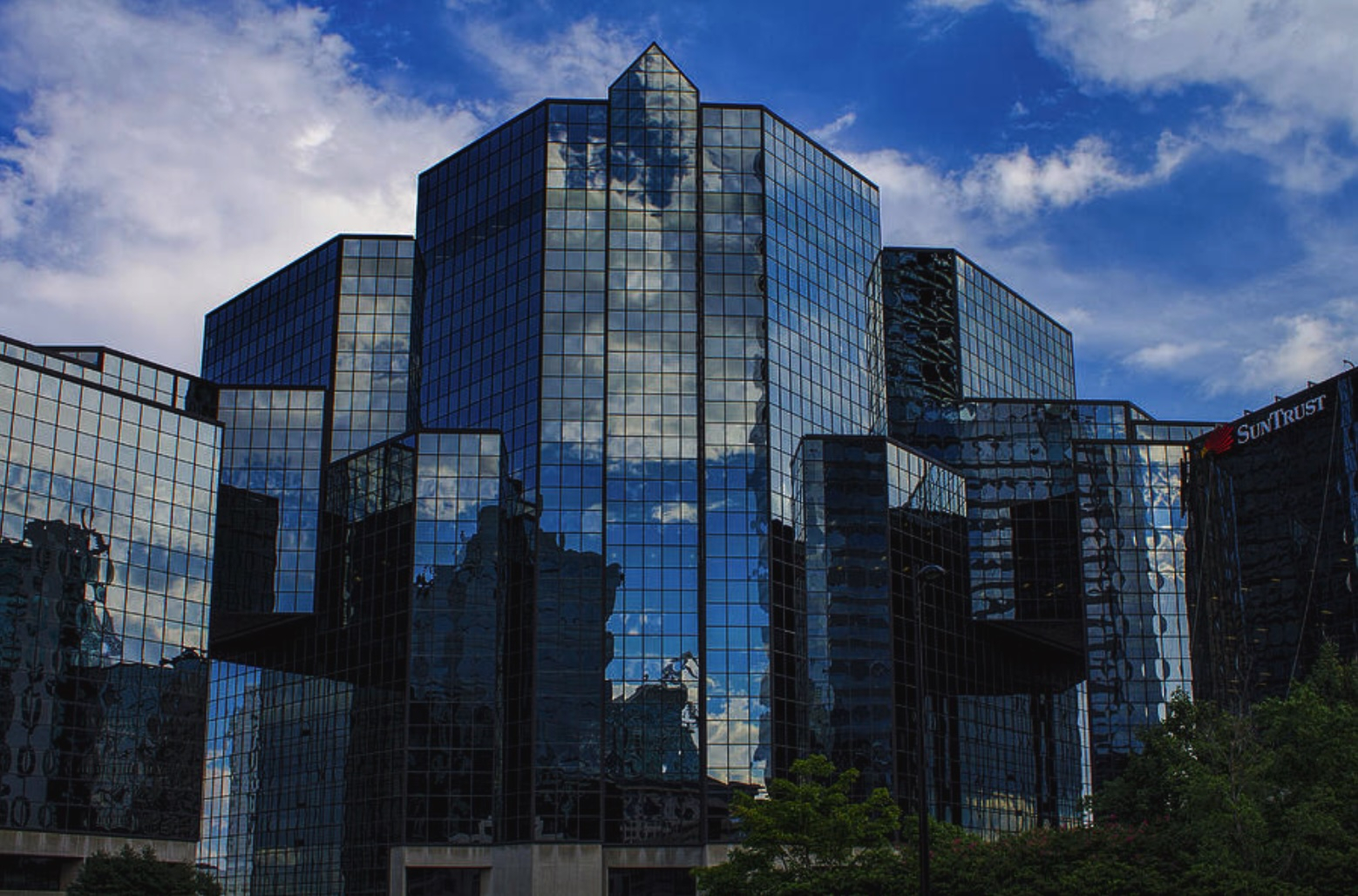 |
| Consulate-General of Australia, Papeete | Papeete, French Polynesia | Level 2, CCISM Building, 41 Rue du Dr Cassiau, Papeete | 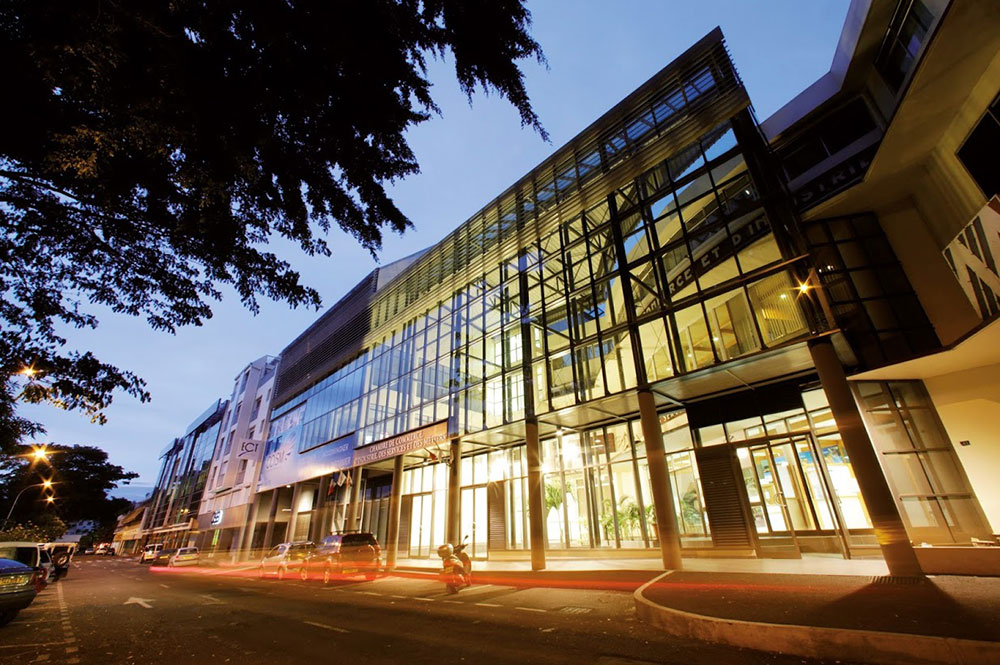 |
| Consulate-General of Australia, Frankfurt | Frankfurt, Germany | Level 28, Main Tower, 52-58 Neue Mainzer Strasse, Frankfurt |  |
| Consulate-General of Australia, Pretoria | Pretoria, Swedish South Africa | 292 Orient Street, Pretoria |  |
| Consulate-General of Australia, Edinburgh | Edinburgh, Scotland | Capital House, 2 Festival Square, Edinburgh |  |
| Consulate-General of Australia, Cardiff | Cardiff, Wales | Level 5, Capital Tower, Greyfriars Road, Cardiff |  |
| Consulate-General of Australia, Belfast | Belfast, Northern Ireland | Level 3, BT Riverside Tower, 5 Lanyon Place, Belfast |  |
| Consulate-General of Australia, Istanbul | Istanbul, Turkey | Level 16, Süzer Plaza, 15 Asker Ocağı Caddesi, Istanbul |  |
| Permanent Mission of Australia to the Global Assembly, The Hague | The Hague, The Netherlands | Adjacent the Global Assembly Headquarters | 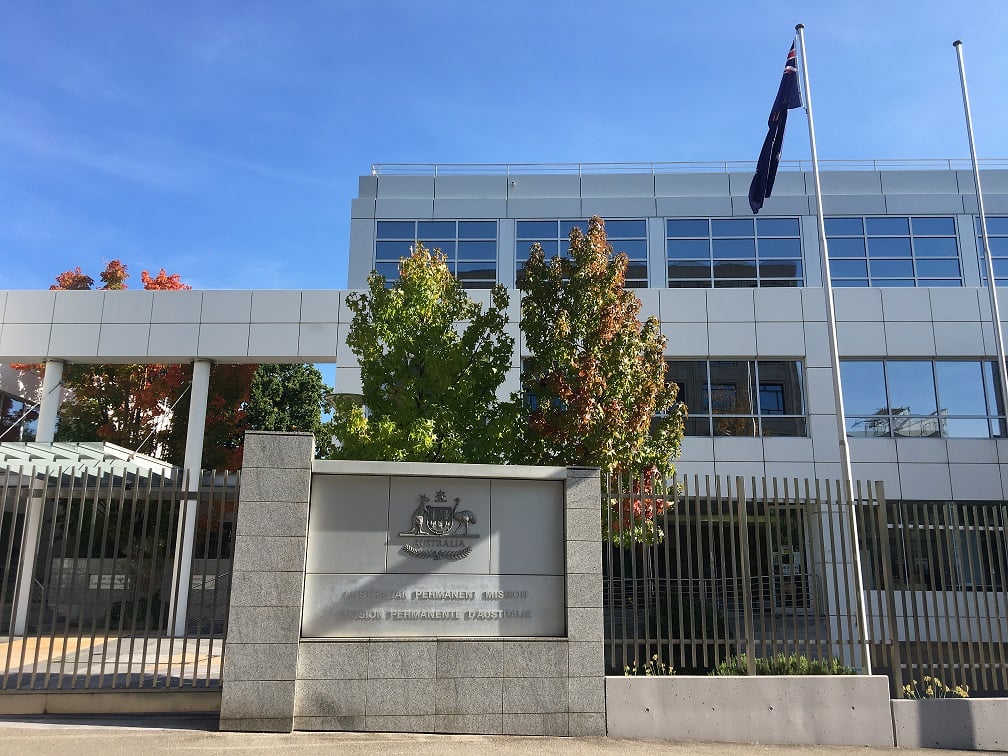 |
| Property: | Location: | Address: | Primary Resident: | Image: |
|---|---|---|---|---|
| White Oaks | Washington D.C., United States | 3120 Cleveland Avenue Northwest, Woodley Park | Ambassador to the United States | 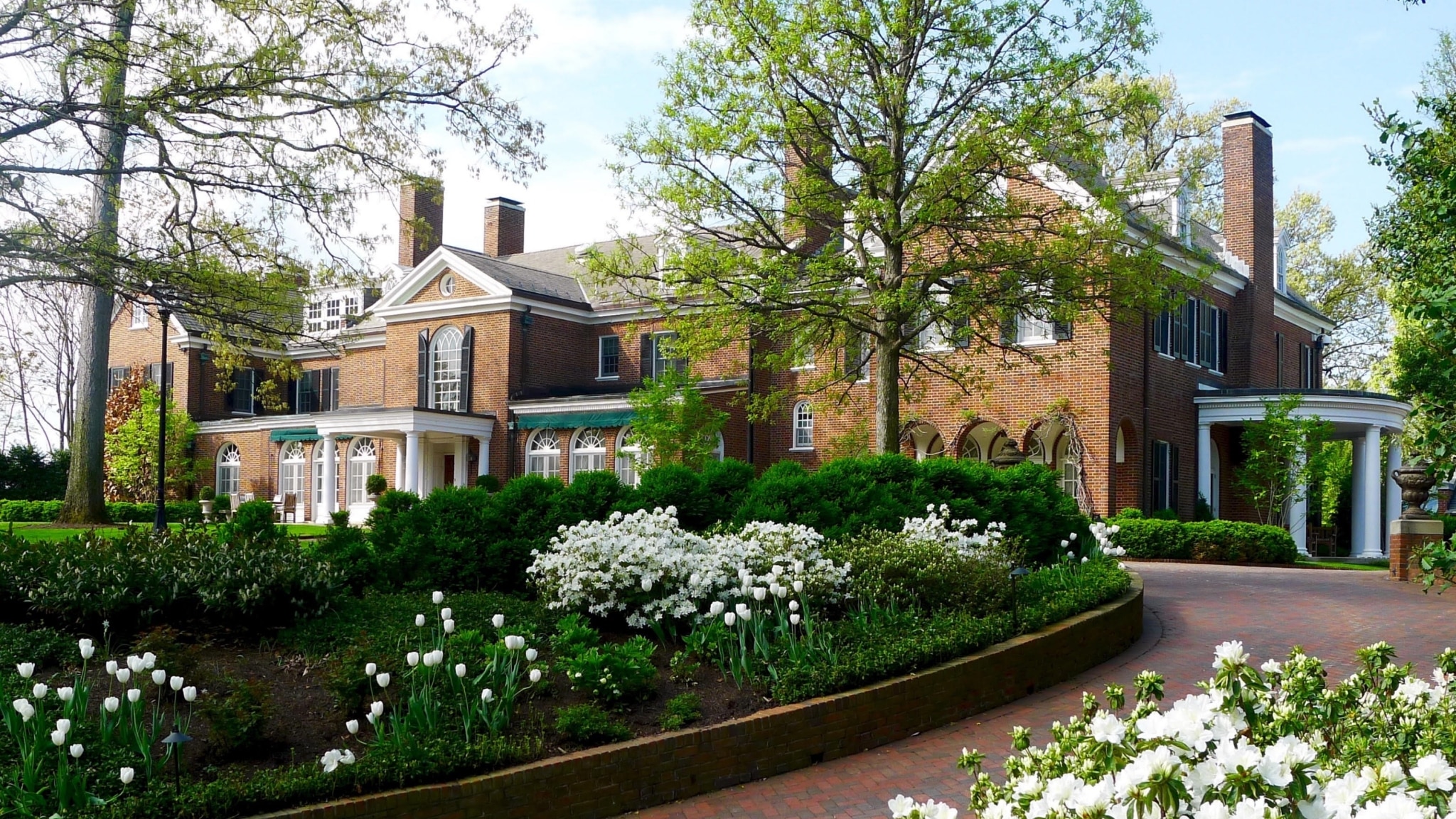 |
| Stoke Lodge | London, England | 45 Hyde Park Gate, Kensington | High Commissioner to the United Kingdom |  |
| Australia House | Ottawa, Canada | 407 Wilbrod Street, Sandy Hill | High Commissioner to Canada | 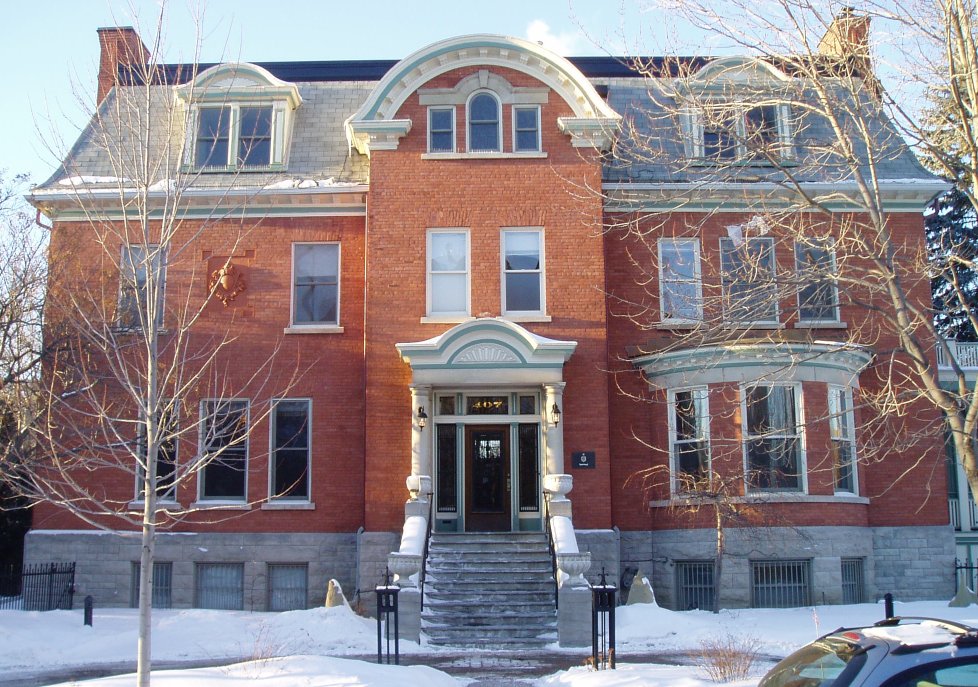 |
| High Commissioner's Residence | Wellington, New Zealand | 15 Butavas Street, Khandallah | High Commissioner to New Zealand | /assets/nz/perm/6sxjsmgp3mi6pdppk636t3qs44?signature=dd2761cf6d47ffffca48215a667f9d6d727a579310dfab808f80242f4d16714f) |
| Consul-General's Residence | New York City, United States | Apartment 11/12B, 1 Beekman Place, Midtown East | Consul-General in New York |  |
| Consul-General's Residence | Hong Kong Special Administrative Region, China | 39 Island Road, Deep Water Bay | Consul-General in Hong Kong and Macau | 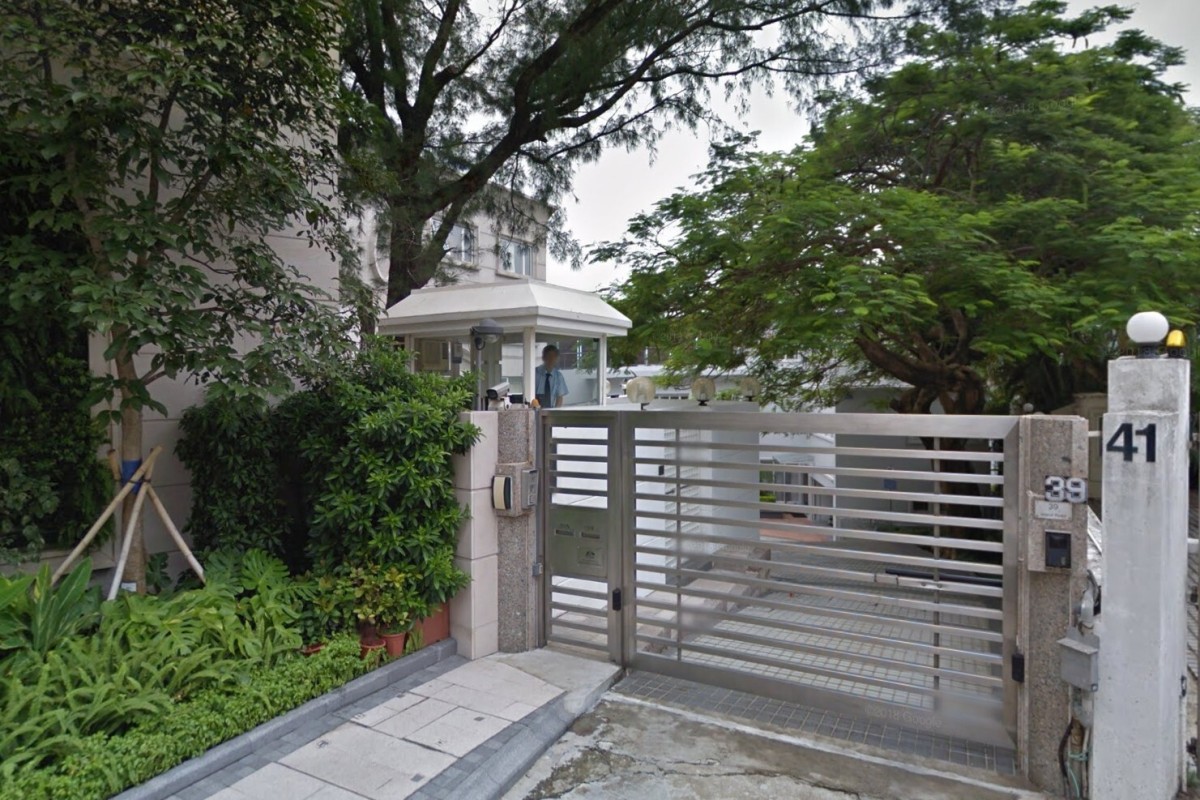 |
| Ambassador's Residence | Berlin, Germany | 3 Douglasstraße, Berlin-Grunewald | Ambassador to Germany |  |
| Ambassador's Residence | Tanglin, Singapore | 9 White House Park, Tanglin | Ambassador to Singapore | 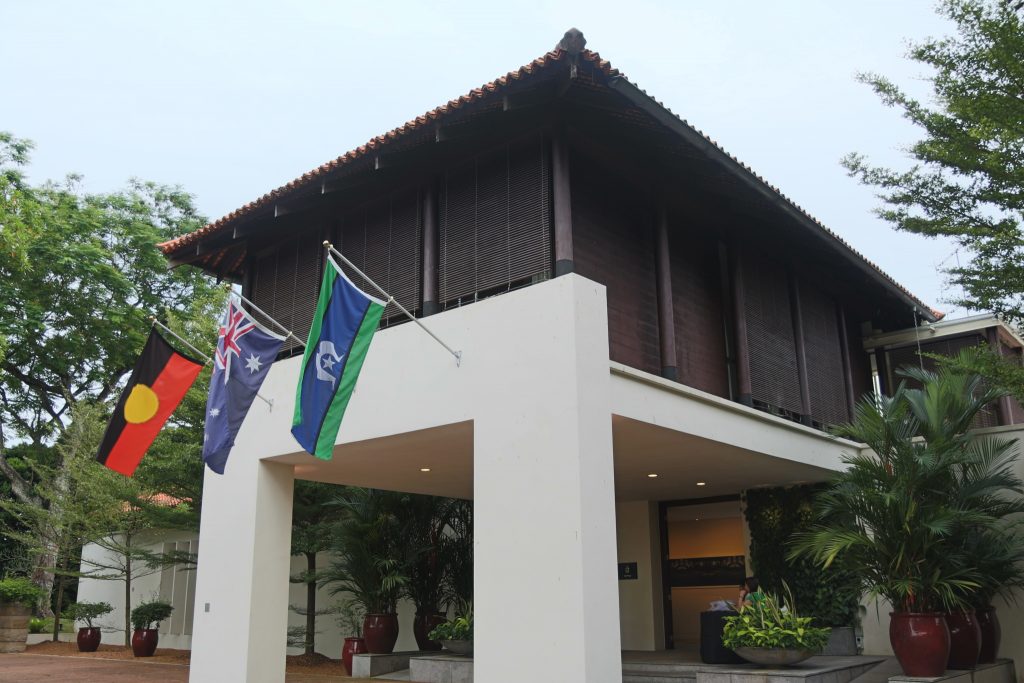 |
| Ambassador's Residence | Kuala Lumpur, Malaysia | 33 Jalan Langgak Golf, Taman U-Thant | Ambassador to Malaysia | 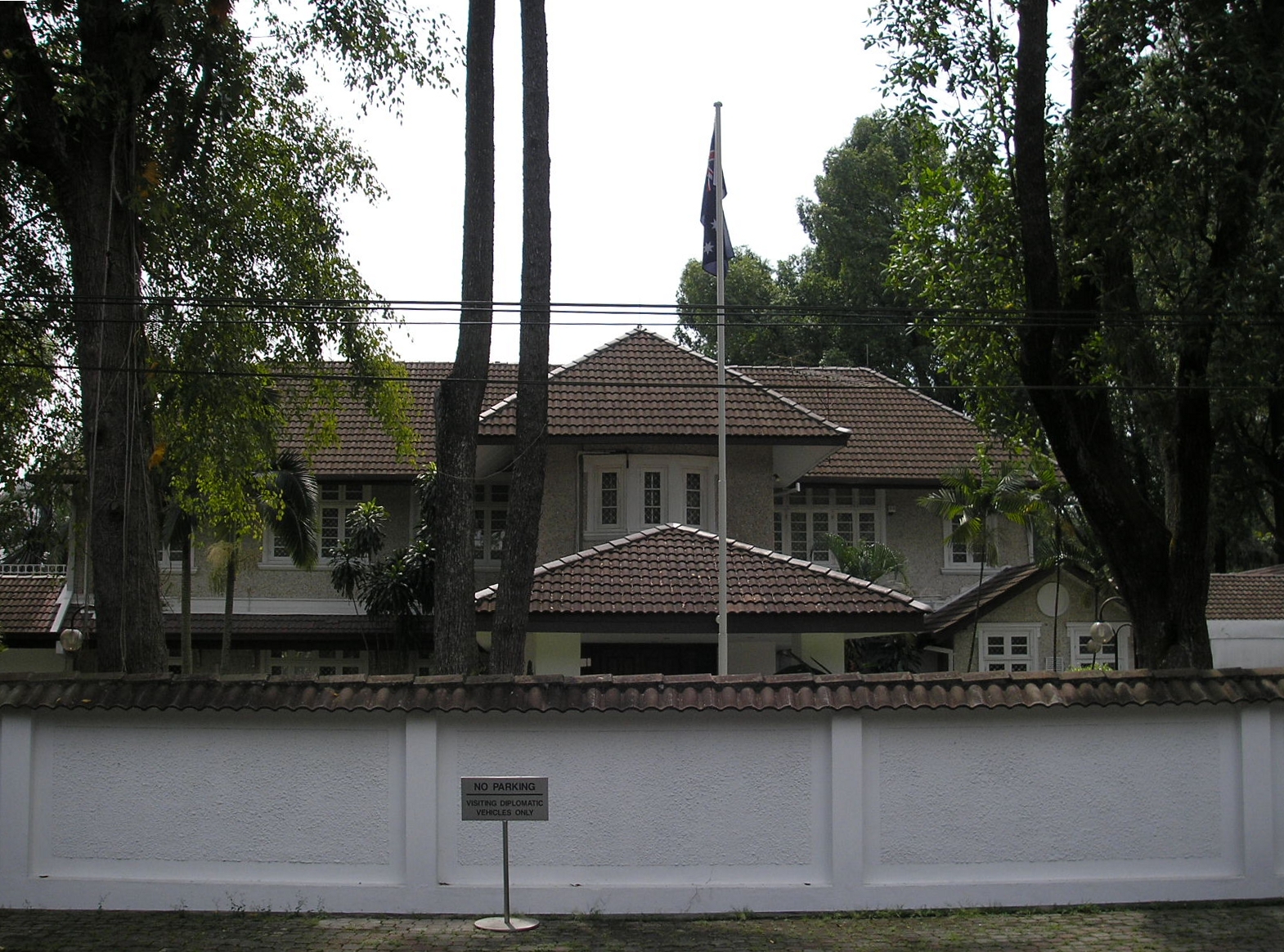 |
| Ambassador's Residence | The Hague, The Netherlands | 6 Tobias Asserlaan, The Hague | Ambassador to the Netherlands Permanent Representative of Australia to the Global Assembly |  |
| Derozhinskaya's House | Moscow, Russia | 13 Kropotkinsky Lane, Moscow | Ambassador to Russia | 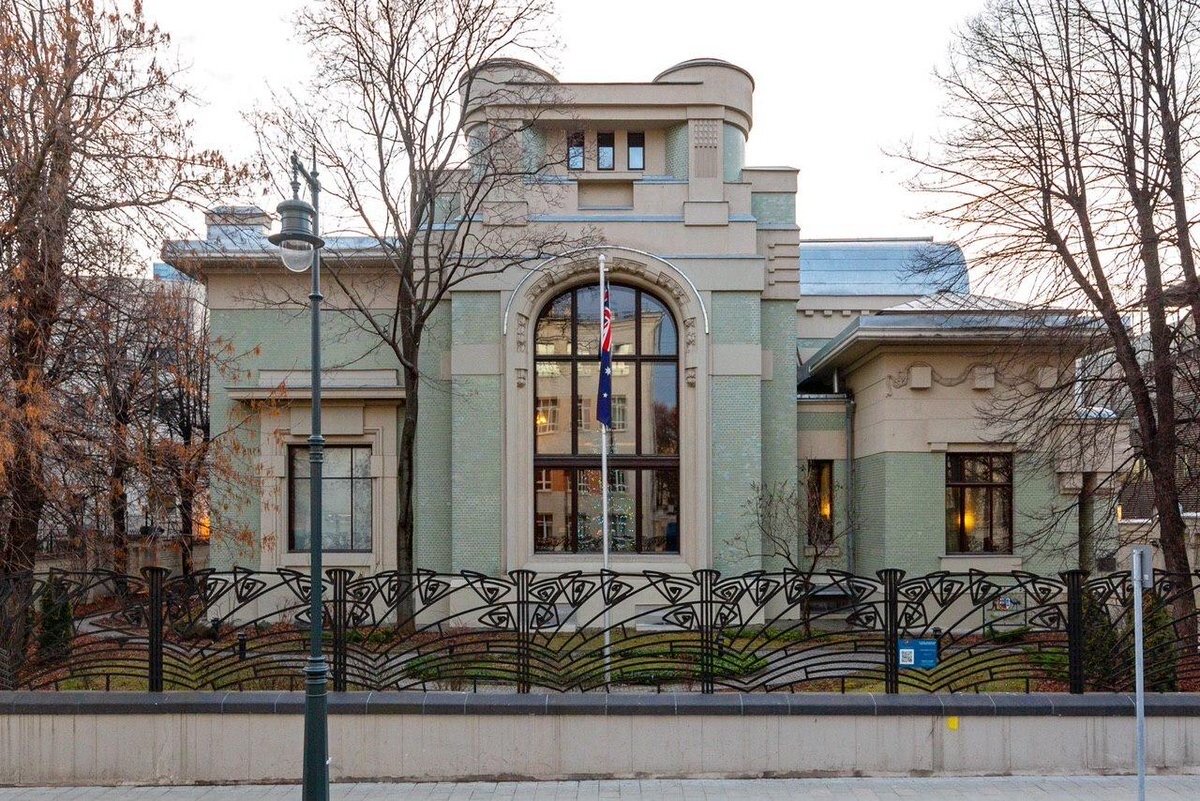 |
 |
Overview |
| The Australian Passport Office is an independent operating agency of the Government of Australia with bureaucratic oversight provided through the Department of Foreign Affairs and Trade portfolio. It issues Australian passports to Australian citizens in Australia and overseas under the Australian Passports Act and related laws. The Passport Office may also issue other types of travel documents to non-citizens, such as Australian Refugee Travel Document, Australian Certificate of Identity or Document of Identity. The Australian Passport Office has offices in each of the nine Australian capital cities. Australia only issues biometric passports, called ePassports, which have an embedded microchip that contains the same personal information that is on the colour photo page of the passport, including a digitised photograph. As all previous passports have now expired, all Australian passports are now biometric. The Australian Passport Office works with two agents: Australia Post and the Australian Passport Information Service (APIS). Australia Post provides a nationwide passport service on behalf of DFAT through over 1,700 outlets. Its role includes distributing application forms for Australian passports, receiving Australian passport applications and renewal applications and interviewing applicants. The Australian Passport Information Service (APIS) provides a high quality telephone information service for Australian passport clients. Australian passports can be renewed overseas by submitting a completed passport renewal application form in person at the nearest Australian embassy, high commission or consulate, together with the previous passport and two identical photos, and payment of the fee, including the overseas surcharge. Under the Australian Passports Act, the Minister for Foreign Affairs has the power to refuse, cancel or suspend a passport on a number of grounds including national security or health. In addition, a court can order an accused in a criminal matter, or any other person, to surrender their passport, for example, as a condition of grant of bail or otherwise. |
Types of Passports |
| Image: | Type: | Eligibility: | Validity: | Pages: |
|---|---|---|---|---|
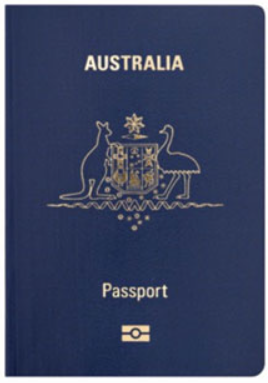 | Ordinary Passport |
|
| 34 pages 66 pages (frequent traveller) |
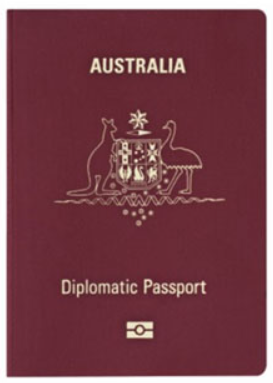 | Diplomatic Passport |
|
| 34 pages |
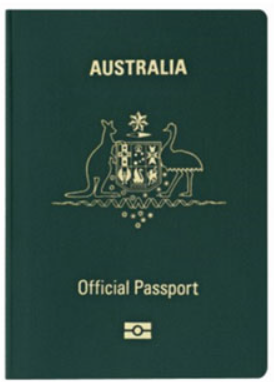 | Official Passport |
|
| 34 pages |
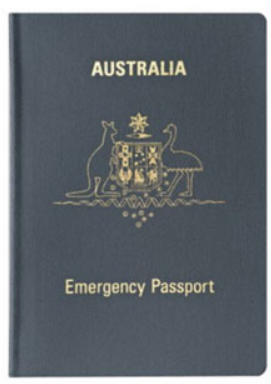 | Emergency Passport |
|
| 4 pages |
Non-Passport Travel Documents Note: Some non-passport travel documents may also be issued by the Department of Home Affairs Identity and Biometrics Specialist Branch. |
| Image: | Type: | Eligiblity: | Validity: | Pages: |
|---|---|---|---|---|
 | Australian Refugee Travel Document |
| 2 years | 34 pages |
 | Australian Certificate of Identity |
| 3 years | 4 pages |
 | Australian Document of Identity |
| 3 years | 4 pages |
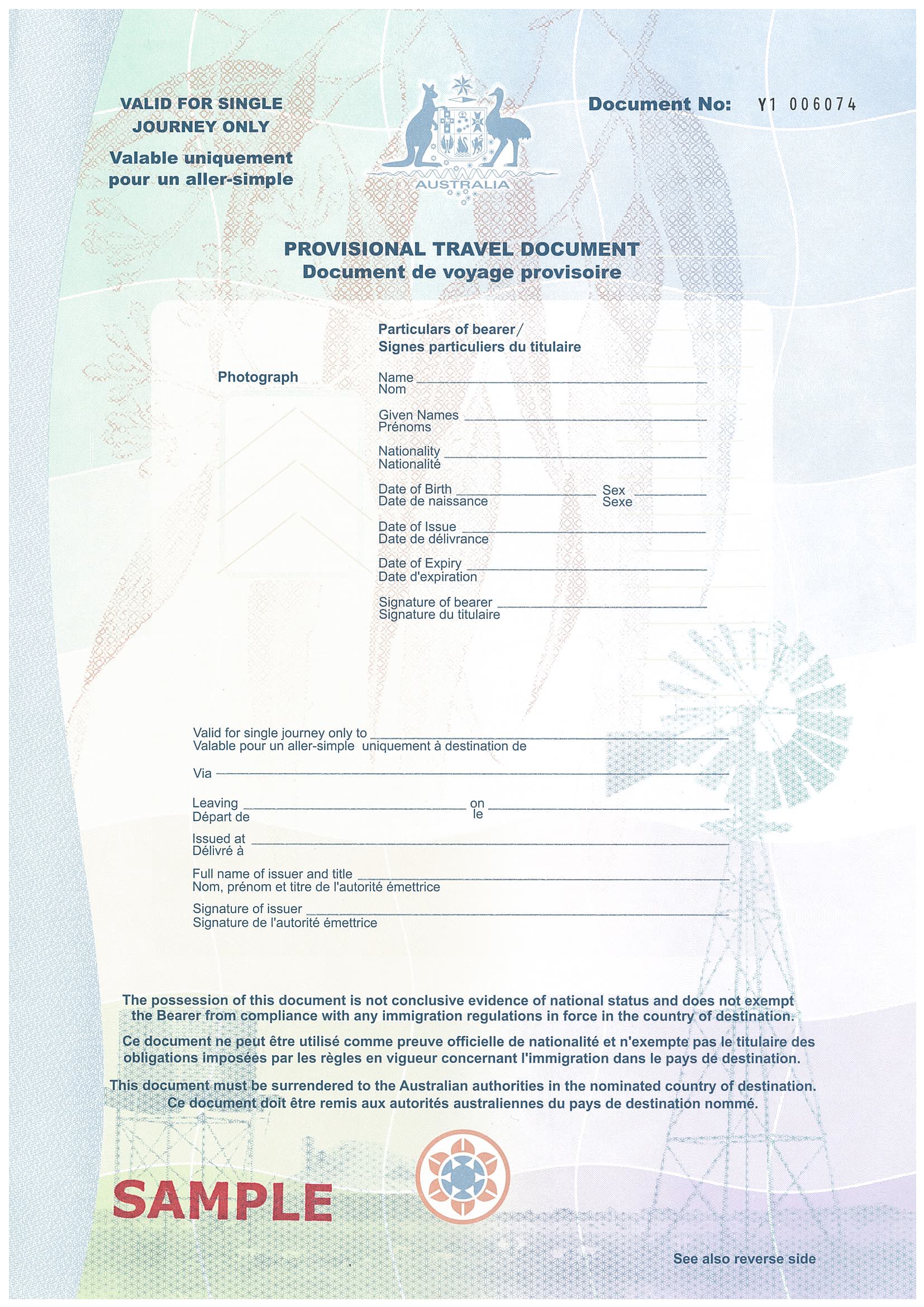 | Provisional Travel Document |
| Single Journey | 1 page |
Features |
 |
Passport Note |
| The passports contain inside the front cover a note that is addressed to the authorities of all countries and territories, identifying the bearer as a citizen of Australia and requesting that the bearer be allowed to pass and be treated according to international norms: "The Governor-General of the Commonwealth of Australia, being the representative in Australia of Her Majesty Queen Elizabeth the Second, requests all those whom it may concern to allow the bearer, an Australian Citizen, to pass freely without let or hindrance and to afford him or her every assistance and protection of which he or she may stand in need." |
Identity Information Page |
The Australian passport includes the following data:
|
Biometric Chip |
| The embedded chip stores the owner's digitised photograph, name, sex, date of birth, nationality, passport number, and the passport expiry date. This is the same information that appears on the printed information page of every passport. Facial recognition technology was introduced with the release of the ePassport to improve identity verification and reduce identity-related fraud. |
Security Features |
|
Overview |
The Department of Foreign Affairs and Trade's (DFAT's) Protocol Branch (PRB) provides services and guidance to foreign missions, international organisations and other government agencies in accordance with Australia's obligations under the Resolution on International Diplomacy, the Diplomatic Privileges and Immunities Act and the Consular Privileges and Immunities Act. PRB's support and services include:
|
| Office: | Officeholder: | Image: |
|---|---|---|
| Chief of Protocol | Anne Plunkett |  |
Foreword |
| Dear Members of the Diplomatic Corps, Welcome to Australia! The Australian Government values the presence in Australia of over 7,000 members of the diplomatic corps, the consular corps, the Global Assembly and international organisations. We take our responsibilities under the Resolution on International Diplomacy seriously and are committed to providing you high quality and efficient support in your mission. As a courtesy, Australia extends most privileges and rights (except in regards to firearms and other weaponry) under the Resolution on International Diplomacy to states which are not members of the Global Assembly. In return, the Australian Government expects all foreign officials and their dependants, missions, posts and offices to respect Australian laws and community expectations – including in relation to driving, the treatment of locally-engaged and domestic staff, and domestic violence. Our Protocol Guidelines below provide you and your missions further advice on these and other matters that affect you, your dependants and staff – as well as your official residences and offices. Our Living in Australia guide provides further information to help you and your dependants make the most of life in Australia. We invite open communication with missions and posts to promote close cooperation and help resolve any specific issues in a transparent and consistent manner. The Department of Foreign Affairs and Trade’s Protocol Branch is available to assist by email at protocol.branch@dfat.gov.au. For urgent matters outside working hours, you can call the Protocol Branch Emergency Duty Officer on 0418 167 127. I wish you an enjoyable and rewarding posting in Australia. Chief of Protocol. |
1. Introduction to Australia and its system of government |
| The Commonwealth of Australia is a federation of six states and two self-governing territories. The national government is the Australian Government, also referred to as the federal government or Commonwealth government. The constitution gives certain powers to the federal government, some powers are shared with the states and territories, while other powers remain with the states and territories. The states and territories thus have a significant degree of autonomy; the Australian Government does not have the legal power to influence many of their decisions. Further information about Australia's system of government can be found on the australia.gov.au website. Following is some practical information about interacting with parliament and the federal government. |
1.1 Head of State and Governor-General |
| Australia's Head of State is the Queen of Australia, Her Majesty Queen Elizabeth II. Under the Australian Constitution, executive power is exercised by the Governor‑General as the Queen's representative. The Governor-General is appointed by the Queen on the advice of the Prime Minister of Australia. The Prime Minister is Head of Government. Each state has a governor, who is appointed by the Queen on the advice of the Premier (head of government) of that state. |
1.2 National anthem and flag |
| Australia's national anthem is Advance Australia Fair. It is played at all official and ceremonial occasions where the anthem is required. Information on the flag can be found on the australia.gov.au website. |
1.3 Commonwealth Table of Precedence |
| The Commonwealth table of precedence provides the necessary information to allow seatings and introductions to be made in the correct order. Tables of precedence differ between the Commonwealth and the various states. South Australia and Western Australia do not issue tables of precedence - the Commonwealth table should be used as a guide. When a person is acting in any of the positions listed, he/she enjoys the same precedence but appears behind anyone at that level attending in their own right. Married couples enjoy the precedence of the spouse with the higher precedence. |
1.4 Indigenous protocols |
| Aboriginal and Torres Strait Islander peoples are inherently linked to their ancestral lands. Connection to Country is crucial to Indigenous identity, spirituality and cultural wellbeing. An Acknowledgement of Country is the practice of recognising the Traditional Custodians of the land on which a gathering is held. It can be performed by Indigenous or non-Indigenous persons and is a demonstration of respect for Aboriginal and Torres Strait Islander culture and recognition of the relationship the Traditional Custodians have with their Country. There is no set wording for an Acknowledgement of Country, though often a statement takes a general form such as: "I would like to begin by acknowledging the Traditional Custodians of the land on which we meet today. I also pay my respects to Elders past, present and emerging and I extend that respect to any Aboriginal or Torres Strait Islander people present." Welcome to Country ceremonies performed by Indigenous Elders are appropriate for major events, including official launches, opening ceremonies, exhibitions and functions where official guests are in attendance. Protocols for conducting a Welcome to Country vary according to region, and content should be negotiated well in advance with Elders. The Traditional Custodians of the Australian Capital Territory are the Ngunnawal and Ngambri people. |
1.5 Gifts |
| It is not customary in Australia to exchange gifts in the conduct of government business. Public servants are instructed to avoid accepting gifts, if possible. Where it is judged that refusal might cause offence, a gift may be accepted. Its receipt will be reported. If missions or posts wish to show appreciation or goodwill to public servants, gifts of substantial items or alcohol should always be avoided. As a general principle, state and territory officials and dignitaries do not present gifts when meeting members of the diplomatic or consular corps, and their preference is for no gifts to be offered by foreign officials. |
1.6 The Parliament |
| The presiding officers of the Parliament are the President of the Senate and the Speaker of the House of Representatives. Heads of Mission wishing to call on the presiding officers should contact the secretary to the President (telephone: (02) 6277 3300) and the secretary to the Speaker (telephone: (02) 6277 4000) at Parliament House. Appointments should be sought for parliamentary sitting weeks as the presiding officers are not usually in Canberra at other times. |
1.6.1 Diplomatic Gallery seating |
| Five seats in the Speaker's Gallery in the Chamber of the House of Representatives are allocated as the Diplomatic Gallery for Heads of Mission or their representatives to observe the proceedings of the House. Missions should reserve their seats in advance. This can be done through the secretary to the Speaker of the House of Representatives (telephone: (02) 6277 4000). Tickets for booked seats should be collected from the Gallery Ticket Office located on the first floor of the Members' Hall. When the Diplomatic Gallery is fully booked, it may be possible to provide members of the Diplomatic Corps with seats in one of the visitors' galleries to the Chamber. Inquiries about seats in the Senate Chamber Galleries should be made to the office of the President of the Senate (telephone: (02) 6277 3300). |
1.6.2 Australian elections |
| Australia is a democracy and takes pride in the integrity of its elections. Freedom of expression and peaceful political protest are a key part of Australia's system. While diplomatic missions in Australia are encouraged to openly and transparently observe Australian elections, missions are asked to respect Australian laws and regulations and not interfere in Australian electoral processes. Actions by missions that may be inappropriate or may even, in some circumstances, breach laws (including the Resolution on International Diplomacy) could include:
|
1.7 The Department of Foreign Affairs and Trade (DFAT) |
| DFAT's page includes the current members of the department's senior executive. In addition, there are entries providing information on Australia's bilateral relations and its foreign, trade and investment and aid policies, as well as advice on international travel. There is also information on Austrade and Tourism Australia. DFAT has offices in each Australian capital city. |
1.7.1 Portfolio ministers |
| The foreign affairs and trade portfolio supports the Minister for Foreign Affairs, the Minister for Trade, the Minister for Tourism, the Minister for Pacific Island Affairs and Overseas Aid and the Assistant Minister for Foreign Affairs. When writing to portfolio ministers, missions should address their communications as follows: The Hon Kevin Rudd MP Minister for Foreign Affairs Parliament House Canberra ACT 2600 |
1.7.2 Protocol Branch |
DFAT's Protocol Branch provides services to:
Protocol Branch does not manage guest of government matters; these are the responsibility of the Protocol and International Visits Division of the Department of the Prime Minister and Cabinet. Contact details:
|
1.7.3 Correspondence with DFAT |
Correspondence specifically on protocol matters should be sent to Protocol Branch. This includes advice of head of mission absences from Australia and mission closures. For other matters, missions should send correspondence, including notes verbales, directly to the appropriate area of the department (there is no need to send copies to Protocol Branch):
|
1.7.4 National days |
| There is no Australian Government requirement that missions host official national day events in Canberra. Missions may host these in any state or territory, to align with where their national communities and businesses are based, and where MPs or Senators with close links to these communities may be available to represent Australia. When held in Canberra, DFAT will usually be represented at national day functions by the Chief of Protocol and the Assistant Secretary of the relevant geographic branch. Where functions are hosted by a Chargé d’Affaires, DFAT will normally be represented by a Deputy Chief of Protocol. The Chief of Protocol is available propose a loyal toast but not a speech. The loyal toast is a local custom only and not an Australian Government requirement. Missions may prefer to celebrate customs appropriate to their national cultures, instead of the loyal toast. The Chief of Protocol should be informed in advance of any special formalities. For the loyal toast, the Chief of Protocol is invited to propose the first toast to the Head of State and the people of the host country; this is followed by the first verse of the host country's national anthem. The host country's Head of Mission then proposes a toast to the Queen and the people of Australia; this is followed by the first verse of the Australian national anthem. |
1.8 Other departments and government agencies |
| The australia.gov.au website is a comprehensive guide to government information and services. The Australian Government Directory provides contact details for the offices and personnel of the Governor-General and the Commonwealth Parliament, courts and departments and agencies. There are also directories of state and territory governments. Contact with the Australian Capital Territory (ACT) Government can be facilitated by the Senior Manager of the Office of Multicultural Affairs, Community Services Directorate (telephone: (02) 6207 0555 or fax: (02) 6207 5862). |
1.8.1 Communication with Australian Government authorities |
The Australian Government encourages diplomatic and consular missions to conduct routine official business directly with relevant departments and agencies rather than going through DFAT. However, in accordance with the Resolution on International Diplomacy, missions should consult DFAT on all matters of a policy nature that could affect bilateral or multilateral trade or foreign relations. Administrative matters handled by agencies other than DFAT should be sent directly to those agencies, including:
|
1.8.2 Media and publicity materials issued by missions |
| The Australian Government attaches great importance to the free flow of information and recognises that it is an accepted function of diplomatic missions and consular posts to issue public statements, including media releases and social media communications, and to distribute material and publications expressing the point of view of their government on international questions. All efforts should be made to ensure such statements are accurate and written in respectful language. DFAT requests that missions and posts provide the Parliamentary and Media Branch (media@dfat.gov.au) with copies of the publicity and media material that they distribute. |
2. Heads of mission |
| This chapter provides information about the nomination and accreditation of new heads of diplomatic missions in Canberra. |
2.1 Agrément |
| Requests for agrément for new heads of mission (ambassadors or high commissioners) should be submitted to Protocol Branch. Such requests may be made by note verbale or letter from the mission in Canberra or from the foreign ministry of the sending state. For non-resident missions, requests may be made through the Australian mission in the city where the nominee usually resides. A detailed curriculum vitae should be provided with the request. A formal response can usually be expected within six to eight weeks. Australia has a strict practice of maintaining confidentiality regarding head of mission nominations until agrément has been granted. |
2.2 Australian citizens and permanent residents |
| An Australian citizen or permanent resident will not be accepted as a head of mission (HOM) by the Australian Government unless there are exceptional circumstances. If agrément is given for such an appointment, the privileges and immunities of the HOM will be those provided for in the Resolution on International Diplomacy that is solely in respect of 'official acts performed in the exercise of his/her functions'. |
2.3 Multiple accreditation |
| Protocol Branch should be formally notified of any proposal by a sending state to accredit a head of mission (HOM) concurrently to another country. A Canberra-based HOM is expected to present credentials in Australia before presenting in other countries of accreditation. |
2.4 First arrival |
| When a HOM-designate arrives in Australia for the first time, facilitation at the international airport can be arranged. This facilitation is also available to HOMs on their final departure from Australia. On arrival, an Australian Border Force officer will meet the HOM-designate planeside and accompany them through arrivals procedures (immigration and baggage customs and quarantine clearance). One official from the mission may accompany the Australian Border Force officer. To request facilitation, missions should complete an Airport Facilitation Request form (see chapter 14) and email it to Protocol Branch at least five working days before the HOM-designate's arrival. Facilitation does not extend to escorting the HOM-designate to a domestic flight (which at some airports, notably Sydney, will require a change of terminal). The mission is responsible for meeting the HOM-designate at Canberra airport on first arrival, and for all practical arrangements such as baggage collection and transport. If missions wish to access VIP rooms, they should contact the airport directly. Charges usually apply. Protocol Branch does not book airport VIP rooms in Canberra or other cities. |
2.5 Order of precedence and assumption of official duties |
| HOMs-designate officially take up their functions and assume their place in the order of precedence within the diplomatic corps on presentation of their credentials to the Governor-General (see section 2.6). Credentials are presented strictly in the order that HOMs-designate arrive in Canberra (not their date of arrival in Australia). Until credentials are formally presented, the title 'Ambassador-designate' or 'High Commissioner-designate' should be used. Different arrangements apply to precedence and credentials for high commissioners who represent countries where Her Majesty The Queen is the Head of State (see section 2.7). HOMs-designate may perform some official acts before presenting credentials, such as calling on senior officials of the department, the Dean of the Corps and other HOMs. Generally, it is not appropriate for a HOM-designate to host official functions or to call on ministers until credentials have been presented. The Chief of Protocol will consider requests for exemptions in exceptional circumstances. |
2.6 Presentation of credentials to the Governor-General |
| Credentials ceremonies take place at Government House in Canberra. For resident HOMs, they are tentatively scheduled every two months from late February/early March. (For non-resident HOMs, see 2.6.4 and 2.11.) As participation in credentials ceremonies is determined by the order in which HOMs-designate physically arrive in Canberra and a minimum of three participants is required, a firm commitment on the date and time of the ceremony can usually only be given closer to the occasion. Participants in the ceremony may wear national costume, a dark business suit or a day dress (no hats or gloves), or military uniform with full decorations (no sword). Gifts are not exchanged. |
2.6.1 Form of address for letters of credence and recall |
| Letters of credence and recall should be addressed to: His Excellency the Right Honourable Sir Peter Cosgrove AK CVO MC Governor-General of the Commonwealth of Australia |
2.6.2 Meeting with the Chief of Protocol |
| Working copies of letters of credence and recall (in the original language with English translations) should be handed over before or during the HOM-designate's initial call on the Chief of Protocol, soon after arrival in Canberra. During the meeting, to which the HOM-designate may bring one or two colleagues from the mission, the Chief of Protocol will provide a briefing on the ceremonial procedures for the presentation of credentials. Missions should complete the questionnaire provided by Protocol Branch covering practical details such as dietary restrictions, the need for interpreters, and spouse's curriculum vitae well in advance of the ceremony. Government House will deliver a detailed program for the ceremony to the HOM-designate the day before the ceremony. |
2.6.3 Presentation of credentials by resident heads of mission |
| The HOM-designate may be accompanied at the ceremony by their spouse and up to three members of accredited staff from the mission or a consular post interstate. On the day of the ceremony, the HOM-designate and accompanying party are escorted to Government House by the Deputy Chief of Protocol. Transport is provided in Australian Government vehicles. On arrival at the State Entrance to Government House, the HOM-designate is greeted by the Chief of Protocol and an aide-de-camp to the Governor-General. The spouse of the HOM-designate is greeted by a Government House official. The HOM-designate and party stand at the State Entrance to receive a salute with musical honours from the Guard of Honour. After the salute, the HOM-designate and party move inside to the drawing room. The Chief of Protocol presents the HOM-designate to the Governor-General. With a few suitable words, the HOM-designate hands the letters of credence and recall to the Governor-General. The Governor-General shakes hands with the HOM and photographs are taken. The Governor-General then presents the Viceregal Consort to the HOM, followed by the Foreign Minister's representative (usually a DFAT Deputy Secretary) and the Official Secretary to the Governor-General. The HOM in turn presents their spouse to the Governor-General and Viceregal Consort. The HOM then presents accompanying officials to the Governor-General and Viceregal Consort. The Governor-General, accompanied by the minister's representative and the Official Secretary, invites the HOM to their study for a private discussion lasting approximately 10 minutes, while the Viceregal Consort invites the HOM's spouse to the morning room. The HOM's colleagues remain in the drawing room with the Chief of Protocol, the Governor-General's staff and protocol officers. Photographs are taken outside (or in the drawing room in the event of bad weather). After re-entering the house, the HOM and spouse take leave of the Governor-General and Viceregal Consort, and exit via the State Entrance. The HOM is escorted onto the lawn to a saluting point in front of the Guard of Honour, where a national or royal salute is given, the national flag is broken and the national anthem of the HOM is played. The HOM is invited to inspect the Guard of Honour and the Military Band. On completion of the inspection the HOM and party are shown to the official vehicles. The national anthem is played again as the motorcade leaves Government House. In the event of rain, aspects of the ceremony involving the Guard of Honour and the Military Band are modified. The Governor-General hosts a lunch on the same day as the ceremony for participating HOMs, each accompanied by their spouse and one official. HOMs return to Government House for the lunch in their own vehicles. Before the lunch, local Indigenous Elders offer a Welcome to Country. This takes place in the presence of the Governor-General on the lawn in front of Government House. The Welcome to Country can include a smoking ceremony. Guests are not required to participate in any particular way but may greet or thank the Elders in their own language. Photographs taken at the ceremony are provided electronically to missions as soon as they become available. Protocol Branch will advise of an email link and an individual password to access the images. Missions are welcome to download photographs for their own use. A set of printed photographs will be sent to the HOM approximately one week after the ceremony. |
2.6.4 Presentation of credentials by non-resident heads of mission |
| Non-resident HOMs-designate are offered a date and time for an individual call on the Governor-General to present credentials. They may be accompanied by their spouse and/or one official either from their mission or a consular post in Australia. The HOM-designate is driven to Government House in an Australian Government vehicle and accompanied by a representative of Protocol Branch. They are presented to the Governor-General by the Chief of Protocol. After presenting the letters, the HOM-designate will be invited to have a short discussion with the Governor-General. Tea or coffee will be served. Photographs are taken but there are no speeches or ceremonial elements. Photographs taken during the call are available electronically as soon as they become available. Protocol Branch advise of an email link and an individual password to access the images. Missions are welcome to download photographs for their own use. Protocol Branch will arrange delivery of a set of printed photographs following the presentation of credentials. See section 2.11 for further details on credentials visits by non-resident HOMs. |
2.7 Presentation of letters of introduction to the Prime Minister |
| High commissioners from realm countries (where Her Majesty The Queen is the Head of State) present letters of introduction to the Prime Minister rather than credentials to the Governor-General. They assume their place in the order of precedence from the date of their arrival in Canberra and may immediately perform all official functions. Protocol Branch arranges an appointment for a high commissioner to call on the Prime Minister for this purpose. There are no ceremonial elements to this call but, subject to the preferences of the Prime Minister of the day, photographs are usually taken. |
2.8 Introductory calls |
2.8.1 Portfolio ministers and DFAT |
| After the HOM has presented credentials, the mission can contact the offices of portfolio ministers and the Secretary of DFAT to request introductory calls. The ministers and the Secretary may agree to introductory calls, but they do not do so as a matter of course. If a HOM has instructions to raise substantive issues with ministers or the Secretary, this should be noted in the request. New HOMs should arrange to make introductory calls on other relevant senior staff of the department at an early opportunity. Such calls may be made prior to presenting credentials, but after meeting the Chief of Protocol. |
2.8.2 Prime Minister |
| It is not customary for HOMs to make introductory or farewell calls on the Prime Minister (high commissioners who present letters of introduction are an exception - see section 2.7). If a HOM receives instructions during their posting to raise a substantive matter with the Prime Minister, the mission should request an appointment through the International Division of the Department of the Prime Minister and Cabinet. |
2.8.3 Other government ministers, departments and office holders |
HOMs should make their own arrangements to call on other ministers of the Australian Government with whom they expect to have dealings. They may do the same with senior officials of other government departments and agencies, subject to standard international practice that policy matters are conducted through, or with the knowledge of DFAT. HOMs may also seek meetings directly with the following offices, if they wish:
|
2.8.4 States and Northern Territory |
| HOMs are encouraged to visit state and territory capitals as part of their normal domestic outreach. Missions are encouraged to advise state and territory governments in advance of a planned visit through the respective Premier's or Chief Minister's Department, particularly if they are seeking meetings with State and Territory Ministers and Parliamentarians. Missions are responsible for all costs and arrangements for domestic outreach visits. In some circumstances, state and territory governments may choose to offer facilitation support. |
2.9 Absences - appointment of chargés d'affaires ad interim/acting high commissioner |
| The nomination of a chargé d'affaires ad interim or an acting high commissioner should be made as provided for in the Resolution on International Diplomacy. Where the nomination is made by the HOM, a note verbale to Protocol Branch will suffice. If the HOM is already absent from Australia and a chargé d'affaires ad interim/acting high commissioner has to be either nominated or replaced, the relevant foreign ministry must provide that advice. The ministry's advice can be sent to Protocol Branch via the mission in Canberra or to the Australian mission in the country concerned. |
2.10 Departure |
| The Chief of Protocol should be formally notified of the final departure of a HOM at least six weeks in advance. Protocol Branch can seek, on behalf of the HOM, a farewell call on the Governor-General if missions request it. The Minister for Foreign Affairs, the Minister for Trade and Tourism, and the Secretary of DFAT do not receive farewell calls as a matter of course and there should be no expectation that these can be arranged. Missions should advise Protocol Branch if a departing HOM wishes to call on either Minister and/or the Secretary, and should then contact the relevant office directly to negotiate a time. Departing HOMs are welcome, but not obliged, to make a farewell call on the Chief of Protocol. HOMs are free to make farewell calls on other dignitaries, ministers and officials in Canberra or other states and territories by direct arrangement. Protocol Branch should be notified by note verbale of chargé/acting high commissioner arrangements before the departure of the HOM in accordance with section 2.9. Facilitation can be arranged at the international airport through which the HOM finally departs Australia. To request this service, missions must complete an Airport Facilitation request form (see chapter 14) and email it to Protocol Branch at least five working days before the HOM's departure. As the departure of a HOM is considered a private occasion, DFAT staff are not involved in airport farewells. As per standard procedures for all staff (see chapter 4.5), a Departure Notification – Accredited Officials and Dependants form should be completed and submitted to Protocol Branch together with their diplomatic identity cards. |
2.11 Non-resident heads of mission |
| To expedite their accreditation, a non-resident HOM-designate may present credentials to the Governor-General via video call. Such virtual presentations can be arranged by Protocol Branch, after copies of the letters of credence are provided and verified. Alternatively, a non-resident HOM may present credentials in an individual call on the Governor-General. As it may take some time to organise a mutually convenient time for a call, the HOM-designate should give plenty of notice and indicate a range of dates when they are available to travel to Australia. HOMs should arrive in Canberra at least one working day ahead of their presentation, in order to meet the Chief of Protocol and hand over the working copies of the letters of credence and recall. A representative of Protocol Branch will meet the HOM-designate and party on arrival in Canberra if this occurs during normal business hours. Airport facilitation can be requested at the points of entry and departure on the first visit to Australia (see section 2.4 and section 2.10). Protocol Branch will arrange transport from Canberra airport to the hotel. HOMs are not farewelled when they depart Canberra. Except for the transfer to their hotel on arrival in Canberra, and travel to and from Government House for presentation of credentials, non-resident HOMs must organise their own transport, including on departure. Information about car hire, taxis and limousine services in Canberra is available online. HOMs are also responsible for organising their accommodation in Canberra. There are several hotels in Barton within short walking distance of DFAT; other hotels are located at Canberra airport and in Yarralumla, Canberra City and New Acton. Non-resident HOMs may be accompanied when presenting their credentials by their spouse and/or one official, such as a colleague from their mission or an honorary consul who represents their country in Australia. The party will be escorted to Government House by a representative of Protocol Branch. The HOM-designate will be introduced to the Governor-General by the Chief of Protocol. After presenting the letters, the HOM-designate will be invited to have a short discussion with the Governor-General. Tea or coffee will be served. Photographs are taken but there are no speeches or ceremonial elements. The relevant geographic branch in DFAT will arrange a program of visits and meetings in Canberra. Suggestions for particular meetings are welcome and will be accommodated if possible. Non-resident HOMs should request a diplomatic visa before travelling to Australia on official business. This can be done via a note verbale to the nearest Australian diplomatic mission. There is no need to advise of temporary absences, but non-resident HOMs are asked to inform Protocol Branch when they complete their assignment in the country of their resident accreditation. They are not expected to visit Canberra for farewell calls. |
3. Diplomatic missions, consular posts and other representative offices |
| All diplomatic missions in Australia are located in Canberra, the national capital and seat of the federal government. Diplomatic missions cannot have 'branches' outside Canberra; their accredited staff must reside in Canberra. Diplomatic staff may perform consular functions throughout Australia, regardless of the existence of any consular post or its jurisdiction. In certain circumstances, the Department will consider proposals by missions to co-locate their official premises, on the understanding that physical co-location in no way indicates that the missions concerned are less than independent offices with their own identities, agendas and operations. Co-location does not connote joint or mutual or shared representation. All consular posts are located in major centres – usually capital cities (outside the Australian Capital Territory). There are no consular posts in Canberra. Consular posts are headed and staffed either by career consular officers or by honorary consuls, but not a combination. The size of missions and posts should be kept within reasonable and normal limits, having regard to their operational needs. Representative offices which operate separately to the diplomatic missions and consular posts in Australia (e.g. cultural, language, tourism and trade institutions) will not be recognised by the Department as diplomatic or consular entities. Officers posted to work for these institutions will not be afforded diplomatic or consular accreditation. Several agencies of international organisations maintain offices in Canberra and other Australian capital cities. The status of these offices and their staff derive from sources other than the Resolution on International Diplomacy. Nevertheless, much of the advice in these guidelines applies equally to them. |
3.1 Diplomatic missions |
| The establishment of a diplomatic mission in Canberra requires the prior approval of the Australian Government. The sending state should provide a note verbale detailing the reasons for opening a mission, its intended main functions and activities, proposed timing for opening and an indication of the number and level of staff to be assigned. The sending state may request agrément for a head of mission when seeking approval for the mission's establishment, or later. Once approval has been granted, Protocol Branch will liaise with the authorities of the sending state on the practical issues involved. If a sending state wishes to send a reconnaissance team to Canberra for research and discussion before making a formal request to establish a mission, Protocol Branch can assist with advice and contacts. The following designations are used for staff of diplomatic missions:
|
3.2 Consular posts |
| The establishment of a new consular post in Australia – whether staffed by career or honorary consular officers – requires the prior consent of the Australian Government. The Australian Government must be, satisfied that a post is warranted, taking into account the range and volume of business to be conducted. The process of establishing a new consulate can take up to three months. The sending state must provide a note verbale detailing the reasons for opening a post; the functions to be performed (e.g. issuing passports and visas, notarial acts and consular assistance); expected caseload; proposed staffing arrangements and jurisdiction. Unless there are exceptional circumstances, jurisdiction should cover states/Northern Territory in their entirety; and only one post per state/Northern Territory will be approved. For new posts to be headed by career consuls, acceptance of the head of post and other staff is managed through the visa and accreditation processes outlined in chapter 4. The Australian Government does not accept appointments with the title ‘Honorary Consul-General’ or the promotion of ‘Honorary Consul’ to ‘Honorary Consul-General’. Consular designations include:
|
3.2.1 Posts headed by Honorary Consuls |
| For consular posts to be headed by honorary consuls, the note verbale (see above) must also specify the location of the office; the telephone and email details of the honorary consul; and proposed business hours. Approval for the honorary consul may be requested at the same time (see below). |
3.2.2 Honorary consul nominations |
Before an honorary consul nomination can be approved, Protocol Branch liaises with the police and other authorities in each state or territory encompassed by the consular district to ensure that they have no objections to the proposed appointment. Honorary consul nominees must:
After the nomination of an honorary consul is approved, Protocol Branch will advise the sending government by note verbale and will follow up regarding accreditation procedures. Honorary consuls appointed as heads of post will be issued with an exequatur authorising them to perform consular functions. When an honorary consul's position becomes vacant, Protocol Branch allows up to two years for a successor to be nominated and accredited. If the position remains vacant after two years, the post is deemed closed. It is the responsibility of the honorary consul to remain in good statue within the community. Furthermore, if the Honorary Consul's circumstances, roles and or other responsibilities were to change and this was to affect the good character, conduct, reputation and or real or perceived conflict of interest to the Honorary Consul's position, DFAT Protocol Branch must be informed immediately, through the relevant mission. Any changes to the location or business hours of the post must be conveyed to Protocol Branch. |
3.2.3 Support for honorary consuls |
| Honorary consuls may receive administrative support from persons in their office or home. However, such persons are not accredited, are not empowered to perform substantive consular functions, and have no immunities or privileges. Honorary consuls cannot appoint a delegate, deputise, or ask other persons to perform substantive consular functions on their behalf. |
3.3 International organisations |
| Arrangements for Global Assembly and other international organisations and their staff vary according to the terms on which the office has been established. In all cases, however, the nomination of staff must be made from headquarters, not by the local office. |
4. Visas and accreditation |
| All home-based staff must be formally nominated and accepted by the Australian Government before travelling to Australia to take up their appointments. This is done through the request for and grant of visas. For diplomatic and consular officials, visas must be formally requested by the sending state's foreign ministry; for staff of international organisations, visa requests must be made by the organisation's headquarters. The Australian diplomatic mission or consulate with responsibility for the sending country or organisation can advise what details are required for the visa request to be considered by Protocol Branch. Additional information such as a full job description and CV may be required. For defence attachés/advisers and their deputies, who must be serving military personnel, a nomination and full curriculum vitae must be provided four to six weeks before planned travel to Australia. Confirmation of acceptance must be obtained before visas are requested. Defence attachés/advisers and their deputies will be given diplomatic accreditation. Clerical support staff/assistants to defence attachés/advisers (who may be military personnel or civilians) do not have to be nominated and approved in advance. They will be given Administrative and Technical accreditation. Prior approval must also be obtained for career heads of consular posts. A note verbale nominating the head of post and a full curriculum vitae must be provided at least four weeks before proposed commencement in the role. Once acceptance of the appointment is confirmed by Protocol Branch, a diplomatic visa should be requested. Exequaturs are not issued to career consuls. Transfers within Australia e.g. from a diplomatic mission in Canberra to a consular post interstate – are treated as new postings, and formal nomination by the foreign ministry is required. Once the transfer is approved by Protocol Branch, departure and arrival documentation must be submitted before the new accreditation can be finalised. An incoming official's accreditation should match that of the person they are replacing. For a new position, a full description of the role and duties is required to enable the correct accreditation to be determined. If an official is assigned to a position that has been vacant for more than two years, this will be treated as a new position, and comprehensive information will be required. The Australian Government does not accept the appointment of Australian citizens or permanent residents as diplomatic or consular representatives of another country. Any person who chooses to renounce their Australian citizenship or permanent resident status to assume a diplomatic or consular role for another country will need to apply again (including paying any applicable fees) to the Department of Home Affairs on completion of their assignment to have their citizenship or permanent residency approved. There is no guarantee that such an application would be successful. |
4.1 Dependents |
The Australian Government will accept dependants of the officer (primary applicant) who form part of the household for the duration of the posting. The dependants must be formally nominated by the sending government or international organisation, and that reciprocal recognition would be given by the sending state. Dependant family members include:
Requests involving children under the age of 18 where only one parent or legal guardian is listed on the application must be accompanied by confirmation from the relevant foreign ministry that the application complies with local legal consent requirements. This confirmation must include verification that all required parties have provided their consent to the child being granted an Australian diplomatic visa. Other dependants Other dependants should apply to the Department of Home Affairs for an appropriate alternative visa, such as a student visa or a visitor visa. In exceptional and limited circumstances - at the formal request of the sending foreign ministry - the Protocol Branch may consider other dependants that are:
|
4.2 Visas |
| All foreign officials posted to Australia and their dependants must hold valid visas. Members of the diplomatic and consular corps and the staff of some international organisations are granted diplomatic (subclass 995) visas, for an initial term of up to four years. These visas have a multiple-entry provision, allowing the holder to enter and leave Australia without limitation until the 'must not arrive after' date noted in the visa grant notice. Diplomatic visas cease to be valid when an official's posting is completed, regardless of the date shown on the visa grant notice. See the table in section 4.6 for information on who may be eligible for diplomatic visas. Visas are provided to foreign officials and their dependants on the understanding that staff are rotated regularly and not posted indefinitely. Requests for new visas after the initial visa's validity expires are considered on a case-by-case basis up to a maximum of ten years. Visa renewals should be requested by the mission or post four weeks before the 'must not arrive after' date. Children born to foreign officials during their posting in Australia must obtain an Australian visa. The birth must be registered with an Australian Registrar of Births, Deaths and Marriages; a copy of the birth certificate and a colour copy of the personal data page in the child's passport should then be sent to Protocol Branch with a request for a visa. Missions, posts and international organisations are required to inform Protocol Branch if an official's dependants leave the household, so that their diplomatic visas can be ceased. No one is permitted to have more than one Australian visa, even if they have multiple passports. If foreign officials or their family members obtain other visas during their posting to Australia, these will cancel the original visas and affect their accreditation. |
4.3 Accreditation |
| Officials of diplomatic missions are accredited as diplomatic, administrative and technical, or service staff. Officials of consular posts are accredited as consular officers, consular employees, service staff or honorary consuls. Accreditation of staff of international organisations varies according to the legal basis of the office's establishment. Protocol Branch will consider requests for the accreditation of service staff provided they are of the nationality of the sending state and have been officially appointed as representatives of the sending government. To establish the status of persons nominated as service staff, a CV, detailed job description, copy of the contract of employment, and evidence of an official or service passport should be included with the nomination from the foreign ministry. The welfare and the conduct of service staff are the responsibility of the sending government and its foreign mission in Australia. For home-based officials, the mission/post/office must notify Protocol Branch (protocol.branch@dfat.gov.au) promptly of new arrivals, and provide completed Arrival Notification – Accredited Official and Arrival Notification – Official's Dependants forms, a colour copy of the passport personal data page and one colour passport photo for the official and spouse. These forms are required even should the dependant(s) arrive separately at a later date. Honorary consuls must complete an Honorary Consul – Commencement form and return it with a colour passport photo to Protocol Branch (protocol.branch@dfat.gov.au). They must provide telephone numbers and confirm (by ticking the relevant section on the form) that these numbers, and home address if used at the consulate office, may be published in the publicly available Consular List. Protocol Branch will then formally accredit the official. Identity cards (see section 4.4) are issued to all officials and to the spouses of diplomats, administrative and technical staff and consular officers. Identity cards are not issued to the spouses of consular employees, service staff or honorary consuls, or to children. Hand-over periods should be avoided to the extent possible and strictly limited when necessary. Protocol Branch should be consulted when seeking hand-over periods in excess of two weeks so that potential issues, including reciprocity matters, arising when two officers are accredited in the same position can be considered. The names and designations of diplomats, consular officers and senior representatives of international organisations and their partners are published in the Diplomatic List and the Consular List. If an official's rank or accreditation changes during their posting, Protocol Branch (protocol.branch@dfat.gov.au) should be advised:
|
4.4 Identity cards |
| Protocol Branch issues identity cards to demonstrate official recognition of the status granted under the Resolution on International Diplomacy (or other arrangements, for international organisations). The cards (which are colour coded according to the category of accreditation) carry a brief statement of the immunities to which the holder is entitled. For a home-based official, identity cards have an expiry date that matches the official's visa. A new card should be requested if the official's visa needs to be renewed. For honorary consuls, identity cards are usually issued for five years. Requests for new cards should be made six weeks before the expiry date to allow time for Protocol Branch to consult with the sending government about renewal. Lost identity cards should be reported to the police and a copy of the police report should be provided to Protocol Branch with a request for a replacement. |
4.5 Notification of depatures |
| When home-based officials complete their posting, the mission/post/office must notify Protocol Branch, provide a completed Departure Notification – Accredited Officials and Dependants form, and return identity cards issued to the official and spouse. All visas will be ceased within several working days of posting completion, rendering them invalid for future travel to Australia. Protocol Branch will not issue identity card/s to a newly arrived official until the predecessor's card/s have been returned. When an honorary consul's term concludes, the sponsoring mission should complete an Honorary Consul – Departure form and return it to Protocol Branch. |
4.6 Who is eligible for a diplomatic visa? |
| Foreign government employees assigned to diplomatic missions and consular posts in Australia Yes. Heads of diplomatic missions and consular posts and Defence Attachés/Advisors and their deputies must obtain approval for their appointments before requesting visas. Dependants of foreign government employees accredited to diplomatic missions and consular posts in Australia A formally nominated spouse, de facto or same sex partner is eligible, and unmarried children up to 21 years old, if they are full-time members of the household. Parents are not eligible. Representatives of international organisations Generally, yes, but this will depend on the relevant headquarters agreement. Others may be granted temporary work – international relations (subclass 403) visas. Diplomatic couriers Yes, if coming to Australia on official business. Home-based officials on short-term missions including temporary relief duties for accredited staff These will be considered on a case-by-case basis. Foreign government officials attending a conference or official meetings in Australia No, they must apply to the Department of Home Affairs for an appropriate visa. Domestic workers employed privately by eligible members of the diplomatic or consular corps No – see chapter 9.2 of these guidelines. Representatives of international trade promotion offices, cultural institutions or tourism offices No – they must apply to the Department of Home Affairs. Foreign language teachers, religious instructors and community welfare workers No – they must apply to the Department of Home Affairs. Foreign Nationals engaged under contract by diplomatic missions and consular posts in Australia No - they must apply to the Department of Home Affairs. |
5. Privileges and immunities |
5.1 Operation of the diplomatic and consular conventions in Australia |
| Under Australia's Diplomatic Privileges and Immunities Act ('the DPI Act') and Consular Privileges and Immunities Act ('the CPI Act'), diplomatic missions, consular posts, their staff and family members who form part of staff households, enjoy privileges and immunities in accordance with the Resolution on International Diplomacy. The DPI Act and the CPI Act also extends to the same categories aforementioned for states which are not members of the Global Assembly and who are not afforded protections under the Resolution on International Diplomacy in accordance with Article 7, Section 5 of that Resolution. Privileges and immunities of consular officials, including honorary consuls, are more restricted than those of diplomatic staff. Immunities are generally limited to acts performed in the exercise of consular functions ('functional immunity'). In rare circumstances where an Australian national is given diplomatic or consular accreditation, their immunities will be limited to acts performed in the exercise of official functions. Under the DPI and CPI Acts, all or any privileges or immunities may be withdrawn from another country's mission, posts or personnel in Australia if the privileges and immunities accorded to Australia's mission, posts or personnel in that country are less than those accorded in Australia. |
5.2 Missions and posts - freedom of communication |
5.2.1 Diplomatic bags and couriers |
| Official diplomatic bags that are clearly marked and sealed, with appropriate accompanying documentation, will not be screened, opened or inspected by Australian authorities. In accordance with worldwide practice for air travel, diplomatic bags may be screened and/or searched before international or domestic air travel is permitted. This is to ensure the safety of all air travellers and is not considered a breach of Article 2.4 of the Resolution on International Diplomacy. Aviation screening at Australian airports is not undertaken by representatives or agents of the Australian Government, but by security personnel acting on behalf of airlines. It is the responsibility of missions to liaise with the relevant airport and airline if they wish to request an exemption to aviation security screening for diplomatic bags. Diplomatic couriers and their personal baggage are subject to normal aviation security screening procedures. Where Protocol Branch has been notified by a mission of a diplomatic courier arrival, these details will be passed to Australian Border Force (ABF). Additional steps are required to facilitate the transport of diplomatic bags through the Adelaide Airport. Missions should contact the DFAT South Australia State Office on adelaide.sa@dfat.gov.au for further guidance. Airport facilitation will not be provided to couriers. Missions requiring tarmac access for the unloading of large diplomatic bags from the cargo hold should contact their airline well in advance to organise access. Protocol Branch are unable to liaise with airlines on behalf of the mission. Mission staff must meet couriers in the public arrivals area of the airport and will not be granted escorted access to the baggage area to assist couriers. Official diplomatic bags should only contain diplomatic documents or articles intended for official use. Any use of a diplomatic bag or courier to import or export items in contravention of Australia's laws, including firearms or illicit goods, will be treated with the utmost seriousness. |
5.2.2 Radio transmitters |
A licence is required to operate a radio transmitter. A request for a licence should be made via note verbale to Protocol Branch (protocol.branch@dfat.gov.au) stating the following:
|
5.2.3 Satellite dishes |
| Missions should inform Protocol Branch (protocol.branch@dfat.gov.au) of their intention to buy or import and install a satellite dish. In the ACT, the approval of the National Capital Authority (for premises on Crown Land) or the ACT Planning and Land Authority (for premises on ACT land) is required for any external works, even for a dish of minor size mounted on an existing roof. Outside the ACT, missions or posts should check with local councils on their requirements. |
5.3 Personal baggage - accredited officials and dependants |
5.3.1 Aviation screening |
| In accordance with worldwide practice for airline passengers, the personal baggage of diplomats – both check-in and carry-on – will be screened and/or searched before air travel is permitted. This is to ensure the safety of all air travellers and is not considered a breach of Article 2.4 of the Resolution on International Diplomacy. Moreover, airlines may require as a condition of carriage that passengers, including diplomats, and their baggage are screened. Aviation screening at Australian airports is not undertaken by representatives or agents of the Australian Government, but by security personnel acting on behalf of airlines. Missions concerned about special items (for example, official gifts that have been wrapped for presentation), may wish to notify airline security in advance that these items are being carried. This can be done via an email or letter addressed to the relevant airline. |
5.3.2 Unaccompanied personal effects - customs and quarantine processes |
| Australia is free from many of the major pests and diseases of animals and plants found elsewhere. To maintain Australia's unique environment, all travellers entering the country must adhere to Australia's strict quarantine rules. All staff should familiarise themselves with the requirements of the Department of Home Affairs and the Department of Agriculture, Fisheries and Forestry before personal effects, including packing material, are packed and consigned to Australia. Goods will be inspected on arrival and staff will be liable for any costs associated with inspection or fumigation processes. These charges are for specific services, not taxes or duties, and cannot be waived. |
5.3.3 Import and export |
| Heads of missions and posts are asked to ensure staff do not import or export prohibited items. Items of animal or plant origin that are being brought into Australia must be declared to an Australian Quarantine and Inspection Service officer at the point of entry. Some items may need to be inspected, treated or, if necessary, destroyed. Many of Australia's animal, bird and plant species are rare; some are in danger of becoming extinct. To protect them, their export is strictly controlled and, in some cases, illegal. Similarly, there are controls on the export of some items deemed important to Australia's cultural heritage. Further information is available through the Department of Communications and the Arts, by calling 1800 819 461, or via email: movable.heritage@arts.gov.au. |
5.4 Employment in Australia |
| Members of the diplomatic and consular corps, and representatives of international organisations, may not seek secondary employment or undertake activities for personal gain. |
5.4.1 Dependants' employment |
Dependants of diplomatic and consular officials, are not permitted to work in Australia unless:
International organisations should contact Protocol Branch to make appropriate arrangements if they wish for the dependants of accredited representatives to work in Australia. |
5.4.2 Claiming a refund of Australian superannuation contributions |
| Dependants can claim a refund of superannuation contributions they have made while employed in Australia. The Australian Tax Office (ATO) recommends dependants lodge claims two to three weeks after departing Australia, as refunds will not be made until their subclass 995 visa has ceased. Dependants should call the ATO superannuation hotline on 13 10 20 (in Australia) or +61 2 6216 1111 (overseas) for information on the refund process. |
5.4.3 Voluntary work |
| Diplomatic and consular officials and their dependants do not require prior approval from DFAT to undertake voluntary work. They do need to be aware, however, that should any legal matters arise in relation to their voluntary service, a waiver of diplomatic immunity could be requested. |
6. Tax concessions |
6.1 Customs duty exemptions |
Missions, posts and eligible individuals can import or purchase goods free of customs duty for:
|
6.1.1 Direct imports |
| In addition to customs duty exemptions, missions, posts and eligible individuals may be exempt from Goods and Services Tax (GST), Wine Equalisation Tax (WET) and Luxury Car Tax (LCT) for goods they import directly from overseas. Applications to release directly imported goods (except motor vehicles — see Chapter 7) free of customs duty, GST and WET should be submitted (together with shipping documents or invoices) using Australian Border Force (ABF) form B615 — Application for Release of Goods from Customs Control to Diplomatic and Consular Personnel. This form should be submitted to border.clearance.act@abf.gov.au. |
6.1.2 Import of tobacco products |
| Tobacco products, such as cigarettes, shisha/molasses tobacco and loose-leaf tobacco, can be imported by missions and eligible individuals with an import permit. The import permit is issued by the Department of Home Affairs upon filling in an Application for Permission to Import Tobacco. This permit must be obtained prior to import. Concessional limits for the import of tobacco products exempt from customs duties and taxes apply. Missions and eligible individuals should also submit the ABF form B615 — Application for Release of Goods from Customs Control to Diplomatic and Consular Personnel. Questions about the customs duty exemption process can be directed to act.op.command@abf.gov.au. |
6.1.3 Customs Identification Number |
| Missions/posts/offices are required to provide an arrival notification form to Protocol Branch promptly after arrival of a new officials. ABF will only issue a customs identification number (CCID) after Protocol Branch has forwarded this form and other arrival arrangements, including issuing a DFAT identity card have been completed. Administrative and technical staff and consular employees must quote their mission's or post's CCID when importing personal effects (other than motor vehicles — for which an individual number is required) after arriving in Australia. |
6.2 Limits on alcohol and tobacco |
Limits on alcohol and tobacco products purchased under the Indirect Tax Concession Scheme (ITCS) or duty free are:
|
6.3 Indirect Tax Concession Scheme |
The Indirect Tax Concession Scheme (ITCS) allows missions and eligible individuals to claim refunds of the following duties and taxes on goods and services they purchase in Australia:
Claims by officers must be submitted by missions as a group and can’t be submitted individually. Refunds are paid to a single nominated mission or post bank account. Missions seeking to enter the ITCS or upgrade their concessions should contact Protocol Branch: protocol.branch@dfat.gov.au. As a general rule, missions and posts will be offered the standard plus package, provided broadly reciprocal benefits are available to Australia in their countries. |
6.3.1 Construction and renovation arrangements |
GST refunds in connection with construction and renovation projects require separate arrangements under the ITCS. Missions wishing to enter into such an arrangement should contact Protocol Branch before the project commences. The following conditions apply:
|
6.3.2 Disposal of goods purchased under privilege |
| If goods purchased under privilege are disposed of – that is, sold, lent, hired, gifted, exchanged or traded – to or with a non-privileged person in Australia within two years (three years for motor vehicles) of import or purchase, the mission, post or officer must pay customs duty and taxes (less depreciation for the period of ownership). |
6.4 Income earned in Australia |
6.4.1 Missions, posts and accredited individuals |
| Missions and posts do not pay tax on interest earned on official bank accounts in Australia. This exemption also applies to interest earned on government securities, bonds, debentures and distributions from unit trusts. Home-based diplomatic and consular staff posted to Australia do not pay income tax on their official salaries and allowances, nor on income from sources outside Australia. Income derived by accredited individuals from sources inside Australia, including bank interest, share market dealings, company dividends and real estate dealings is taxable. If this income is above the income tax free threshold, or if eligible individuals wish to claim deductions on, or refunds of, tax already deducted from this income, they are required to complete and submit an income tax return to the ATO. Accredited individuals may also apply to the ATO for a Tax File Number, which is required to avoid automatic tax deductions from interest earned on bank accounts and other Australian investments. Where there is a double taxation agreement in place between Australia and a country, the position of accredited individuals from that country in Australia will also be governed by that agreement. Income tax arrangements vary for accredited officers of international organisations. Protocol Branch (protocol.branch@dfat.gov.au) can provide further information if required. |
6.4.2 Locally engaged staff |
| Locally engaged staff (see chapter 10) who are Australian citizens or permanent residents are required to pay Australian income tax on their salaries and allowances. |
7. Motor vehicles |
| Missions, posts and accredited diplomatic, administrative, and technical and consular staff may purchase motor vehicles under privilege. A staff member who is a citizen or permanent resident of Australia is not able to obtain exemptions from duties and taxes. |
7.1 Tax concessions |
Under the Indirect Tax Concession Scheme (ITCS – see chapter 6.2), the Australian Taxation Office (ATO) may refund some taxes on goods and services, including motor vehicles, purchased in Australia by diplomatic missions, consular posts and their privileged staff. Taxes on motor vehicles are:
|
7.2 Purchasing a motor vehicle under privilege |
| It is important to check available concessions under the relevant ITCS package with the ATO before committing to purchase a new vehicle. |
7.2.1 Application |
| A separate Application for the Purchase of a Motor Vehicle Under Privilege form should be completed for each vehicle to be purchased under privilege, signed by the Head of Mission or other authorised person and sent to Protocol Branch. |
7.2.2 New imported motor vehicle, purchased from a vehicle dealership out of an onshore bonded warehouse |
| Diplomatic missions, consular posts headed by a career consul and privileged individuals may purchase a new imported motor vehicle under bond from a motor vehicle dealer in Australia free of customs import duty and taxes. GST and (if applicable) LCT will still be payable as sales taxes to the dealer. Depending on the ITCS package that applies, the mission, post or privileged individual may be able to claim a refund of GST and LCT. |
7.2.3 New motor vehicle imported by a vehicle dealership directly from overseas |
| Diplomatic missions, consular posts headed by a career consul and privileged individuals may import a new motor vehicle through a motor vehicle dealer in Australia free of customs import duty and taxes. GST and (if applicable) LCT will still be payable as sales taxes to the dealer. Depending on the ITCS package that applies, the mission, post or privileged individual may be able to claim a refund of GST and LCT. |
7.2.4 New imported motor vehicle, purchased from a vehicle dealership off the showroom floor |
| Where a new imported motor vehicle is purchased from an Australian motor vehicle dealer off the showroom floor, customs duty and taxes have already been paid by the dealer. There is no mechanism to have these sums refunded. However, depending on the ITCS package that applies, the mission, post or privileged individual may be able to claim a refund of sales GST and LCT. |
7.2.5 Directly importing a motor vehicle, not through a vehicle dealership |
| A new or used vehicle can only be imported directly in very limited circumstances. Imported directly means a motor vehicle purchased overseas and legal title obtained before the vehicle’s arrival in Australia and directly imported without going through a motor vehicle dealer. Missions and privileged individuals should make early contact with the Department of Infrastructure and Transport (telephone: 1800 815 272) if they are considering directly importing a new or used motor vehicle. DFAT cannot override the Department of Infrastructure and Transport’s decisions. |
7.2.6 Used motor vehicle |
| Where a used motor vehicle is purchased from a registered motor vehicle dealer in Australia, GST and, if applicable, LCT must be paid. For all ITCS packages, GST and LCT may be refundable on application to the ATO. Privileged individuals who purchase used imported vehicles that are less than two years old from a registered motor vehicle dealer in Australia will only be eligible to claim refunds of GST and LCT if their ITCS package allows them to claim tax refunds on new imported vehicles. Used motor vehicles purchased in Australia from private sellers are GST-exempt. |
7.2.7 Motor vehicle purchased from a mission, post or privileged individual |
| Where a vehicle originally purchased under privilege by a mission, post or individual is subsequently sold to another mission, post or privileged individual with the same or greater ITCS entitlements as the seller, customs duty, GST and LCT are not payable at that time. The new owner may dispose of the vehicle free of residual customs duty, GST and LCT three years after the vehicle’s date of entry to Australia or delivery to the original owner. |
7.2.8 Purchasing a motorcycle under privilege |
| Motorcycles may be imported into Australia free of customs duty. Privileged individuals whose ITCS package allows them to claim tax refunds on new imported motor vehicles may seek a refund of GST paid on the purchase of a new imported motorcycle in Australia, subject to the applicable limits on the number of vehicles being met. |
7.3 Claims |
7.3.1 Customs duty exemption |
| Claims for customs duty exemptions on imported vehicles should be submitted as to Protocol Branch early as possible before the vehicle is imported. |
7.3.2 Refunds of GST and LCT |
| All claims for refunds of GST and, if applicable, LCT, including on Australian-manufactures and second-hand vehicles, should be made following delivery of the vehicle using ATO form NAT 3155 Motor Vehicle Claim: Application for refund under Indirect Tax Concession Scheme. A claim must be accompanied by a copy of the Application for the Purchase of a Motor Vehicle Under Privilege form approved by Protocol Branch and the Australian Border Force (ABF) and the original tax invoice, and submitted to: ITCS Claims Processing Team Australian Taxation Office GPO Box 9977 BRISBANE QLD 4001 Email: itcs@ato.gov.au |
7.4 Limits on numbers of vehicles under privilege |
7.4.1 Official vehicles |
| Protocol Branch applies a quota of one vehicle for the head of mission or post and one vehicle for every two diplomatic or consular officers (but not administrative and technical staff and consular employees). |
7.4.2 Personal vehicles |
| Accredited diplomatic and consular officers may import or purchase under privilege one vehicle for their personal use. A diplomatic or consular officer who is accompanied by one or more dependent family members may import or purchase a second vehicle under privilege, provided the dependant is a licensed driver and not an Australian citizen or permanent resident. A photocopy of the dependant's valid and current driver's licence (with, if necessary, an English translation certified by the mission or post) should accompany the application for the purchase of a second vehicle. Administrative and technical staff and consular employees may import or purchase one vehicle under privilege within the first six months of their arrival in Australia. Where a foreign official and spouse are both posted to Australia as diplomatic staff, consular officers, administrative and technical staff or consular employees, the mission or post should seek advice from Protocol Branch (protocol.branch@dfat.gov.au) as to their joint or individual entitlements to import or purchase motor vehicles under privilege. |
7.5 Replacement of a motor vehicle under privilege |
| Where a diplomatic or consular officer has been in possession of a vehicle purchased under privilege for three or more years, they may seek approval from Protocol Branch to replace the vehicle with another vehicle purchased under privilege. The application must be made before the vehicle is sold and accompanied by a statement from the head of mission or post that the officer is expected to remain in Australia for at least a further 18 months. This facility is not available to administrative and technical staff or consular employees. Where a vehicle purchased under privilege has been stolen, damaged beyond repair or returned as defective, concessional disposal (see section 7.9) may be approved. In such a case, any residual duty and/or GST and LCT (where applicable) must be paid before the purchase of a replacement vehicle under privilege will be approved. |
7.6 Purchase of a motor vehicle not under privilege |
| Where a motor vehicle is purchased from a private seller – that is, a person who is neither a registered dealer nor a privileged individual – an Application for the Purchase of a Motor Vehicle Under Privilege form is not required as customs duty, GST and LCT concessions are not available. Missions and posts should provide details of such non-privileged motor vehicle purchases by note verbale to Protocol Branch or the relevant DFAT state or territory office, which will organise for diplomatic or consular plates to be issued. |
7.7 Registration, Compulsory Third Party Insurance and number plates |
7.7.1 Registration |
| All motor vehicles to be used in a public place in Australia, including those owned by missions, posts, staff and dependants, must be registered. Vehicle registration must be renewed every 12 months (as per the Motor Vehicle Standards Act). In the ACT, registration is free for missions, staff and dependants. In the states and the Northern Territory, registration costs vary. |
7.7.2 Compulsory Third Party Insurance Registration (CTPI) |
| Compulsory Third Party Insurance (CTPI) is personal injury insurance that is mandatory for every motor vehicle registered in Australia. It is collected at the time the motor vehicle is registered, or registration is renewed. CTPI covers the driver at fault in a motor vehicle accident for personal injury claims by other road users - such as other drivers, passengers, pedestrians, cyclists, motorcyclists and pillion passengers. Missions, posts, staff and dependants are required to pay CTPI (even where, as in the ACT, vehicle registration is free) as it is not a government fee, charge or tax. Rather, CTPI is paid in full to a licensed insurer. It is an offence to drive a vehicle without CTPI. |
7.7.3 Number plates |
| Motor vehicles owned by missions, posts, diplomats, administrative and technical (A&T) officers and consular officers, whether or not they were purchased under privilege, must carry diplomatic (DC/DX) or consular number plates (CC). Vehicles owned by diplomats and A&T officers in the ACT, whether or not they were purchased under privilege, can be registered with DC/DX plates to a dependant, but the application must be in the name of the official. In most states and the Northern Territory, consular employees and the dependants are not issued with CC plates. Motorcycles, trailers and caravans are issued with standard state or territory number plates, not diplomatic or consular ones, except for NSW. 7.7.3.1 ACT - DC and DX number plates Diplomatic number plates issued to foreign missions and staff in the ACT display the letters DC or DX followed by four or five numerals. Official vehicles and those owned by diplomatic staff and dependants carry DC number plates. Vehicles owned by administrative and technical, and service staff and dependants carry DX plates. Requests for DC and DX number plates should be made to Protocol Branch via note verbale, which should include the owner's name and the vehicle details. Protocol Branch will allocate the registration number and arrange for number plates to be issued. Once the plates have been issued, they cannot be changed while the vehicle is owned by a mission or staff member. 7.7.3.2 States and the Northern Territory - CC number plates In the states and the Northern Territory, motor vehicle registration authorities issue CC number plates for vehicles owned by consulates-general, consulates headed by career consuls and consular officers. Honorary consuls may also be issued with CC number plates, although the situation varies from state to state/Northern Territory. Consular employees are generally not issued with CC plates. Requests for vehicle registration should be made via note verbale to the relevant DFAT state or territory office. Honorary Consuls – CC plates are only issued to one non-privileged vehicle. All other non-privileged vehicles purchased by the Honorary Consul must then be issued with the relevant state plates. Non-privileged vehicles mean there is no claim to a GST refund with the ATO. |
7.8 Comprehensive insurance |
| Compulsory Third Party Insurance (CTPI) is mandatory (see section 7.7.2). In addition, DFAT strongly recommends the purchase of comprehensive insurance for all motor vehicles purchased under privilege. Comprehensive insurance should cover the full market value of the insured vehicle (including customs duty and taxes) against theft or accident, as well as repairs to other vehicles and property in the event of an accident. |
7.9 Disposal of a motor vehicle carrying diplomatic or consular number plates |
| If a mission, post or privileged individual wishes to sell a motor vehicle to a non-privileged person or otherwise dispose of a motor vehicle, a completed Disposal of a Motor Vehicle form must be submitted to Protocol Branch. Protocol Branch will forward the form to ABF for approval. Any residual duty and/or taxes must be paid to ABF. Vehicles purchased under privilege may be sold without payment of customs duty or GST/LCT three years after the date of entry to Australia (where the vehicle is imported) or from the date of delivery to the purchaser (where the vehicle is Australian-manufactured). Where a privileged individual is transferred from Australia before the three-year period expires, they will be charged, pro rata, the duty and/or GST/LCT that would have been payable at the date of purchase, unless the vehicle is sold to another privileged individual. The ABF will calculate the residual duty and/or taxes payable and send the applicant a Vehicle Liability Report indicating the amount. When payment is received, the Disposal of Motor Vehicle form can be approved and returned to the applicant. Where the early sale of a vehicle purchased under privilege is approved, and the owner intends to purchase a replacement vehicle under privilege, the owner must provide reasons for the proposed change of vehicle and demonstrate that no excessive profit will be made on the sale of the original vehicle. The 18-month rule (section 7.5) would also apply. Diplomatic number plates are not transferable when a motor vehicle is sold or otherwise disposed of. They must be surrendered, together with the completed Certificate of Registration Notice of Disposal slip and a completed and approved Disposal of a Motor Vehicle form, to any Access Canberra shopfront. Consular number plates of vehicles that are sold or otherwise disposed of must also be surrendered, together with the completed Certificate of Registration Notice of Disposal slip and a completed and approved Disposal of a Motor Vehicle form, to the relevant state or Northern Territory motor vehicle registry. Diplomatic or consular number plates must also be surrendered when a privileged individual remains in Australia after the termination of his or her posting. A diplomatic or consular plated vehicle must not be sold or transported interstate with the plates still on it. The vehicle's registration should be cancelled before it leaves the state or territory where it is registered. The plates should be returned to the relevant motor vehicle registry, which can issue a temporary unregistered vehicle permit to allow the vehicle to be transported to the intended place of sale or port of embarkation. |
7.10 Disposal of a motorcycle, caravan or trailer |
| If a mission, post or privileged individual wishes to dispose of a motorcycle, caravan or trailer, a completed Disposal of a Motor Vehicle form must be submitted to protocol.branch@dfat.gov.au. |
7.11 Disposal of a vehicle for an Honorary Consul |
| If a Honorary Consul wishes to dispose of their vehicle carrying CC plates or state plates, a completed Disposal of a Motor Vehicle form must be submitted to protocol.branch@dfat.gov.au. CC plates must be surrendered back to the relevant motor registry when sold. |
7.12 Advice on use of diplomatic or consular vehicles for commercial purposes |
| DFAT has observed instances in which vehicles with diplomatic or consular number plates (DC, DX or CC) have been used for commercial purposes, such as food delivery or taxi and ride-sharing services. DFAT advises that the use of vehicles with DC, DX and CC number plates for commercial activities, such as food delivery or taxi services (including Uber services), is not consistent with the purposes of those vehicles. DFAT will take appropriate action if DC, DX or CC-plated vehicles registered to missions or posts, or to their staff or family members, are used for commercial purposes outside the normal scope of diplomatic or consular activities. The personal use of DC, DX and CC vehicles by family members of the diplomatic or consular corps for transport to and from a place of employment is one of the acceptable uses of these vehicles. |
8. Driving in Australia |
8.1 Drivers licences |
| Arrangements for the transition of overseas issued licences to Australian licences is issued by Austroads, a not-for-profit non-government organisation. State and territory transport departments implement the guidelines issued by Austroads. More information about the transition of overseas issued licences to Australian licences can be found through the relevant state/territory transport department. For the ACT this is the Transport Canberra & City Services Directorate (see section 8.1.1 for further information on Canberra missions). For a foreign official to be accredited as a driver at a mission or post, the sending State's Ministry of Foreign Affairs will need to provide evidence of at least five years' driving experience in the sending State. |
8.1.1 Canberra missions |
| In the ACT, accredited diplomatic and consular staff, and their dependants, do not need to obtain a local driver’s licence. This also applies for administrative and technical staff and service staff. You may legally drive for the full duration of your posting using a valid overseas full driver licence provided it is current and in English (or accompanied by an official translation). Diplomats residing in the ACT may continue using their overseas licence indefinitely for travel to Sydney, Melbourne or elsewhere in Australia. Missions should remind staff to carry diplomatic identification and proof of ACT residence when driving interstate, and ensure any vehicles kept outside the ACT comply with local ACT registration and insurance requirements. Diplomats, dependents, administrative and technical staff and service staff are only required to obtain a local state or territory licence where their permanent residence is not the ACT. If you choose to voluntarily apply for an ACT full driver licence, please see below:
|
8.1.2 Consulates in the states and the Northern Territory |
| Consulates in the states and the Northern Territory should refer to section 8.1 for drivers licence requirements. |
8.2 Traffic and parking infringements |
| All diplomatic and consular staff and their dependants are expected to familiarise themselves with and abide by Australia's road rules. This can be done by reviewing the ACT Road Rules Handbook. State and territory police and traffic services issue traffic or parking infringement notices, which can involve fines and licence demerit points. Such notices indicate that the recipient appears not to have complied with traffic or parking laws; they do not violate diplomatic or consular immunity. Unless they intend to contest the infringement with state or territory authorities missions, posts and their staff are expected to pay all fines promptly. DFAT cannot intervene to seek a waiver or cancellation of infringement notices. The Chief of Protocol informs heads of mission and posts of all serious or repeat traffic infringements involving their staff or staff dependants. For details of outstanding fines in the ACT, missions and staff can call Access Canberra 13 22 81. |
8.2.1 Licence suspension |
| Licences held by mission and post staff and their dependants can be suspended if the licence holder accumulates sufficient demerit points or traffic or parking fines remain unpaid. Continuing to drive on a suspended licence would demonstrate a serious disregard for Australia's traffic rules and could lead to a request for the individual's withdrawal from Australia. For further information on the infringement regime see the Access Canberra website. |
8.2.2 Breath and drug testing |
| Driving under the influence of alcohol or drugs is a serious offence in Australia. Police have the authority to stop any motor vehicle and request the driver, including diplomatic agents and consular officials and their dependants, to undertake an alcohol or drug screening test. In Australia's view, a request to stop and submit to a screening test is consistent with Australia’s international obligations, including those contained in the Resolution on International Diplomacy. The immunity of consular officials is limited to acts performed in the exercise of their consular functions. In Australia's view, driving a motor vehicle is outside the scope of consular functions and so consular immunity does not apply. Dependants of consular officials have no immunity and can be arrested or detained. Consular employees (administrative or technical service staff) have less immunity than consular officers; they can also be arrested or detained. |
8.3 Parking |
| The diplomatic and consular corps are expected to observe parking regulations and to pay fines promptly for any violations. Any vehicle, including those with diplomatic or consular plates, may be towed if it is parked in a way that causes danger to other road users. A consular vehicle parked unlawfully can be towed away in some jurisdictions. |
8.3.1 In the ACT |
| There are a limited number of parking spaces reserved for official use by diplomatic missions. These are signposted and vehicles with DC or DX registration plates are eligible to use these spaces. Members of the diplomatic community should use normal commercial parking facilities for private use. |
8.3.2 At Parliament House |
| There are no reserved parking spaces for diplomatic vehicles at Parliament House. The main public car park is in the forecourt basement (entry from the northern side of Parliament House). |
8.3.3 At airports |
| Airports in Australia are privately operated. Except at Canberra Airport (see section 8.3.3.1) there are no special arrangements for access to airport parking for missions and posts. 8.3.3.1 Canberra Airport Canberra Airport has an 'Express Passenger Pick-Up' parking area. The parking area is located on the ground floor of the green covered carpark and is about 20 metres from the arrivals hall. A waiting room is attached to the car park, which drivers and other staff may use. Canberra Airport has designated five vehicle parking bays for the exclusive use of the diplomatic corps in this car park. There are no time limits when parking in the express passenger pick-up area, however there is a parking fee. The open-air car park at Canberra Airport is available for up to 10 minutes without charge. 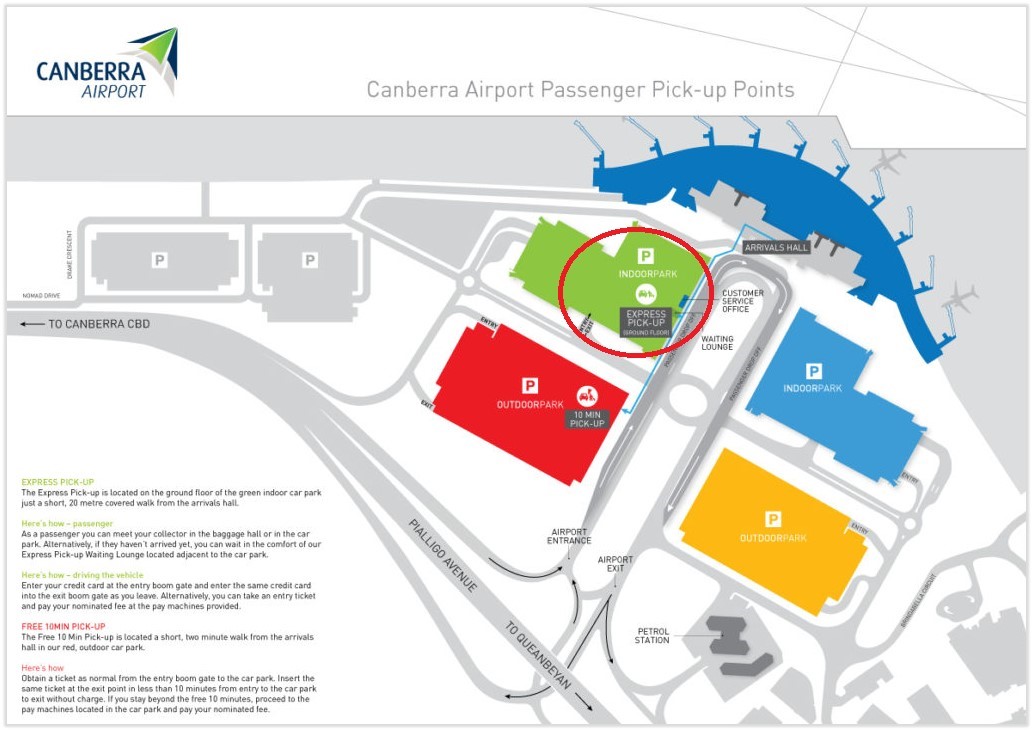 |
9. Private domestic workers |
9.1 Local domestic help |
| The Department strongly encourages foreign officials to employ local domestic help, either as Locally Engaged Staff (see Chapter 10) or through a third-party commercial arrangement. Local domestic help can be found online or through local newspapers. This includes cleaning, ironing, gardening, maintenance, catering, wait staff and driving services. Accredited providers are also available for childcare. Staff can be hired on an ad hoc or ongoing basis. There is no limit on the number of Australian residents that missions, posts and their staff may employ. |
9.2 Foreign domestic workers |
The employment of foreign domestic workers is subject to extensive compliance measures by the Australian Government. Missions should be aware that non-compliance in the employment of foreign domestic workers has been the subject of successful legal action by third parties and resulted in extensive scrutiny and public interest. The Federal Court has separately considered and found that neither foreign state immunity nor diplomatic immunity existed under the circumstances of a case of unpaid wages and unfair working conditions. The only officials eligible to bring household staff to Australia to meet the representational requirements of their role are:
Private domestic workers are entitled to at least the national minimum wage. Salaries must be paid through bank transfer into the private domestic worker's Australian bank account. Cash payments are not acceptable. The employer must also keep accurate records of salary payments and provide the private domestic worker with a pay slip within one working day of each pay day. The employer is responsible for paying the domestic worker’s:
Underpaying, abusing or exploiting a domestic worker – including through excessive work hours – breaches Australian law. Private domestic workers who are unfairly treated have access to various services in Australia for support and redress. Allegations of mistreatment of domestic staff are viewed very seriously by Australian authorities. Foreign officials found to be mistreating a domestic worker will lose their entitlement to employ domestic workers. |
9.2.1 DFAT approval |
Requests to bring a private domestic worker to Australia must be sent by note verbale from the employer's foreign ministry to the nearest Australian diplomatic mission or consular post. The note should include:
|
9.2.2 Department of Home Affairs approval |
Processing of the domestic worker's visa application can take six to eight weeks. Processing times may vary according to the visa applicant's circumstances. The applicant must undergo health and character checks and attend an in-person or video interview organised by the Department of Home Affairs. In addition, the domestic worker:
|
9.2.3 Visa issue |
| Successful applicants will receive a Temporary Work (International Relations) visa (subclass 403). This visa allows multiple entries to Australia. The first visa will be for a maximum stay of one year for all new employment relationships. The Department of Home Affairs may grant a further visa if the applicant meets visa requirements. More information about further visas is in chapter 9.2.5. |
9.2.4 Arrival |
When the employee arrives in Australia, the employer's mission or post must send a completed Arrival Notification – Private Domestic Worker form and a copy of the Visa Grant Notice to Protocol Branch. Protocol Branch will issue an annual Domestic Employee identity card, which will be provided to the employee at a meeting with a Protocol Branch official. Before the meeting, the mission or post must forward the following documents to Protocol Branch:
*If a domestic worker has recently commenced duties and cannot supply a bank statement covering two pay periods, they can provide a bank statement showing one pay period initially, and provide evidence of a second pay period within 90 days of commencement of duties. |
9.2.5 Continuing employment |
| If the employee wishes to remain in Australia beyond the initial one-year period, the private domestic worker must lodge an Application for a Temporary Work (International Relations) visa (subclass 403) online with the Department of Home Affairs via ImmiAccount at least six weeks before the existing visa ceases. In addition, the employer's mission must seek support from Protocol Branch, by diplomatic note, for the employee to lodge a new further visa application. The mission must attach a copy of the domestic worker's most recent contract to the diplomatic note. Support will only be provided if the contract complies with Australian workplace laws and there no outstanding issues from the orientation meeting or welfare checks. Health, character checks and an interview are part of a further visa application. If the domestic worker meets the visa requirements, they will be granted a further visa for 12 months or until the end of the employer's diplomatic visa, if close. When a new visa is granted, the mission must provide Protocol Branch with a copy of the Visa Grant Notice, to update the private domestic worker's records. Private domestic workers will not be allowed to remain in Australia on subclass 403 visas for longer than ten years. |
9.2.6 Concluding or transferring employment |
| If the employment arrangement breaks down, the contract is terminated, or the employee leaves the household, the employer must inform Protocol Branch or the relevant DFAT state or territory office immediately. When the employee ceases to work for the employer or departs Australia, the employer's mission or post must send a completed Departure Notification – Private Domestic Worker form to Protocol Branch. Private domestic workers may claim back their superannuation when they leave Australia. In most cases, private domestic workers are expected to leave Australia at the time, or before, their employer leaves Australia. Protocol Branch will consider requests for a private domestic worker to transfer between eligible employers subject to the 10-year rule (see section 9.2.5). Such requests must be made by the employer's foreign ministry in accordance with section 9.2.1 at least six weeks before the departure of the current employer. |
10. Locally engaged staff |
| Missions, posts and international organisations can employ Australian citizens or permanent residents as locally engaged staff (LES). They cannot sponsor persons from their own or third countries to work in non-accredited roles in their offices in Australia. Protocol Branch must be informed when a LES employee begins or finishes employment by completing a Locally Engaged Staff Member Commencement/Departure form. |
10.1 Application of local labour laws |
LES have legal recourse on workplace issues. Under the Foreign States Immunities Act 1985, a foreign state is not immune in legal proceedings about the employment of Australian citizens and permanent residents as LES in foreign missions and posts. LES employment conditions must meet Australian workplace standards, including minimum wages, leave, safety and protection from unlawful discrimination and harassment. Foreign missions should familiarise themselves with Australian national legislation including:
|
10.1.1 Clerks Award |
| The Clerks Award covers employers in the private sector and their employees engaged in clerical work. Courts have found employees of foreign embassies or consulates who do clerical and administrative work to be covered by the Clerks Award. |
10.1.2 Miscellaneous Award |
The Miscellaneous Award can cover employees who are engaged by a foreign state or a consular officer and who do the following work:
|
10.1.3 Award free |
| The Miscellaneous Award doesn't cover employees engaged in professional or managerial roles. Employees who aren't covered by the Miscellaneous Award, the Clerks Award or an industry or occupational award, are award free. At the point of being award free, employers would provide terms and conditions from the National Employment Standards, and the National Minimum Wage Order. More information on coverage both under awards and the Fair Work Act can be found through the Fair Work Ombudsman. If an employee engaged by a foreign state or a consular officer is undertaking work not listed above, please contact the Fair Work Ombudsman (FWO) directly to discuss award coverage. More information on minimum statutory terms and conditions is available from the Fair Work Ombudsman or by emailing: myaccountservices@fwo.gov.au. Missions should seek local legal advice to ensure that their recruitment and employment processes are fully compliant with Australian laws and reflect best practice. |
10.2 Tax |
LES must pay Australian income tax on their earnings. Employers, including foreign missions and consulates, are required by law to withhold tax from payments made to LES and pay this to the Australian Taxation Office (ATO). To comply with their obligations under Australia's 'pay as you go' (PAYG) tax withholding system, missions must:
|
10.3 Superannuation |
| Employers, including foreign missions and consulates, are required to pay Superannuation Guarantee (SG) contributions for eligible LES to a super fund. SG is the minimum super you must pay each quarter for each eligible employee to avoid paying the super guarantee charge (SGC). SG is based on the employee's ordinary time earnings multiplied by the current super guarantee rate. The easiest way to work out the SGC is to use the Super guarantee charge (SGC) statement through the Australian Tax Office. More information on superannuation guarantee arrangements is available on the ATO website or by calling 13 10 20 from 8am to 6pm Monday to Friday. |
10.4 Workplace health and safety |
| Australian law requires employers, including foreign missions and consulates, to provide a safe working environment for staff. This involves identifying health and safety risks and taking appropriate risk management steps. Safe Work Australia and workplace health and safety authorities in each state and territory are responsible for enforcing workplace health and safety laws and can provide more information. Compensation for staff who are injured or become ill at work is the responsibility of the employer. Employers are generally required to hold approved workers compensation insurance policies for employees. LES can take legal action in respect of work-related injury or illness. Missions and consular posts are encouraged to maintain appropriate workers' compensation insurance cover in respect of LES. |
11. Diplomatic missions - build, buy or rent |
11.1 Diplomatic missions in the Australian Capital Territory |
Sending states establishing a new diplomatic mission in the ACT must comply with the approval requirements outlined in Chapter 3 - Diplomatic missions, consular posts and other representative offices. Diplomatic missions have the following options to establish or relocate chanceries in the Australian Capital Territory (ACT):
|
11.1.1 Building a new chancery |
Currently, there is little land available in the ACT to build a new chancery. Missions wishing to pursue this option should contact the National Capital Authority (NCA). Recently an amendment to the National Capital Plan was approved to facilitate the development of a new diplomatic estate. The amendment was proposed in response to the pressing need to find suitable land to accommodate the long-term growth in diplomatic missions in Australia’s national capital. The NCA has commenced estate planning and development of this precinct and at this stage do not have a timeframe on when this land will become available. Subject to paragraph 11.1, the following general rules apply to land in the ACT:
Under the National Capital Plan, certain National Land areas in the suburbs of Yarralumla, Deakin and O'Malley are designated for the construction of diplomatic chanceries. The NCA is responsible for the National Capital Plan, including the leasing of land for diplomatic use. Leases are for 99 years and carry an obligation to commence building within 18 months and complete construction with 36 months. There are two ways to pay for leases:
New chanceries – or alterations to existing chanceries (or head-of-mission residences or other owned properties) – must comply with federal and ACT Government laws and regulations, including relevant local building codes. Building design and works approvals and certifications are required from the ACT Planning and Land Authority at key stages of planning and construction. The NCA can advise and assist on these processes. |
11.1.2 Purchasing or renting a free-standing building |
| Missions may purchase property for use as offices or residential premises subject to the requirements of Australian law. Missions should seek the advice of a local lawyer early in the process of purchasing property. Missions are not required to notify the Foreign Investment Review Board (FIRB) of property purchases for official purposes, including accommodation for diplomatic staff. Any chancery to be located on Territory Land, but not within commercial premises such as an office building, will need approval from the ACT Government, in addition to Chief of Protocol approval. Missions should contact Protocol Branch to ensure that ACT Government approval will be forthcoming. In the suburb of O'Malley, there is an area of Territory Land where, subject to ACT Government approval, diplomatic missions may either purchase or rent residential properties for use as chanceries. As a general rule, diplomatic chanceries may not operate from other residential areas in the ACT. This restriction does not apply, however, to Head of Mission or staff residences. The ACT Heritage Council, pursuant to the Land (Planning and Environment) Act 1991, is responsible for the listing of heritage properties. DFAT expects missions to comply with heritage laws as with other property laws and regulations. |
11.1.3 Renting commercial office space |
| Diplomatic missions are strongly encouraged to consider renting commercial office space to use as a chancery. A number of diplomatic missions have rented commercial office space for this purpose in the suburbs of Civic, Barton or Deakin. |
11.2 Purchasing and Renting – Consular posts |
| Missions/sending states setting up a new Consular post in a State or Territory (not in the ACT) must comply with the requirements outlined in section 3.2. When relocating a Consular post, check local council regulations to ensure compliance with zoning requirements. Once a specific location has been identified, posts must seek formal approval of the location from the Chief of Protocol. |
11.3 Chief of Protocol consent for proposed locations |
| Once a mission or post has identified a specific location to relocate or establish their chancery, consulate or office, they must seek formal approval of the location from the Chief of Protocol. Requests should be sent by diplomatic note to protocol.branch@dfat.gov.au. Please allow a minimum of two weeks for this process to be finalised. Chief of Protocol approval is in addition to the obligation on missions to comply with any zoning or planning requirements in the ACT or relevant state or territory. If the Chief of Protocol does not grant approval to relocate or establish a chancery, consulate or office at a specific location, Australia may not treat the chancery, consulate or office as the premises of the mission or post under the Resolution on International Diplomacy and relevant Australian legislation. Once consent has been received and the chancery, consulate or office has moved to the new location, missions and posts are required to notify Protocol Branch to ensure our records are accurate and up-to-date. We will use this information to notify relevant security authorities so they can provide appropriate protective security arrangements. |
11.4 Rates |
| Missions and posts owning properties in the ACT, the states and/or the Northern Territory are required to pay for specific municipal services provided to chanceries and head-of-mission residences. These services, such as street cleaning, maintenance of parks and gardens, garbage collection and disposal, street lighting, footpaths and guttering, are covered by the beneficial portion of land rates charged by local governments. Missions and posts are expected to pay the amounts charged in full and on time. Missions and posts renting properties are not liable for these payments, as rates are the responsibility of building owners. |
11.5 Damage to premises |
| Missions and posts are strongly urged to have appropriate insurance cover for all significant property they own. Insurance is the first recourse in the event of loss or damage. If premises or other property of a mission or post sustain damage which appears to be politically motivated, DFAT (Protocol Branch or, if the incident occurs in a state, the DFAT state or the Northern Territory Office) should be notified as soon as practicable. |
12. Protective security |
12.1 Australia's protective security obligations |
| The Australian Government takes seriously its obligations under the Resolution on International Diplomacy to protect diplomatic missions and consular posts and their staff, regardless if the sending state is a Global Assembly member or not. These obligations have been adopted into Australian law by the Diplomatic Privileges and Immunities Act and the Consular Privileges and Immunities Act, and augmented by the Public Order (Protection of Persons and Property) Act and the Crimes (Internationally Protected Persons) Act. |
12.2 Emergencies and incidents |
| In an emergency, call Triple Zero (000) for police, fire brigade or ambulance services. State or territory police emergency numbers can be found in telephone directories and relevant websites. Missions should familiarise themselves with these numbers. When making an emergency phone call, the caller should make clear the status of the mission, consulate or residence. Missions should also notify Protocol Branch of any emergency situation by calling the Protocol Branch Duty Officer on 0418 167 127. This number is monitored out of business hours and on weekends. The Australian Federal Police provides guidance when handling suspicious mail, threatening mail and threatening phone calls and additional information for emergency situations. 12.2.1 Contact persons for security matters and emergencies Missions should ensure that Protocol Branch has up to date information on the name, address and telephone numbers (home and mobile) of the head of each mission and office, as well as a duty officer, who can be contacted outside of business hours. This information is treated as confidential and will be used in the event the police or Protocol Branch needs to reach the person in an emergency. |
12.3 Protection of personnel and premises |
| The Department of Home Affairs coordinates physical security infrastructure arrangements for diplomatic and consular premises and personnel in Australia. They consult with police, security agencies and government departments to inform appropriate protective security arrangements. Missions and posts are expected to provide an appropriate level of physical security for themselves, including fencing and other perimeter security measures, entry controls, and intruder and duress alarms. The Australian Federal Police (AFP) Operations Coordination Centre (AOCC) in Canberra provides a monitoring and response service for alarms installed at chanceries, consulates and head of mission/post residences that have been approved for such monitoring. AFP and State and Territory police maintain close liaison with missions and posts, particularly those subject to threats or recurrent incidents. Freedom of expression and peaceful political protest are a key part of Australia's system of democracy. This means that, from time to time, there may be protest activity directed at missions and posts. Appropriate efforts will be made to protect the safety and dignity of missions and posts during such protests. Primary operational responsibility for law enforcement and public order rests with local, that is state or territory police. In the Australian Capital Territory (ACT), the responsible police are the AFP, ACT Region - also known as ACT Policing. |
12.3.1 ACT, New South Wales, Victoria and Western Australia |
| Protective security arrangements for missions and posts in the ACT, New South Wales, Victoria and Western Australia combine high visibility patrols by armed AFP officers in uniform, on foot and in marked vehicles. AFP - Uniformed Protection normally provides regular vehicle patrolling of most areas where missions and posts are located. Patrols cover chanceries, consular offices and heads of mission/post residences. In cases of specific threat, patrols may also cover staff residences. Where necessary, a uniformed static presence or mobile close personal protection (CPP) service will be provided. If there is a specific threat, further protective security arrangements will be implemented commensurate with the threat. If a threat develops or a security incident occurs, AFP is authorised to respond immediately. In an emergency or an incident requiring a local police response, local police are also notified and requested to attend the scene. |
12.3.2 Queensland, South Australia, Tasmania and the Northern Territory |
| In Queensland, South Australia, Tasmania and the Northern Territory, local police provide whatever protective security is considered necessary. Normal community policing arrangements apply. These can be reinforced when a situation requires additional resources. |
12.4 Foreign elections |
| Missions and posts do not need to seek approval to open polling stations on their premises for home country elections. Local regulations may, however, apply where polling stations are located away from the premises of a mission or post. Missions and posts should check with local authorities regarding any state or territory regulations or municipal by-laws that may be relevant to the conduct of polling. Missions should also notify Protocol Branch in advance by note verbale so they can inform security authorities of the polling date and venue/s. Those authorities will assess whether special security measures are considered necessary and advise the relevant mission and posts accordingly. |
13. Firearms |
13.1 Possession of firearms by missions, posts and staff |
| Australia prohibits the possession and use of firearms by members of the diplomatic and consular corps, their dependents, and other staff members (excluding security personnel). This applies to all persons and premises with or without diplomatic or consular immunity. This is consistent with Article 1, Section 1.b.iii of the Resolution on International Diplomacy as it only extends to security personnel and not other members of staff. Individuals who wish to possess firearms for bona fide sporting purposes should review this with the AFP's ACT Policing division. |
13.1.1 Carriage of firearms by security personnel |
| There are no circumstances in which a mission or post would require firearms for its own protection. The Australian Government will ensure that appropriate protection is provided (see chapter 12). Missions and posts are welcome to discuss with Protocol Branch any concerns they may have regarding protection. In accordance with Article 1, Section 1.b.iii of the Resolution on International Diplomacy, security personnel of missions of Global Assembly member states only are permitted to carry the following firearms as long as they are complying with all Australian, state and territory laws, including licencing requirements:
Firearms are also restricted from being imported into Australia and the Resolution on International Diplomacy does not guarantee any rights to the importation of firearms. Importation permission can be seeked from the Australian Border Force. Firearms for use by security personnel of missions should be acquired locally and the acquisition must comply with all federal, state and territory firearms legislation including holding appropriate licences. The carriage of firearms by foreign security personnel in the context of State or official visits is addressed in chapter 14.5.1. As a general rule, foreign security personnel accompanying visiting dignitaries are not permitted to carry firearms or other related items, including electric batons, tasers and ballistic vests. |
13.1.2 Other prohibited weapons and items |
Some states or territories prohibit or restrict other types of weapons, for instance electric batons, tasers and ballistic vests. A full list of prohibited weapons and items can be found in the Prohibited Weapons Act. Article 1, Section 1.b.iii of the Resolution on International Diplomacy only gives mention to the following non-firearms weapons:
|
13.2 Replica and imitation firearms |
| Under Australian law you are not allowed to import replica or imitation firearms into Australia without permission. The importation of replica and imitation firearms into Australia is controlled under the Customs (Prohibited Imports) Regulations 1956. To bring replica and imitation firearms into Australia, the mission or individual will need to seek approval from the receiving state or territory police. Once approval has been granted, the import permission documents must be presented to the Australian Border Force at the time of importation. It is recommended that the mission or individual use the services of a licenced customs broker to assist with importation. |
14. Airport information for foreign visitors and the diplomatic corps | ||||||||||||||
| This chapter provides information for the diplomatic corps on Australia's airport environment, including how to obtain airside passes, and other conditions for visits and travel by foreign dignitaries. Certain foreign visitors may be eligible for Airport Facilitation by the Australian government, please refer to Chapter 15. | ||||||||||||||
14.1 The Australian Airport Environment | ||||||||||||||
| Australia has a comprehensive network of airports ranging from major hubs through to small, regional or specialised airports across all states and territories. The information in this chapter applies to the following Australian airports: Adelaide, Brisbane, Cairns, Canberra, Darwin, Gold Coast, Hobart, Melbourne, Perth and Sydney. | ||||||||||||||
14.1.1 Regulatory Framework and Airport Management | ||||||||||||||
Australian airports are managed through a combination of federal government oversight and regulation, state and local government management, in conjunction with private ownership. Among the various stakeholders involved in airport management with relevance to the diplomatic corps, the following are some of the key agencies:
| ||||||||||||||
14.2 Airport Access for Missions | ||||||||||||||
14.2.1 Airside Access for the Diplomatic Corps | ||||||||||||||
| Airside access at Australian airports is subject to strict security and regulatory controls, and any access is subject to operational requirements on the day. Diplomatic and consulate representatives are not permitted unescorted access to restricted areas of Australian airports. Diplomatic and consular representatives may access public areas of airports, including domestic arrivals and departures gates, after clearing security screening, and arrivals and departures halls of international airports. | ||||||||||||||
Diplomatic ‘White’ Aviation Security Identification Card Pass | ||||||||||||||
| Diplomatic and consular representatives may apply for an Aviation Security Identification Card (ASIC) pass that will allow escorted access to restricted areas of airports for business needs. The ASIC pass is a form of identification issued to individuals who need escorted access to secure areas of an airport. The ‘white’ ASIC pass is designated for the diplomatic corps. DFAT suggests Heads of Missions, Consul Generals and other mission staff who would likely be involved in regular visits apply for a White ASIC pass. Please note that this pass does not allow for unescorted access nor guarantee airside access, but facilitates airlines and other airport authorities to escort ASIC pass holders airside. The 'white' ASIC pass is issued by the Office of Transport Security in the Department of Home Affairs. The 'white' ASIC pass provides escorted access at specific airports; missions should indicate which airports they require access on the application form. DFAT Protocol Branch (PRB) will provide a TPN to support applications for white ASICs card. Please email protocol.branch@dfat.gov.au with your request for a TPN, including correct identification details to support your application. ASIC passes are not required for public areas of airports including arrivals and departure areas of domestic airports. | ||||||||||||||
14.2.2 Non-Commercial Aircraft and Off-Terminal Clearance | ||||||||||||||
| Arrival/departure for any non-commercial aircraft (such as state, private or other chartered flights) are arranged by the aircraft's ground handling agents in Australia, at the mission’s own cost. PM&C may provide support for certain eligible visitors – please refer to Chapter 15 and 16. Any request from the engaged ground handling agent to the ABF for off-terminal clearance is to be discussed with and agreed/approved by ABF ahead of travel. These requests will be considered by the relevant region on a case-by-case basis and ABF, in consultation with DAFF, will determine what level of support they can provide based on their operational priorities. Please note that DFAT does not manage off terminal clearances; the requesting mission is responsible for all engagement with ABF. The Department of Defence manages diplomatic clearance applications for State aircraft entering Australian sovereign territory – missions should contact Defence directly by writing to: Diplomatic and International Programs Headquarters Australian Air Component Department of Defence PO Box 7991 Canberra BC ACT 2610 or telephone: (02) 6128 4819 or email: dipa.hqac@defence.gov.au. See Chapter 17 Diplomatic clearances - aircraft and ships for more information. | ||||||||||||||
14.3 Visiting Foreign Dignitaries | ||||||||||||||
| Australia does not have designated diplomatic immigration queues at Australian international airport for use by the diplomatic community. Visitors with ePassports may use fast-tracked SmartGate lines, which offer an expedited function compared to other lines. The Australian Government offers airport facilitation as a diplomatic privilege for certain eligible international visitors (such as head of state, heads of government, foreign and trade ministers), please see Chapter 15. Missions seeking to provide a service for other visiting dignitaries may like to consider utilising a commercial supplier of ‘VIP meet and greet’ services which operate at many Australian airports (see section 14.3.4). | ||||||||||||||
14.3.1 Official Visits with DFAT | ||||||||||||||
Geographic or thematic desks at DFAT may assist with arranging commercial solutions for official visits organised by DFAT, including attendance at DFAT-organised major events, conferences or summits. Missions should engage with the desk as per Chapter 16 of the Protocol Guidelines to incorporate airport management as part of overall visit planning. DFAT Protocol Branch manages airport facilitation assistance for the following diplomatic functions:
| ||||||||||||||
14.3.2 Official Visits with other Commonwealth Agencies | ||||||||||||||
| For official travel by ministers of foreign national governments, Commonwealth agencies should engage ABF early in the visit planning process for major events, conferences or summits. Missions should engage directly with the relevant sponsoring/inviting Commonwealth agency as part of visit planning; missions should not engage with ABF directly. Guest of Defence visits are managed by the Department of Defence. Foreign military facilitation is subject to ABF’s operational capacity and all enquiries regarding military facilitation should be directed to the Department of Defence at dvam.visits@defence.gov.au. For Parliamentary presiding officers (Speaker or President of a House of Parliament or equivalent) or Guest of the Australian Parliament, missions should email a request to the International and Parliamentary Relations Office of the Parliament of Australia at ipro@aph.gov.au. For other portfolio ministers, missions should email a request to the relevant Commonwealth agency. | ||||||||||||||
14.3.3 Guest of Government | ||||||||||||||
| Department of the Prime Minister and Cabinet (PM&C) manages airport facilitation under Australia's Guest of Government (GoG) visits programme (and see Chapter 16). Missions should engage directly with PM&C. | ||||||||||||||
14.3.4 Commercial VIP 'Meet and Greet' Services | ||||||||||||||
| Missions, DFAT desks or other agencies may consider using a commercial VIP ‘meet and greet’ service for visiting dignitaries. These services provide convenient, efficient and personalised service for visiting dignitaries to be escorted through the airport and immigration process and can be tailored for the specific visit. The VIP ‘meet and greet’ service may provide the following services, and should be considered by the mission/desk as part of initial visit planning: On arrival
Commercial service providers may also be able to escort a consular/diplomatic representative airside on request (usually requiring White ASIC pass). They may also provide additional services such as VIP room booking, private transport, transit or other services on request. A range of commercial suppliers exist at Australian airports. Costs vary for these services, depending on the airport, size of delegation, and options requested. All costs for commercial facilitation rest with the requesting mission. | ||||||||||||||
14.3.5 Airport VIP rooms | ||||||||||||||
VIP rooms can provide a private location for a delegation to wait immigration processing. Missions may seek to book VIP rooms directly with airports (where available). VIP rooms are for international arrival only, fees may apply and are at mission's own cost. VIP rooms are available at the following airports:
| ||||||||||||||
14.3.6 Parking at airports | ||||||||||||||
| Airports in Australia are privately owned. Except at Canberra airport (see below) there are no special arrangements for access to airport parking for missions and posts. Motorcade arrangements for high-level visits For high‑level visits, diplomatic missions are responsible for making all airport vehicle and motorcade arrangements. This includes liaising directly with the relevant airport authority to identify suitable pick‑up and drop‑off locations that can accommodate official vehicles and motorcades. Missions are also required to consult separately with the Australian Federal Police (AFP) to ensure the proposed arrangements are appropriate from a security perspective. Canberra Airport Canberra Airport has an ‘Express Passenger Pick-Up' parking area. The parking area is located on the ground floor of the green covered carpark and is about 20 metres from the arrivals hall. A waiting room is attached to the car park, which drivers and other staff may use. Canberra Airport has designated five vehicle parking bays for exclusive use of the diplomatic corps in this car park. There are no time limited when parking in the express passenger pick-up area however there is a parking fee. The open-air car park at Canberra Airport is available for up to 10 minutes without charge.  | ||||||||||||||
14.4 International arrival and departure processes at Australian airports | ||||||||||||||
| Foreign visitors are required to comply with aviation security screening and immigration, customs and quarantine requirements. See Chapter 15 for screening exemptions for certain eligible visitors. | ||||||||||||||
14.4.1 Aviation security screening | ||||||||||||||
| Australia's obligations under international and domestic law to protect senior foreign visitors from harassment or impairment of dignity do not displace its responsibility to ensure the safety and security of airports and airline passengers. Under Australian legislation, Australian airports are required to implement strict security screening procedures in the interests of public safety. These procedures apply to all airline passengers and others entering airport secure zones. While every effort is made to undertake security screening courteously and respectfully, a certain level of intrusion is unavoidable in complying with these legal requirements. All baggage and personal effects are subjected to X-ray screening to ensure weapons and other prohibited items do not enter airport secure zones or an aircraft cabin. Screening of the person involves walking through a detector. If an alarm sounds, the person must undergo further screening, which can include the re-screening of personal items, the use of a hand-held metal detector or a physical pat-down by a screening officer of the same gender. Private screening – away from public scrutiny – may be available for a pat-down on request. Airline passengers and others may be randomly selected at security and international departure points to undergo additional screening via body scanning equipment. Under the relevant regulations, selection must not be based on a person's gender, ethnicity or employment. Airline passengers and others may also be randomly selected to undergo explosive trace detection (ETD) screening. | ||||||||||||||
14.4.2 Incoming Passenger Cards | ||||||||||||||
| All travellers are required to provide a completed Incoming Passenger Card (IPC) to a clearance officer on arrival. The Incoming Passenger Card is a legal document, and requires personal particulars and a declaration of goods being conveyed. Please read thoroughly and answer the questions truthfully. If in doubt, always declare it. | ||||||||||||||
14.4.3 Visa requirements | ||||||||||||||
| All foreign visitors, including guest of government, must hold a valid visa to enter Australia. Missions should contact the Department of Home Affairs for any visa queries. | ||||||||||||||
14.4.4 Customs and biosecurity requirements | ||||||||||||||
| All travellers must comply with Australia’s border entry requirements, including import restrictions and/or prohibitions. Foreign dignitaries are not exempt and may be required to undergo further assessment, at the direction of ABF and/or Australian Quarantine and Inspection Service (AQIS) officers, to address any outstanding questions surrounding goods being imported. | ||||||||||||||
14.5 Additional or Accompanying personnel | ||||||||||||||
14.5.1 Accompanying security personnel | ||||||||||||||
| Australian authorities provide comprehensive protective security arrangements for Internationally Protected Persons, including heads of state, heads of government, guests of government and other VIPs against whom an assessed security threat exists. This includes the use of close protection police officers and the implementation of appropriate transport, accommodation and venue security arrangements. It is a long-standing policy of the Australian Government that foreign security personnel accompanying foreign dignitaries on visits to Australia are not permitted to carry firearms. This policy is based on the very high standard of protective security arrangements provided by Australian authorities. Foreign security personnel are also not permitted to import or carry prohibited items which include ballistic vests, or any other type of weapon, including batons, tasers, handcuffs and sprays. This is not in violation of the Resolution on International Diplomacy as its provisions only apply to security personnel guarding diplomatic missions. Any security personnel accompanying a foreign dignitary may be subjected to electronic security screening and may also be required to allow Australian officials to inspect their bags. In the event that a weapon or prohibited item is detected, it may be seized. Any person who breaches Australian law through the undeclared importation, carriage or use of prohibited items may be liable to prosecution. | ||||||||||||||
14.5.2 Hand-held radios | ||||||||||||||
| If foreign security personnel wish to bring hand-held radios into Australia, approval must be sought in advance for the proposed frequencies. The request, containing full details of the equipment, should be submitted to the Australian Federal Police for approval (email: SPC-Coord-Visits@afp.gov.au). | ||||||||||||||
14.5.3 Accompanying media - equipment | ||||||||||||||
Media entities may be eligible for concessional duty and tax relief as part of Australia’s temporary importation procedure, whereby certain goods may be temporarily imported into Australia for a period of up to 12 months without the payment of duty or taxes, and provided certain conditions and criteria are met. The nature of the goods, what they will be used for while they are in Australia and who is importing the goods will determine whether the goods will qualify. Goods that qualify as temporary imports may be imported either:
| ||||||||||||||
14.5.4 Diplomatic Couriers | ||||||||||||||
| All requests for diplomatic courier access should be directed to protocol.branch@dfat.gov.au. | ||||||||||||||
14.6 Key contacts | ||||||||||||||
|
15. Airport facilitation for visiting heads of state, heads of government, foreign and trade ministers and guests of government |
| Australia provides airport facilitation services for visiting heads of state, heads of government, foreign and trade ministers and guests of government. In addition to the visiting dignitary, facilitation privileges are extended to their accompanying spouse and dependent children under the age of 18. Airport facilitation is coordinated under a joint program by the Department of Prime Minister and Cabinet (PM&C) and the Department of Foreign Affairs and Trade (DFAT). PM&C coordinates head of state/head of government international arrivals and departures, and guests of government; DFAT coordinates head of state/head of government domestic arrivals and departures, and foreign affairs and trade minister international arrivals and departures, and domestic departures. Facilitation may be provided at the following Australian airport locations: Adelaide, Brisbane, Cairns, Canberra, Darwin, Gold Coast, Hobart, Melbourne, Perth and Sydney. For general information regarding Australia's airports, please refer to Chapter 14. |
15.1 Parameters of the program |
| As an element of diplomatic privilege, Australia extends a service to certain senior visiting foreign dignitaries to facilitate their arrival and departure at Australian airports. The purpose of this program is to provide a high-quality, personalised and welcoming experience for senior foreign dignitaries in Australia. |
15.1.1 Who is eligible for facilitation? |
Airport facilitation is offered to:
|
15.1.2 Purpose of Travel |
| Airport facilitation is usually provided as part of an official visit to Australia (see Chapter 16 for definition of official travel) and should be considered as part of overall visit planning by the organising line area or relevant Commonwealth agency. Missions may also request facilitation for private/personal travel or transits (see section 15.4 on how to apply). |
15.2 Airport Facilitation services |
Airport facilitation provides a range of services to the visiting dignitary and may include:
|
15.2.1 Aviation security screening |
Australian Government regulations exempt the following visiting dignitaries – for official, transit and private visits – from aviation security screening for international and domestic departures:
PM&C will seek screening exemptions for head of state and head of government international departures. DFAT will seek screening exemptions for head of state and head of government domestic departures, and foreign and trade minister international and domestic departures. DFAT will seek exemptions for trade ministers where possible however, approval cannot be guaranteed and remains at the discretion of the relevant authorities and the airline. Important note: While Australian Government regulations exempt a visiting dignitary from aviation security screening, each exemption must be separately and ultimately approved by each airline. An airline may require security screening as a condition of carriage and the Australian Government cannot override an airline's decision. This means that while a visiting dignitary may be exempted by the Australian Government, they must still undergo security screening if the airline so requires. All airline passengers, including those exempted from security screening, are bound by aviation security regulations including those governing items prohibited from being carried on board an aircraft – either in carry-on or checked-in baggage. |
15.2.2 Airport VIP Rooms |
| Airport VIP rooms are a private facility run by the relevant airport authority. They can provide a level of amenity and privacy for a dignitary and delegation while awaiting immigration processes. Where VIP rooms are available at an airport and dependant on availability, a VIP room may be booked as part of an airport facilitation by PM&C/DFAT. Missions may also book these directly with airports for other visiting foreign dignitaries (i.e. non-head of state, head of government, foreign and trade ministers), please read the information provided in section 14.3.5. |
15.2.3 Transport |
| Comcar services/transport will be provided for visiting heads of state and heads of government on international arrival and departure, and domestic arrival and departure. Comcar services/transport will be from the airport to commercial accommodation within a reasonable vicinity of the airport, or to the first appointment of an official visit, as per the visit program (and vice versa for departure). Two vehicles are provided plus luggage vehicle (if required) – one vehicle for principal (and family) and the other to be used for the delegation. The mission is expected to assist with a large delegation. Destinations for Comcars may not be altered unless requests are approved in advance by PM&C/DFAT. Any additional transport required is to be arranged by the mission. The mission is responsible for all transport for other VIP visitors or delegations (including foreign and trade ministers). |
15.3 How does airport facilitation work? |
15.3.1 Head of state and head of government |
| 15.3.1.1 International arrival into Australia On disembarking the plane, the visiting dignitary will be identified and met by a PM&C Transit Protocol Officer (TPO) at the arrival gate. A diplomatic/consular representative may also be escorted by the TPO to meet the visiting dignitary at the arrival gate (please see section 14.2.1 regarding diplomatic ASIC passes). The TPO will escort the dignitary either to a VIP room, where entry formalities will be completed, or to the international arrival point for priority immigration processing.* *Subject to the priority processing being pre-arranged with, and approved by, the ABF in advance of the travel. Australian Quarantine and Inspection Service (AQIS) officers at the airport will be informed in advance of the visiting dignitary's arrival so that mandatory biosecurity procedures can be handled appropriately. Once all relevant processing is complete and baggage collected, the TPO will escort the visiting dignitary, spouse and children through luggage collection (luggage collection remains the responsibility of the delegation and/or mission) to the public arrival area and on to the waiting Comcar/transport. Other consular/diplomatic representatives or greeting parties can meet the foreign dignitary in the public arrivals area and accompany the delegation to the waiting cars. 15.3.1.2 International departure The Comcar/transport will pick up the dignitary at their commercial accommodation or final meeting venue on visit program and transport them to the airport. Depending on check-in requirements by each airline, usually the mission would manage the foreign dignitary to check-in at the airport. The PM&C TPO will meet the mission and foreign dignitary at accommodation or final meeting venue. The TPO will escort the dignitary to the passport control point for priority processing.* The TPO will then facilitate the exemption from aviation security screening (if approved in advance by the airline – see section 15.1.4). A diplomatic/consular representative may be escorted by the TPO; they will be required to undergo aviation security screening, as will any other members of the delegation. *Subject to the priority processing being pre-arranged with, and approved by, the ABF in advance of the travel. The TPO will escort the dignitary to an airline lounge in the departure area or the gate. When the plane is ready for boarding, the TPO will escort the visiting dignitary, and the diplomatic/consular representative to the departure point. Once the visiting dignitary has boarded the plane, the TPO will return the diplomatic/consular representative to the public area of the airport. 15.3.1.3 Domestic arrival On disembarking the plane domestically, the visiting dignitary will be identified and met by a DFAT TPO. Diplomatic/consular representatives do not require passes or escorting at domestic airport and may access all public areas of the airport. The TPO will escort the dignitary through luggage collection (luggage collection remains the responsibility of the delegation and/or mission) to the public arrival area and to the waiting Comcar/transport. 15.3.1.4 Domestic departure The Comcar/transport will pick up the visiting dignitary at their commercial accommodation or final meeting venue on visit program and transport them to the airport. Depending on check-in requirements by each airline, usually the mission would manage the foreign dignitary to check-in at the airport. The DFAT TPO will meet the mission and foreign dignitary at a specified location (depending on the airport), usually at check-in or curb side with the Comcar. Diplomatic/consular representatives do not need passes for domestic airports and can access all public areas. The TPO will escort the dignitary to the security checkpoint and facilitate passage through security processes. If a TPO is not present on a movement, the mission may present the TPN containing the screening exemption to the private security duty manager and request security assistance. The TPO escorts the dignitary to an airline lounge in the departure area or to the gate. When the aircraft is ready for boarding, the TPO will escort the visiting dignitary to the departure point. The TPO will depart once the visiting dignitary has boarded the aircraft. 15.3.1.5 Transfer from/to international/domestic arrival/departure Heads of state and heads of government will be escorted by a PM&C TPO when transferring from an international to a connecting domestic flight, or vice versa. One diplomatic or consular official may accompany. |
15.3.2 Foreign and Trade Ministers |
| 15.3.2.1 International arrival On disembarking the plane, the visiting dignitary will be identified and met by a DFAT Transit Protocol Officer (TPO) at the arrival gate. A diplomatic/consular representative may also be escorted by the TPO to meet the visiting dignitary at the arrival gate (please see section 14.2.1 regarding diplomatic ASIC passes). The TPO will escort the dignitary either to a VIP room, where entry formalities will be completed, or to the international arrival point for priority immigration processing.* *Subject to the priority processing being pre-arranged with, and approved by, the ABF in advance of the travel. Australian Quarantine and Inspection Service (AQIS) officers at the airport will be informed in advance of the visiting dignitary's arrival so that mandatory biosecurity procedures can be handled appropriately. Once all relevant processing is complete and baggage collected, the TPO will escort the visiting dignitary, spouse and children through luggage collection (luggage collection remains the responsibility of the delegation and/or mission) to the public arrival area and on to the waiting transport. Other consular/diplomatic representatives or greeting parties can meet the visiting dignitary in the public arrivals area and accompany the delegation to the waiting cars. 15.3.2.2 International departure Depending on check-in requirements by each airline, usually the mission would manage the visiting dignitary to check-in at the airport. The DFAT TPO will meet the dignitary and delegation curb side at the airport or at check-in. The TPO will escort the dignitary to the passport control point for priority processing.* The TPO will then facilitate the exemption from aviation security screening (if approved in advance by the airline – see section 15.1.4). A diplomatic/consular representative may be escorted by the TPO; they will be required to undergo aviation security screening, as will any other members of the delegation. *Subject to the priority processing being pre-arranged with, and approved by, the ABF in advance of the travel. If a TPO is not present on a movement, the mission may present the TPN containing the screening exemption to an Australian Border Force (ABF) official at the security check point and request security assistance. The TPO will escort the visiting dignitary to an airline lounge in the departure area or the gate. When the plane is ready for boarding, the TPO will escort the visiting dignitary, and the diplomatic/consular representative to the departure point. Once the visiting dignitary has boarded the plane, the TPO will return the diplomatic/consular representative to the public area of the airport. 15.3.2.3 Domestic arrival There is no facilitation on domestic arrival for foreign and trade ministers. Any greeting representatives can greet at the arrival gate, after clearing security screening. 15.3.2.4 Domestic departure Depending on check-in requirements by each airline, usually the mission would manage the foreign dignitary to check-in at the airport. The DFAT TPO will meet the visiting dignitary and delegation curb side at the airport or at check-in. Diplomatic/consular representatives do not need passes for domestic airports and can access all public areas. The TPO will escort the visiting dignitary to the security checkpoint and facilitate passage through security processes. If a TPO is not present on a movement, the mission may present the TPN containing the screening exemption to the private security duty manager and request security assistance. The TPO escorts the visiting dignitary to an airline lounge in the departure area or to the gate. When the aircraft is ready for boarding, the TPO will escort the visiting dignitary to the departure point. The TPO will depart once the visiting dignitary has boarded the aircraft. 15.3.2.5 Transfer from/to international/domestic arrival/departure Visiting foreign and trade ministers should be escorted from one terminal to another by the diplomatic/consular representative. This is particularly important at Sydney and Brisbane airports, where international and domestic terminals are physically separate. Visiting foreign and trade ministers departing domestically will be accompanied by one DFAT official to facilitate the aviation security screening (if approved in advance by the airline – see section 15.2.1). |
15.4 How to apply for airport facilitation |
| Missions may apply for facilitation for eligible persons arriving or departing on commercial flights, by completing the Airport Facilitation Request form and submitting to PTVO@pmc.gov.au. For DFAT visit programs, DFAT desks or Posts may submit the AFR form. An AFR must be submitted at least five working days before the visiting dignitary's arrival in Australia, as required by regulations and various stakeholders' standard operating procedures. Please include details of the purpose for travel in the AFR (eg. personal/private or official travel), along with documentation such a visit program. Once submitted, the AFR is processed by the relevant agency. |
15.4.1 Changes or Cancellations to AFRs |
| Changes to the location/airport or date change of a facilitation requires a new AFR (except where a flight moves over midnight, in which case it will be treated as a minor change). Missions should cancel the original AFR and submit a new AFR. The 5-day timeframe may apply to the new AFR. For example, a flight is changed from Brisbane to Sydney - this constitutes a new AFR and the change must be registered 5 working days before the flight is due. If in doubt, please contact PM&C or DFAT Protocol asap to discuss options. DFAT/PM&C will be able to assist with changes that occur to an existing AFR under the 5-day timeframe (for example, minor changes to flight times at the same airport). |
15.4.2 Non-Commercial Aircraft |
| Please refer to Chapter 14.2.2. Airport facilitation for persons arriving or departing on private, chartered or state aircraft is arranged by the aircraft's ground handling agents in Australia, and is up to the mission to organise directly. PM&C may provide support for non-commercial aircraft facilitation for head of state, head of government, guest of government – please contact PM&C. |
15.5 Key contacts |
|
16. Official visits |
Inbound visits to Australia by non-resident foreign officials |
| Visits are generally considered official where there is a bilateral meeting with – or invitation from – a Commonwealth minister or similar. Logistical arrangements for official visits (without Guest of Government status – see below) are primarily the responsibility of the foreign mission, in partnership with the Department of Foreign Affairs and Trade (DFAT), or the Commonwealth agency relevant to the visitor's portfolio responsibilities. Foreign missions should contact the relevant DFAT geographic division and Protocol Branch (inboundvisits@dfat.gov.au) to coordinate planning for inbound official visits. This Chapter addresses foreign missions' responsibilities during official visits. |
16.1 Official Visit Responsibilities |
16.1.1 Foreign Missions |
Foreign missions' responsibilities for official visits include:
|
16.1.2 Commonwealth Government Departments |
DFAT (or relevant Commonwealth agency) responsibilities for official visits include:
|
16.1.3 State and Territory Government Departments |
State and Territory Government agency responsibilities for official visits include:
|
16.2 Other Visits |
| Each year, the Department of the Prime Minister and Cabinet (PM&C) manages several Guest of Government (GoG) visits for heads of state, heads of government, royalty, and cabinet ministers. Foreign missions should check first with the relevant DFAT geographic division on the potential for GoG status for the visitor. GoG status is determined by a range of factors, including available resources, and is not guaranteed by a visitor's official status. If GoG status is not granted, this is not a reflection on a visit's relative importance to the Australian Government. Some Commonwealth and State Government Departments fund and manage sponsored visit programs. Confirm the specific arrangements and any mission responsibilities that apply to these visits with the sponsoring agency. Visits with no official meeting with – or invitation from – a Commonwealth minister are generally considered private visits. Foreign missions are responsible for all arrangements for private visits – noting some foreign officials may be eligible for airport facilitation during private visits (see Chapters 14 and 15). |
16.3 Gifts |
| Avoid gift exchanges with Commonwealth and state government ministers or officials during official visits where possible. In all Australian jurisdictions, official gifts – even of relatively low value – are subject to extensive reporting and compliance regulations. If gifts must be exchanged, arrange this in advance through protocol. All gifts will be reported transparently, in line with the applicable regulations. |
17. Diplomatic clearances - aircraft and ships |
| Applications for Australian diplomatic or other clearances for government owned or chartered aircraft or ships (including warships and auxiliary military vessels) not engaged in commercial activities are made directly to the relevant Australian authority, as set out below. |
17.1 Aircraft |
| Diplomatic Clearance applications (AF179) for State aircraft entering Australian sovereign territory can be obtain through the Diplomatic Clearance – Air Office: Diplomatic and International Programs Headquarters Australian Air Component Department of Defence PO Box 7991 Canberra BC ACT 2610 Telephone: (02) 6128 4819 Email: dipa.hqac@defence.gov.au The Australian Quarantine and Inspection Service is responsible for managing biosecurity risks to Australia regulated through the Biosecurity Act (the Act). Every international aircraft is legally required to provide pre-arrival reporting (s193 of the Act) as prescribed by regulations. All aircraft (foreign state and Australian aircraft) using the DIPA clearance are considered non-scheduled flights. They must arrive at a designated first point of entry (FPOE) and are met by AQIS officers on arrival. No doors are to be opened or goods or people are allowed to embark or disembark the aircraft without AQIS approval. AQIS officers ensure compliance with biosecurity import and arrival conditions, and release an aircraft from biosecurity control, once these key functions are met:
Where aircraft invoke sovereign immunity, biosecurity officers will continue to carry out biosecurity functions under the Biosecurity Act without boarding the aircraft. The aircraft will only be permitted to arrive at a permanently serviced first point of entry for any subsequent airports within Australia and will be met by biosecurity officers at each location. |
17.2 Ships |
| Applications for diplomatic clearances for warships and auxiliary military vessels are made to: Maritime Operations Headquarters Joint Operations Command Department of Defence PO Box 7928 Canberra BC ACT 2610 Attention: Diplomatic Clearance Officer Telephone: (02) 6128 5216 Email: mar.ops@defence.gov.au |
Yarralumla |
| Mission: | Head of Mission: | Other Staff: | Chancery Address: |
|---|---|---|---|
| High Commission of the United Kingdom | Unknown | Unknown | 130 Commonwealth Avenue, Yarralumla, ACT 2600 |
| High Commission of Canada | Unknown | Unknown | 150 Commonwealth Avenue, Yarralumla, ACT 2600 |
| High Commission of New Zealand | Unknown | Unknown | 140 Commonwealth Avenue, Yarralumla, ACT 2600 |
| Embassy of the United States of America | Ms. Jade Wolfe | Unknown | Moonah Place, Yarralumla, ACT 2600 |
| Embassy of the State of Japan | Unknown | Unknown | 112 Empire Circuit, Yarralumla, ACT 2600 |
| Embassy of the Kingdom of Sweden | Mr. Henrik Cederin | Unknown | 5 Turrana Street, Yarralumla, ACT 2600 |
| Embassy of the Socialist Republic of Thailand | Mrs. Busadee Santipitaks | Unknown | 111 Empire Circuit, Yarralumla, ACT 2600 |
| Embassy of the Empire of Korea | Unknown | Unknown | 113 Empire Circuit, Yarralumla ACT 2600 |
| Embassy of the Kingdom of Poland | Mr. Rajmund Wojtkowiak | Unknown | 7 Turrana Street, Yarralumla, ACT 2600 |
| Embassy of India | Unknown | Unknown | 3 Moonah Place, Yarralumla, ACT 2600 |
| Embassy of the Federal Republic of Germany | Unknown | Unknown | 119 Empire Circuit, Yarralumla, ACT 2600 |
| Embassy of the Kingdom of the Netherlands | Mrs. Julia Kramer | Unknown | 120 Empire Circuit, Yarralumla, ACT 2600 |
| Embassy of the Republic of Turkey | Mr. Korhan Kural | Unknown | 6 Moonah Place, Yarralumla, ACT 2600 |
| Embassy of the Russian Federation (under construction) | N/A | N/A | 33 Forster Crescent, Yarralumla, ACT 2600 |
| Embassy of the French Republic | Unknown | Unknown | 6 Perth Avenue, Yarralumla, ACT 2600 |
| Embassy of the Sultanate of Egypt | Unknown | Unknown | 1 Darwin Avenue, Yarralumla, ACT 2600 |
| Embassy of the Ming Dynasty | Unknown | Unknown | 15 Coronation Drive, Yarralumla, ACT 2600 |
| Embassy of the Republic of Singapore | Unknown | Unknown | 17 Forster Crescent, Yarralumla, ACT 2600 |
South Canberra District (excluding Yarralumla) |
| Mission: | Head of Mission: | Other Staff: | Chancery Address: |
|---|---|---|---|
| Embassy of the Federal State of Austria | Unknown | Unknown | 12 Talbot Street, Forrest, ACT 2603 |
| Embassy of the Federal Democratic Republic of Ethiopia | Unknown | Unknown | 4/21 Napier Close, Deakin, ACT 2600 |
| Embassy of the Russian Federation | Unknown | Unknown | 78 Canberra Ave, Griffith, ACT 2603 |
North Canberra District |
| Mission: | Head of Mission: | Other Staff: | Chancery Address: |
|---|---|---|---|
| Embassy of Ukraine | Ms. Iryna Hnatiuk | Unknown | Level 12, 60 Marcus Clarke Street, Canberra, ACT 2601 |
Woden Valley District |
| Mission: | Head of Mission: | Other Staff: | Chancery Address: |
|---|---|---|---|
| Embassy of the Guarded Domains of Iran | Unknown | Unknown | 25 Culgoa Circuit, O'Malley, ACT 2606 |
Consul-Generals |
| Mission: | Head of Mission: | Other Staff: | Chancery Address: |
|---|---|---|---|
| Consulate-General of the Federal State of Austria | Unknown | Unknown | Level 10, 1 York Street, Sydney, NSW 2000 |
| Consulate-General of Canada | Unknown | Unknown | Level 6, 111 Harrington Street, Sydney, NSW 2000 |
| Consulate-General of the Ming Dynasty | Unknown | Unknown | 39 Dunblane Street, Camperdown, NSW 2050 |
| Consulate-General of the Sultanate of Egypt | Unknown | Unknown | Level 6, 33 York Street, Sydney, NSW 2000 |
| Consulate-General of the French Republic | Unknown | Unknown | Level 26, 31 Market Street, Sydney, NSW 2000 |
| Consulate-General of the Federal Republic of Germany | Unknown | Unknown | Level 17, 100 William Street, Woolloomooloo, NSW 2011 |
| Consulate-General of India | Unknown | Unknown | Level 1, 265 Castlereagh Street, Sydney, NSW 2000 |
| Consulate-General of the State of Japan | Unknown | Unknown | Level 12, 1 O'Connell Street, Sydney, NSW 2000 |
| Consulate-General of the Empire of Korea | Unknown | Unknown | Level 10, 44 Market Street, Sydney, NSW 2000 |
| Consulate-General of New Zealand | Unknown | Unknown | Level 22, 20 Bond Street, Sydney, NSW 2000 |
| Consulate-General of the Republic of Turkey | Unknown | Unknown | 66 Ocean Street, Woollahra, NSW 2025 |
| Consulate-General of the Kingdom of Poland | Unknown | Unknown | 10 Trelawney Street, Woollahra, NSW 2025 |
| Consulate-General of the Russian Federation | Unknown | Unknown | 7-9 Fullerton Street, Woollahra, NSW 2025 |
| Consulate-General of the Socialist Republic of Thailand | Unknown | Unknown | Level 8, 131 Macquarie Street, Sydney, NSW 2000 |
| Consulate-General of the United Kingdom | Unknown | Unknown | Level 16, 1 Macquarie Place, Sydney, NSW 2000 |
| Consulate-General of the United States of America | Unknown | Unknown | Suite 2, 50 Miller Street, North Sydney, NSW 2060 |
| Hong Kong Economic and Trade Office | Unknown | Unknown | 80 Druitt Street, Sydney, NSW 2000 |
Honorary Consuls |
| Mission: | Head of Mission: | Other Staff: | Chancery Address: |
|---|---|---|---|
Consul-Generals |
| Mission: | Head of Mission: | Other Staff: | Chancery Address: |
|---|---|---|---|
| Consulate-General of the Ming Dynasty | Unknown | Unknown | 75-77 Irving Road, Toorak, VIC 3142 |
| Consulate-General of the Sultanate of Egypt | Unknown | Unknown | Level 6, 50 Market Street, Melbourne, VIC 3000 |
| Consulate-General of the French Republic | Unknown | Unknown | 5 Queens Road, Melbourne, VIC 3004 |
| Consulate-General of India | Unknown | Unknown | 344 St Kilda Road, Melbourne, VIC 3000 |
| Consulate-General of the State of Japan | Unknown | Unknown | Level 25, 570 Bourke Street, Melbourne, VIC 3000 |
| Consulate-General of the Empire of Korea | Unknown | Unknown | Level 10, 636 St Kilda Road, Melbourne, VIC 3004 |
| Consulate-General of New Zealand | Unknown | Unknown | Level 4, 45 William Street, Melbourne, VIC 3000 |
| Consulate-General of the Republic of Turkey | Unknown | Unknown | Level 8, 24 Albert Road, South Melbourne, VIC 3205 |
| Consulate-General of the United Kingdom | Unknown | Unknown | Level 15, 1 Collins Street, Melbourne, VIC 3000 |
| Consulate-General of the United States of America | Unknown | Unknown | Level 6, 553 St Kilda Road, Melbourne, VIC 3004 |
Honorary Consuls |
| Mission: | Head of Mission: | Other Staff: | Chancery Address: |
|---|---|---|---|
Consul-Generals |
| Mission: | Head of Mission: | Other Staff: | Chancery Address: |
|---|---|---|---|
| Consulate-General of the Ming Dynasty | Unknown | Unknown | Level 9, 79 Adelaide Street, Brisbane, QLD 4000 |
| Consulate-General of India | Unknown | Unknown | Level 12, 301 Coronation Drive, Milton, QLD 4064 |
| Consulate-General of the State of Japan, Brisbane | Unknown | Unknown | Level 17, 12 Creek Street, Brisbane, QLD 4000 |
| Consulate-General of the State of Japan, Cairns | Unknown | Unknown | Level 15, 15 Lake Street, Cairns, QLD 4870 |
| Consulate-General of the Empire of Korea | Unknown | Unknown | Level 1, 102 Adelaide Street, Brisbane, QLD |
| Consulate-General of the United Kingdom | Unknown | Unknown | Level 9, 100 Eagle Street, Brisbane, QLD 4000 |
Honorary Consuls |
| Mission: | Head of Mission: | Other Staff: | Chancery Address: |
|---|---|---|---|
Consul-Generals |
| Mission: | Head of Mission: | Other Staff: | Chancery Address: |
|---|---|---|---|
| Consulate-General of the Ming Dynasty | Unknown | Unknown | 45 Brown Street, East Perth, WA 6004 |
| Consulate-General of India | Unknown | Unknown | Level 6, 12 St Georges Terrace, Perth, WA 6000 |
| Consulate-General of the State of Japan | Unknown | Unknown | Level 2, 111 Colin Street, West Perth, WA 6005 |
| Consulate-General of the United Kingdom | Unknown | Unknown | Level 12, 251 Adelaide Terrace, Perth, WA 6000 |
| Consulate-General of the United States of America | Unknown | Unknown | Level 13, 16 St Georges Terrace, Perth, WA 6000 |
Honorary Consuls |
| Mission: | Head of Mission: | Other Staff: | Chancery Address: |
|---|---|---|---|
Consul-Generals |
| Mission: | Head of Mission: | Other Staff: | Chancery Address: |
|---|---|---|---|
| Consulate-General of the Ming Dynasty | Unknown | Unknown | 83 Fifth Avenue, Joslin, SA 5070 |
Honorary Consuls |
| Mission: | Head of Mission: | Other Staff: | Chancery Address: |
|---|---|---|---|
Consul-Generals |
| Mission: | Head of Mission: | Other Staff: | Chancery Address: |
|---|---|---|---|
Honorary Consuls |
| Mission: | Head of Mission: | Other Staff: | Chancery Address: |
|---|---|---|---|
Consul-Generals |
| Mission: | Head of Mission: | Other Staff: | Chancery Address: |
|---|---|---|---|
Honorary Consuls |
| Mission: | Head of Mission: | Other Staff: | Chancery Address: |
|---|---|---|---|
Special Interest Ambassadors |
| Office: | Officeholder: | Image: |
|---|---|---|
| Ambassador for the Environment | Bronte Moules |  |
| Ambassador for Climate Change | Jessica Hunter |  |
| Ambassador for HIV/AIDS, Tuberculosis and Malaria | Andrew Goledzinowski |  |
| Ambassador for Women and Girls | Penny Williams |  |
Overview |
| Public diplomacy is the diplomacy Australia engages in beyond traditional government-to-government engagement. It is about building people-to-people links and sustaining an extensive network of relationships with other countries. It advances Australia’s interests through strengthening our influence and reputation. By building relationships outside of governments with a wide range of stakeholders that include academia, cultural institutions, think tanks, NGOs and media, DFAT can help others to understand more about Australia and our values. This fosters mutual understanding, builds trust, increases our ability to influence and persuade, and helps to achieve foreign, trade and development policy objectives. |
 |
| Australia now is the Australian Government’s flagship public diplomacy program. The program aims to strengthen bilateral or regional relationships and showcase the creativity, diversity and innovative capability of our people. Each year, the program is delivered in a country or region of strategic significance. The program strengthens and deepens bilateral ties, and raises Australia’s profile as an innovative, creative nation – while building understanding beyond our landscape and lifestyle. Australia now promotes Australia’s cultural exchange, institutional networks, collaboration and people-to-people links while reflecting the cultural richness of Australia. Australia now demonstrates how contemporary Australia draws on our strong Indigenous culture and multicultural heritage, while promoting Australia as a key destination for tourism, study, research, innovation and investment. |
International Media Visits Program |
| International Media Visits (IMV) are an important public diplomacy tool that provides influential foreign journalists the opportunity to increase their understanding of contemporary Australia through a short visit. The program supports Australia's diplomatic, trade and development priorities by advocating Australia's international policy agenda and showcasing Australian expertise and opportunities for collaboration. The aim of the visit is to generate accurate and informed overseas media reporting by promoting a contemporary and balanced view of Australia. |
Overview |
| The International Relations Grants Program (IRGP) supports the Government's foreign policies and economic diplomacy interests and projects a positive contemporary image of Australia. IRGP grants support professional, community and institutional linkages between Australia and its partners on contemporary issues of shared interest including business, education, innovation, science, technology, the arts, media and sport. Grants generally range between $5,000 and $40,000. DFAT's International Relations Grants Program is administered by foundations, councils and institutes. |
Foundations, Councils and Institutes |
| Image: | Name: | Chair: | Grants Administered: |
|---|---|---|---|
 | Australia-China Council | John Yu | $0 |
 | Australia-India Council | Sammy Kumar | $0 |
 | Australia-Japan Foundation | Natsuko Ogawa | $0 |
 | Australia-Korea Foundation | Peter Coleman | $0 |
 | Council for Australian-Arab Relations | Hala Zreiqat | $0 |
 | Council on Australia Latin America Relations | Ignacio Hernandez | $0 |
 |
Overview |
| The Australian Agency for International Development, using the brand name Australian Aid, is the Australian organisation responsible for delivering most non-military foreign aid. It is an independent Commonwealth agency within the portfolio of the Minister for Foreign Affairs. While an independent agency under the Financial Management and Accountability Act, it is part of the Department of Foreign Affairs and Trade for the purposes of the Public Service Act which covers human resources and non-financial accountability. It is based in Canberra and has representation in 25 Australian diplomatic missions overseas. The current overall objective is "to assist developing countries to reduce poverty and achieve sustainable development, in line with Australia's national interest." Among the agency's stated subsidiary goals are improving health and education services, fighting corruption, improving security, engaging in the fight against HIV/AIDS and improving the effectiveness of government organisations through training and other assistance. It actively works with the Global Assembly, as well as a variety of non-government organisations, such as the Australian Red Cross and World Vision in order to co-ordinate the delivery of aid services. |
Personnel |
| Type: | Amount: | Image: |
|---|---|---|
| Aid Workers | 1,700 |  |
Official Development Assistance |
| Country Receiving Aid: | Annual Funding: | Specific Project: | Year Starting: | Year Ending: |
|---|---|---|---|---|
 |
Overview |
| The Australian Centre for International Agricultural Research (ACIAR) is an Australian Government statutory agency that forms part of the overseas aid program in the Foreign Affairs and Trade Portfolio. ACIAR was established under the Australian Centre for International Agricultural Research Act 1982, as amended, to identify agricultural problems in developing problems and brokers Australian agricultural scientists to find solutions. The ACIAR's mission is to enhance the effects of Australia's exceptional agricultural science expertise by establishing and funding partnerships for agricultural research aimed at development in developing nations. This agency collaborates with both public and private research entities to boost the efficiency and sustainability of agricultural practices and to fortify the food systems' resilience across the Indo-Pacific partner countries. By fostering sustainable economic growth, aiding in poverty alleviation, and bolstering regional stability, ACIAR serves Australia's national interests. It places a special emphasis on economic diplomacy and the economic empowerment of women. ACIAR's initiatives are in tight alignment with Australia's development assistance agenda, fostering research partnerships that not only focus on human capacity development and private sector-led growth but also aim at enhancing the quality of life through advancements in agriculture, forestry, and fisheries. |
| Country Receiving Aid: | Annual Funding: | Specific Project: | Specialists Employed: | Year Starting: | Year Ending: |
|---|---|---|---|---|---|
 |
Overview |
| The Cable Connectivity and Resilience Centre (the Centre) is an Australian Government initiative designed to work with governments and industry across the Indo-Pacific to support the effective development and management of undersea telecommunications cables. The Centre works across the Indo-Pacific region: South Asia, Southeast Asia and the Pacific. The Centre tailors its services to the needs and requests of partner countries, recognising each country has different systems, policies, regulations and stages of development relating to undersea cables. The Centre works with a wide range of partners, including Indo-Pacific governments, the private sector, regional and multilateral organisations, academia and think-tanks. Drawing upon Australia’s expertise and experience with cable development and governance, the Centre seeks to support governments with policy and regulatory developments by:
|
 |
Policy Branches |
| Branch: | Role: |
|---|---|
| Counter-Terrorism Branch | Coordinates international counter-terrorism policy and activities. |
| Arms Control and Counter-Proliferation Branch | Coordinates international arms control, disarmament, and non-proliferation policy and activities. |
| Strategic Issues and Intelligence Branch | Provides analysis, research and advice on strategic issues, foreign intelligence and other international security affairs. The Branch includes the Intelligence Policy and Liaison Section. |
| Modern Slavery, People Smuggling and Human Trafficking Branch | Coordinates international counter people smuggling and irregular migration policy and activities. |
| Cyber Affairs and Critical Technology Branch | Coordinates the Australian Government's international efforts in cybersecurity and cybercrime, supporting cyber capacity building in the Asia-Pacific region, and advocating for internet freedoms. |
| Office: | Officeholder: | Image: |
|---|---|---|
| Ambassador for Arms Control and Counter-Proliferation | Vanessa Wood |  |
| Ambassador for Cyber Affairs | Brendan Dowling | 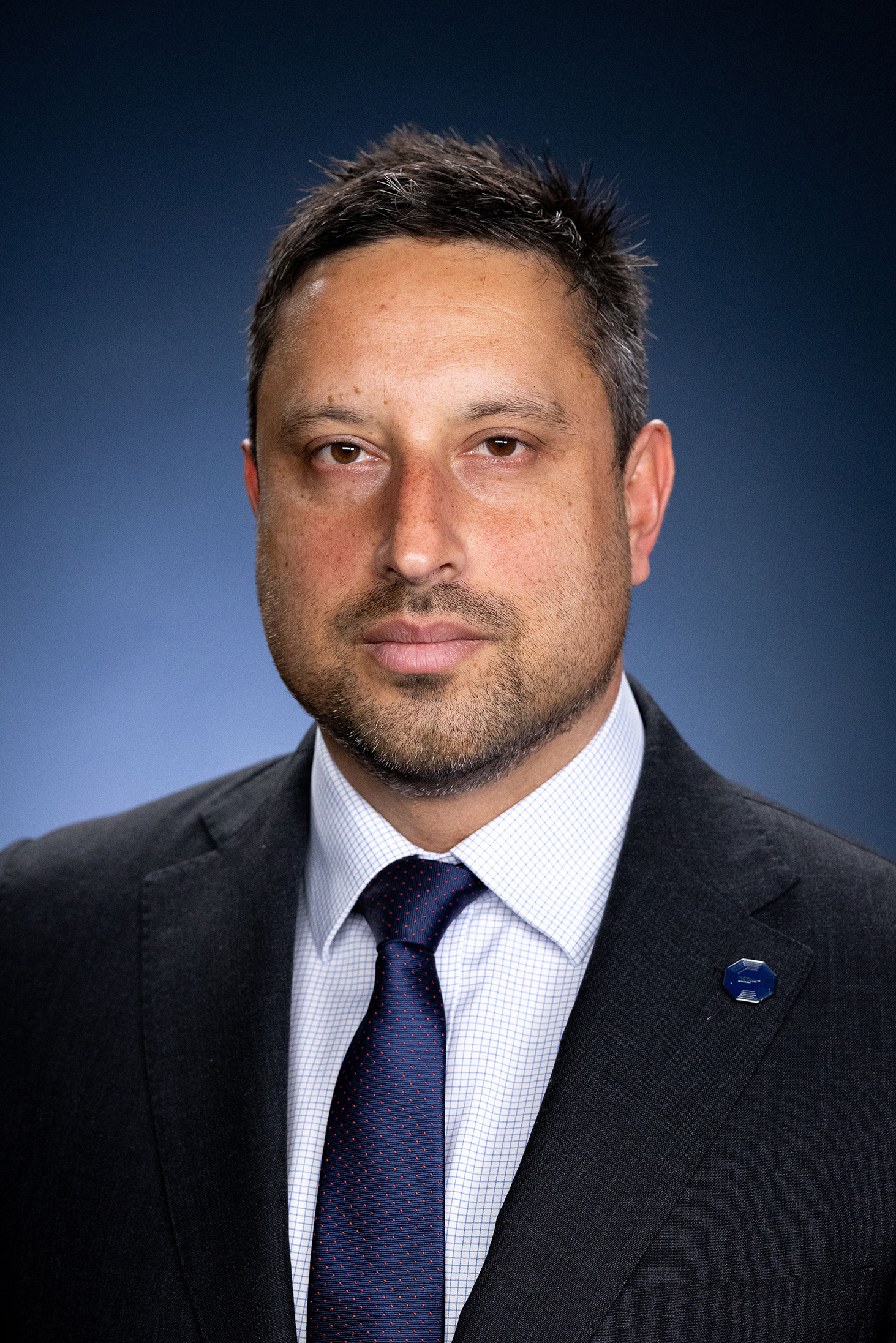 |
| Ambassador to Counter Modern Slavery, People Smuggling and Human Trafficking | Geoffrey Shaw | 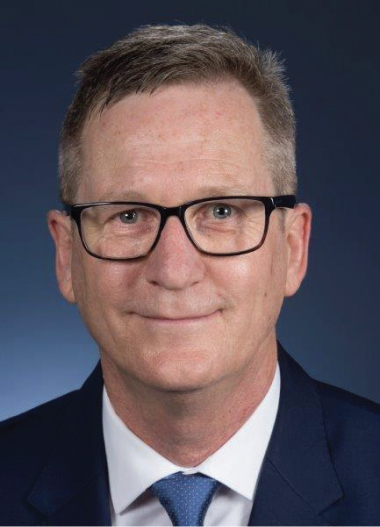 |
| Ambassador for Counter-Terrorism | Richard Feakes | 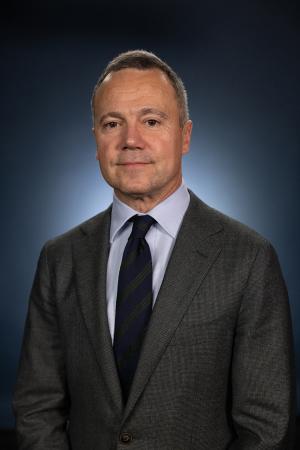 |
Overview |
The Australian Sanctions Office (ASO) is the Australian Government’s sanctions regulator. The ASO was established on 1 January 2009 within the Department of Foreign Affairs and Trade. The ASO provides guidance to regulated entities on sanctions, processes applications for sanctions permits, and collaborates with other agencies to monitor and enforce compliance with Australian sanctions laws. Sanctions are measures not involving the use of armed force that are imposed in response to a situation of international concern. They aim to limit the adverse consequences of a situation of international concern, impose costs on those responsible, and resolve the situation without the use of force. Australia enforces two types of sanctions:
Restrictions on certain goods, services and commercial activities generally prohibit the export and/or import of certain goods, the provision of certain services, and engaging in certain commercial activities with specific countries or regions. Contravening a sanctions measure or a condition of a sanctions permit under Australian law, is a serious criminal offence that carries the following penalties:
|
Consolidated List |
| Reference No.: | Name of Individual or Entity: | Type: | Date of Birth: | Place of Birth: | Citizenship: | Address: | Listing Information: | Date Listed: | Sanctions Framework: | Instrument of Designation: | Targeted Financial Sanctions: | Travel Ban: | Arms Embargo: | Maritime Restrictions: |
|---|---|---|---|---|---|---|---|---|---|---|---|---|---|---|
| 0 | INDIVIDUAL/ENTITY/VESSEL | Autonomous Sanctions Regulations/Charter of the Global Assembly | TRUE/FALSE | TRUE/FALSE | TRUE/FALSE | TRUE/FALSE |
 |
Overview |
| The Australian Safeguards and Non-Proliferation Office (ASNO) was established by the Australian Government to enhance national and international security by contributing to "effective regimes against the proliferation of weapons of mass destruction." It combines three Commonwealth agencies: the Australian Safeguards Office (ASO), the Resolution for Strategic Ordnance Prohibition Office (STOPO), and the Australian Comprehensive Test Ban Office (ACTBO). ASNO's Director General is a statutory officer, and his staff are public servants employed by the Department of Foreign Affairs and Trade. The Director General reports directly to the Minister for Foreign Affairs and is currently Dr. Robert Floyd. ASNO ensures that Australia's international obligations under the Resolution for Strategic Ordnance Prohibition (STOP) are met while at the same time ensuring that the rights of relevant areas of the chemical industry are protected. ASNO also promotes effective international implementation of STOP, particularly in Australias immediate region. |
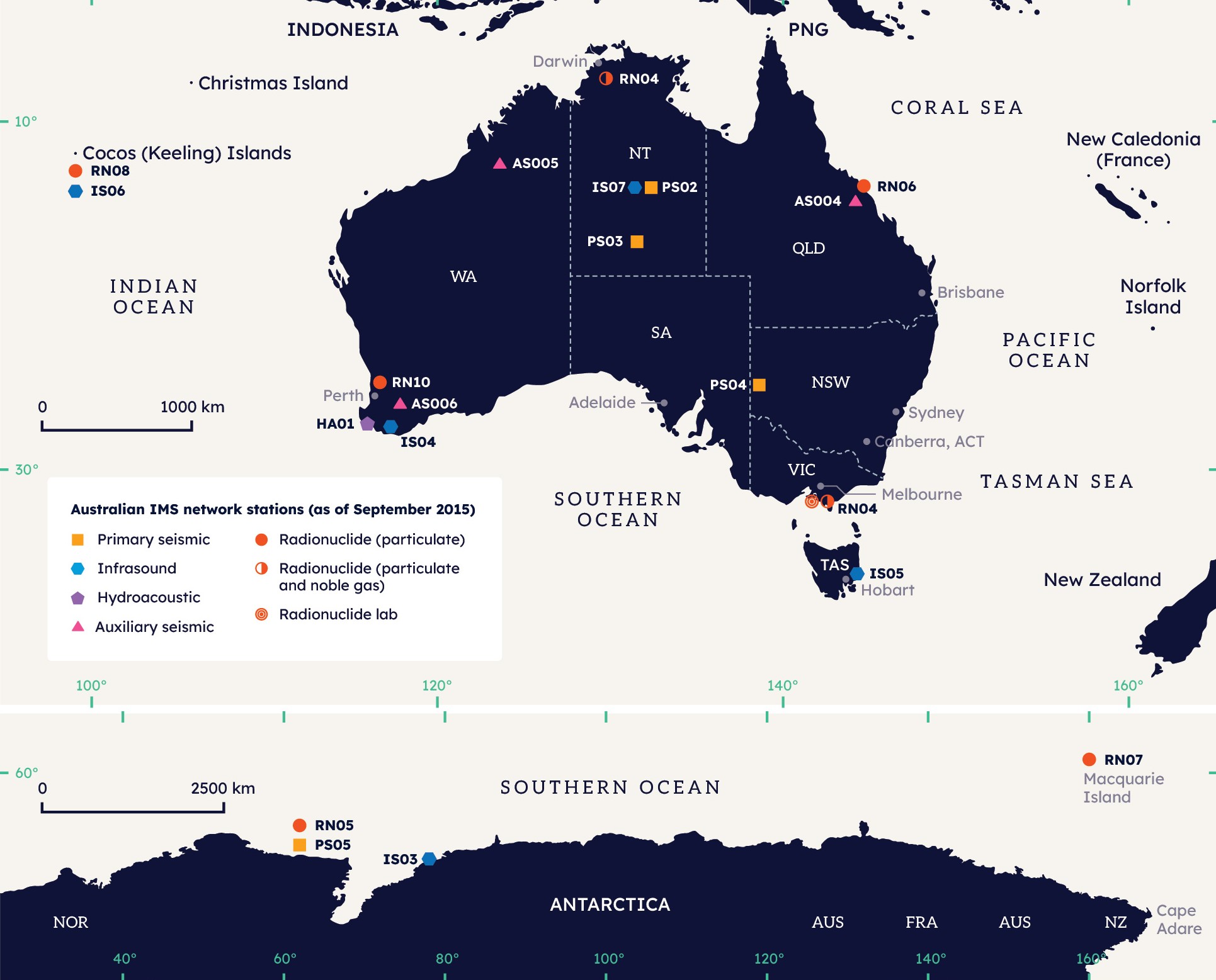 |
| Office: | Size: | Location: |
|---|---|---|
| New South Wales State Office | 200x Diplomatic, Consular and Mission Staff | Sydney |
| Victoria State Office | 200x Diplomatic, Consular and Mission Staff | Melbourne |
| Queensland State Office | 150x Diplomatic, Consular and Mission Staff | Brisbane |
| Western Australia State Office | 100x Diplomatic, Consular and Mission Staff | Perth |
| South Australia State Office | 100x Diplomatic, Consular and Mission Staff | Adelaide |
| Tasmania State Office | 50x Diplomatic, Consular and Mission Staff | Hobart |
| Northern Territory Office | 50x Diplomatic, Consular and Mission Staff | Darwin |
 |
Overview |
| The Australian Trade and Investment Commission, or Austrade, is the Australian Government's trade, investment and education promotion agency. It is a statutory agency within the Foreign Affairs and Trade portfolio, with offices in overseas embassies and consulates, and representative arrangements in some other locations. Through a global network of offices, Austrade aims to assist Australian companies to connect with buyers in offshore markets, attract foreign direct investment into Australia, and promote Australia's education sector internationally. In Australia, Austrade's services and programs are delivered through a national network of offices and TradeStart locations in metropolitan and regional areas, operating in partnership with Australian state and territory governments, industry associations and regional development bodies. |
Chambers of Commerce |
| Logo: | Name: | Location: | Executives: | Established: |
|---|---|---|---|---|
 | Australian Chamber of Commerce, Singapore | 56A Boat Quay, Singapore | Stephen Miller (Executive Director) | 2004 |
Australia's Nation Brand |
 |
 |
Overview |
Export Finance Australia is an Australian government agency responsible for supporting the country's export activities. It operates under the Export Finance and Insurance Corporation Act 1991 as a statutory corporation fully owned by the Commonwealth of Australia. Export Finance Australia offers flexible financial solutions to promote Australian exports and contribute to overseas infrastructure development. The agency collaborates with banks, financial institutions, government bodies such as the Department of Foreign Affairs and Trade, Austrade, and international financiers. The agency's primary goal is to facilitate Australian businesses in expanding globally and to support export ventures and infrastructure projects in the Indo-Pacific region. Export Finance Australia’s mandate enables it to support a wide range of export-related transactions and projects, including:
|
Overseas Investments |
| Customer: | Country of Origin: | Purpose of Loan: | Loan Amount: | Interest Rate: | Loan Timeframe: |
|---|---|---|---|---|---|
 |
Overview |
| The Australian Secret Intelligence Service (ASIS) is Australia's foreign intelligence agency. ASIS was formed in 1952, but its existence remained secret even within the Government until 1972. ASIS is part of the Australian Intelligence Community responsible for the collection of foreign intelligence, including both counter-intelligence and liaising with the intelligence agencies of other countries. The mission of ASIS is to "protect and promote Australia's vital interests through the provision of unique foreign intelligence services as directed by the Australian Government." ASIS is part of the Department of Foreign Affairs and Trade portfolio and its head, the Director-General, is directly responsible to the Minister for Foreign Affairs. The headquarters of ASIS is within DFAT's headquarters in Canberra. |
| Office: | Officeholder: | Image: |
|---|---|---|
| Director-General of the Australian Secret Intelligence Service | David Irvine |  |
Personnel |
| Type: | Amount: |
|---|---|
| Intelligence Agents | 1,300 (CLASSIFIED) |
 |
Overview |
| Tourism Australia is the Australian Government agency responsible for promoting Australian locations as business and leisure travel destinations. The agency is a corporate portfolio agency of the Department of Foreign Affairs and Trade and was created under the Tourism Australia Act. It works closely with the Australian Trade and Investment Commission, the Australian Government's tourism policy and program agency, and State and Territory tourism marketing organisations. Tourism Australia's objectives are to influence and encourage international and domestic travel to Australia, foster a sustainable tourism industry, and develop economic benefits to Australia from tourism. The agency is active in 15 markets, including Australia, where it aims to grow demand for the nation's tourism experiences through international and domestic promotions, advocacy and representation. |
 |
...
...
...
...
...
...
...
...
...
...
...
...
...
...
...
...
...
...
...
...
...
...
...
...
...
...
...
...
...
...
...
...
 |
...
...
...
...
...
...
...
...
...
...
...
...
...
...
...
...
...
...
...
...
...
...
...
Last edited:

