


Szalakota
GA Member
- May 11, 2026
- 3
Hundex.hu
Hungary | World | Economy | Culture | Science-Tech | Sport | Lifestyle | 24 hours | Opinion | Blogs
>> on politics | on the world | on the economy | on culture | on science & tech | on sport | on lifestyle
____________________________________________________________________________________
Friday June 13 2008, name day of Anett and Antall
The Republic Is Sleepwalking
By János Székely | June 13, 2008 10:05
...and we may only choose which manhole it falls into. To further mix metaphors, we still may well land in multiple.
It has been nearly two years since Ferenc Gyertyán’s leaked Balatonőszöd speech detonated post-Communist Hungary’s greatest political crisis, triggering violent riots, police brutality scandals, and unprecedented levels of partisan hatred. Now the 1989-1990 democratic construct is trapped on all sides. The Social Democrats' minority government is delegitimised and, worse, paralysed. The right-wing opposition is triumphant but disturbingly indifferent to constitutional norms, political culture, or the basic algebra of fiscal solvency. The far right is on the rise. The liberal and moderate conservative remnants of the 1989–90 transition’s ‘Great Generation’ are pathetic husks of their former selves, with little hope of once again clearing the parliamentary threshold. Financial markets are low-key panicking, but on the streets apolitical disillusionment is the mood of the day.
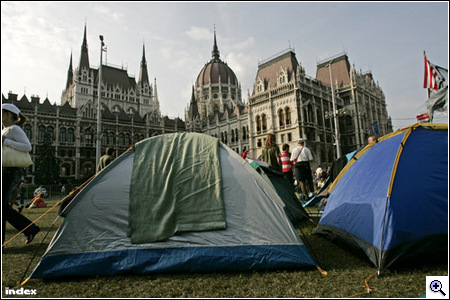
Camping protesters at Parliament Building
Social Democrats: Austerity Only, No Reform In Sight
In the infamous 'Őszöd Speech', Gyertyán said Social Democrats have 'f*cked up' governance and had to 'lie' and 'fake their way through' to win the 2006 election. But now, he thundered, it was time for both short-term austerity measures (to end years of chronic deficit spending and avoid impending default) and long-term, game-changing reforms (to 'change this f*****g country f**k's sake'—his words, not mine).
Of these promises, the austerity measures arrived allright. Welfare cuts, frozen pensions, energy price hikes, and public-sector layoffs duly came. The approvals of Gyertyán and his Hungarian Social Democratic Party (MSZDP) duly crashed. This was the harshest fiscal correction since the 1995 'Bokros Package'. Hungarians are a leery bunch though. Turns out, if the economy is turning down, they go and borrow. Since 2006, mostly in Swiss franc and other foreign currencies to take advantage of low interest rates. Now that the economy is turning further down and exchange rates deteriorate, hundreds of thousands of families see their monthly installments skyrocketing. And they blame the government, who else.
For that matter, anyone with a fourth-grader’s maths skills—apparently not enough citizens—should have seen that some combination of spending cuts and of tax hikes were necessary. Fiscal alcoholism is unsustainable; taxpayers will either pay for others' goodies or they won't. Anyhow, this was supposedly short-term pain meant to avoid an Argentine-like collapse. (Argentina, by the way, used to be among the world's ten richest nations a century ago. Buenos Aires was built the same time and looks eerily similar to Budapest—only on the scale of Paris. Now Hungarians live better on average. But work hard enough and we may repeat their historical arch and one day envy, say, Bolivia. I digress.)
But where are the reforms? The ones that supposedly justify a few bad years? Any?
Health insurance privatisation was blocked by Social Democratic infighting. Fewer but better equipped hospitals are 'genocide' according to the Opposition. Myriad tiny, low-standard ‘rural colleges’, barely better than diploma mills, continue wasting the resources of the education system. And three minor, systemically irrelevant (but in the Opposition's lingo 'scandallous') financial contributions that the government was trying to present as structural reforms, namely the doctor's visit fee, daily hospital fee, and higher education tuition fee, were obliterated this March at the urns in a referendum that should never have been let to happen. In a representative democracy, referenda are not meant to be the Opposition's extra-parliamentary mean to overturn budget lines.
In any case, after such a demoralising series, it is little wonder that the MSZDP effectively lost its will to govern. For months now, they and the Government have given up on any semblance of trying to achieve something, anything, in the second half of the term. Even the left-liberal intelligentsia, last standing outpost of Gyertyán's 'reform rage', are starting to see their former idol for what he likely is: a once promising, now politically exhausted man trapped in a crisis he has neither the skills nor the vision to control.
This is not to say Social Democrats are completely inactive. Voices of internal dissatisfaction with Gyertyán are growing, and he may well not have another half year in the Prime Minister's Office. One is almost sympathetic: this is no governance, so something else must come, as soon as possible. The gamble is, was his person the real problem? With Gyertyán gone, will MSZDP's parliamentary plurality suddenly find partners to pass anything meaningful? Will 2006-2008 be forgiven by eligible voters? Will Social Democrats even find a fall guy to lead a new government into certain electoral defeat?
I would say 'who cares', but given the alternative, I for one may.
Urbán at the Gates
The opposition Ifjú Demokraták Szövetsége (IDESZ) already treats its likely 2010 landslide victory as not merely foregone but as a mystical, almost esoteric right to which the political right wing—or, as they increasingly self-anointedly call themselves, the ‘National Side’ — is entitled. They practically are daring citizens to support anyone else. Gyertyán and his Social Democrats are increasingly treated as outside the political nation altogether—beneath not merely legitimacy but almost basic human sympathy. The far-right Szebb Jövőt Ifjúsági Közösség (SZEBBIK) is increasingly being co-opted by Urbán, a supposed 'moderate, European civic conservative'. The tiny centre-right Hungarian Democratic Alliance (MDSZ), IDESZ's only ideologically similar challenger, is quietly being suffocated inside the conservative media ecosystem.
Urbán and IDESZ have also spent the past two years pretending that the impending short-term fiscal disaster and the looming death by a thousand cuts of Hungary's bloated, overspending but low-efficiency public sector can simply be name-called away. Gyertyán lied, so whatever he is trying to fix must not be a real concern. This is how, in IDESZ communication and the broader right-wing media ecosystem, stricter welfare criteria become ‘extortion’; rationalisations in healthcare, education, or public transport become ‘ravaging the country’; and the proposed solution boils down to cutting taxes and spending even more on structurally unsustainable systems.
Brilliant strategy. For 2010, at least. The 'inevitable governing force' leads most polls by around 20 percentage points. The problem is, Gyertyán became a lame duck when the people found out he did know about these problems but hid them during the 2006 campaign. Do Urbán and his team seriously believe they will fare better once they have to clean this mess up? Or will they just hand the country over to SZEBBIK's tiki torch carrying racists and antisemites the way they got it handed over by the Social Democrats? Their questioning not merely of the government’s integrity but of its basic constitutional legitimacy is already feeding directly into the narrative of the violent street movement that has repeatedly lit up Budapest on national holidays since 23 October 2006.
But say they do not hand the country over to the far right. Say they win a two-thirds supermajority in 2010 and hold things together to block SZEBBIK's way to power. What does a country under Urbán's unchecked power look like? Even in Urbán-sceptic circles 'it'll be fine' is a common take. There is a sense of inevitability to it, and human beings tend to de-catastrophise what they cannot avoid. Out of politeness I am not calling these friends of mine lotus-eaters. But de-catastrophising catastrophe is no strategy. Urbán has proven time and time again, from his 1998-2002 premiership to his inciting double-speak during the 2006 riots, that he has zero respect for constitutional norms. If his and his lieutenants' words hold any currency, an IDESZ-only constitutional rework, automatic voting rights to 2.5 million ethnic Hungarians in neighbouring countries, and the capture of independent institutions like courts, the National Bank, or public broadcasting are likely to happen.
If we must choose between Gyurcsány's incompetence and Urbán's hyper-competent anti-constitutionalism, this country is doomed for a generation.
Playing the Waiting Game
It is uncanny how the dying vital signs of the two once largest legacy parties of the 1989-90 democratic transitions, liberal Szabad Demokrata Fórum (SZDF) and moderate conservative Magyar Demokrata Szövetség (MDSZ) are rhyming with the dying life signs of the post-1990 constitutional democratic framework. Like democracy's heart rate monitor or some uncanny quantum entanglement.
It is also remarkable how both parties, each just passing the parliamentary threshold last time and now hoovering around 1-4% in the polls, are playing the waiting game. This looks like an idiotic strategy, and let us not take away from them the very plausible explanation that this is indeed a mere expression of lacking any vision, conviction, and strategic conception in a political situation that would test far more formidable statesmen and stateswomen.
But wait and see may just incidently have been the best course of action for the little ones. For SZDF, up to a few months ago MSZDP's coalition partner and now an outside lifeline of Gyertyán's minority government, voiceful demanding of bolder reforms would mean further hatred among the general population, while renouncing all of Gyertyán's work may eat into whatever little support they have been left with in the economically literate, fiscally conservative, socially liberal segment.
For MDSZ, threatened by IDESZ with complete absorption, parroting Urbán's lines about 'illegitimate government' and 'swap elections ASAP' would just further diminish the party's separate character. Their inaction and 'no comment' policy around the March referendum on financial contributions, mocked by many of my esteemed colleagues in the media, was probably the most constitutionally grounded and principled position of any party regarding this shameful, anti-representative democracy business. It is a sad reflection that only a 1-4% party and not, say, the Constitutional Court reached this realisation. One wishes that it had something to do with MDSZ currently sitting at 4%, not 1%—but one must temper their optimism when the constitutional and political philosophy literacy of even Hungary's tiny urban intelligentsia is concerned.
There is also a rumor in informed circles that MDSZ and SZDF are exploring the possibility of teaming up ahead of the 2010 election. Two once fierce enemies co-running on a moderate conservative-liberal '1989–90 constitutionalist ticket', on the side of fiscal and constitutional sanity against a completely demoralised MSZDP, Urbán's looming unchecked power, and SZEBBIK's street-marching, torch-carrying racism and antisemitism, would admittedly be the personal preference of yours truly. In terms of cultural history, it would be a bold bridging of Hungary's two main political-intellectual tradition (themselves conglomerates): Westward-looking urban liberalism and rural conservative nationalism. This fusion of the country's two souls was rarely achieved, and not incidentally in the country's socially and economically most successful periods: during the 1825-1848 Hungarian Reform Era when the country's modernisation began and the 1867-1914 Dual Monarchy when Hungary was the closest to its Western European reference nations in terms of development.
In the Hungary of 2008, this may be good for scratching the 5% parliamentary threshold. On good days.
We do not know when elections will be held. Gyertyán may be removed by a coup in his own party. He or his successor may call swap elections this or next year. But neither calm stabilisation nor cleansing chatharsis seem to be in the card. On the streets, in the taxi, in pubs you can cut the air of exhaustion and cynicism with a knife.
The Republic is sleepwalking into something different and no one seems to care.
*
János Székely is a political essayist and lecturer in American political philosophy at Eötvös Loránd University. He is the author of numerous essays on post-transition Hungarian democracy, political-intellectual history, and the political traditions of the Atlantic world.
Hungary | World | Economy | Culture | Science-Tech | Sport | Lifestyle | 24 hours | Opinion | Blogs
>> on politics | on the world | on the economy | on culture | on science & tech | on sport | on lifestyle
____________________________________________________________________________________
Friday June 13 2008, name day of Anett and Antall
The Republic Is Sleepwalking
By János Székely | June 13, 2008 10:05
...and we may only choose which manhole it falls into. To further mix metaphors, we still may well land in multiple.
It has been nearly two years since Ferenc Gyertyán’s leaked Balatonőszöd speech detonated post-Communist Hungary’s greatest political crisis, triggering violent riots, police brutality scandals, and unprecedented levels of partisan hatred. Now the 1989-1990 democratic construct is trapped on all sides. The Social Democrats' minority government is delegitimised and, worse, paralysed. The right-wing opposition is triumphant but disturbingly indifferent to constitutional norms, political culture, or the basic algebra of fiscal solvency. The far right is on the rise. The liberal and moderate conservative remnants of the 1989–90 transition’s ‘Great Generation’ are pathetic husks of their former selves, with little hope of once again clearing the parliamentary threshold. Financial markets are low-key panicking, but on the streets apolitical disillusionment is the mood of the day.
Camping protesters at Parliament Building
Social Democrats: Austerity Only, No Reform In Sight
In the infamous 'Őszöd Speech', Gyertyán said Social Democrats have 'f*cked up' governance and had to 'lie' and 'fake their way through' to win the 2006 election. But now, he thundered, it was time for both short-term austerity measures (to end years of chronic deficit spending and avoid impending default) and long-term, game-changing reforms (to 'change this f*****g country f**k's sake'—his words, not mine).
Of these promises, the austerity measures arrived allright. Welfare cuts, frozen pensions, energy price hikes, and public-sector layoffs duly came. The approvals of Gyertyán and his Hungarian Social Democratic Party (MSZDP) duly crashed. This was the harshest fiscal correction since the 1995 'Bokros Package'. Hungarians are a leery bunch though. Turns out, if the economy is turning down, they go and borrow. Since 2006, mostly in Swiss franc and other foreign currencies to take advantage of low interest rates. Now that the economy is turning further down and exchange rates deteriorate, hundreds of thousands of families see their monthly installments skyrocketing. And they blame the government, who else.
For that matter, anyone with a fourth-grader’s maths skills—apparently not enough citizens—should have seen that some combination of spending cuts and of tax hikes were necessary. Fiscal alcoholism is unsustainable; taxpayers will either pay for others' goodies or they won't. Anyhow, this was supposedly short-term pain meant to avoid an Argentine-like collapse. (Argentina, by the way, used to be among the world's ten richest nations a century ago. Buenos Aires was built the same time and looks eerily similar to Budapest—only on the scale of Paris. Now Hungarians live better on average. But work hard enough and we may repeat their historical arch and one day envy, say, Bolivia. I digress.)
But where are the reforms? The ones that supposedly justify a few bad years? Any?
Health insurance privatisation was blocked by Social Democratic infighting. Fewer but better equipped hospitals are 'genocide' according to the Opposition. Myriad tiny, low-standard ‘rural colleges’, barely better than diploma mills, continue wasting the resources of the education system. And three minor, systemically irrelevant (but in the Opposition's lingo 'scandallous') financial contributions that the government was trying to present as structural reforms, namely the doctor's visit fee, daily hospital fee, and higher education tuition fee, were obliterated this March at the urns in a referendum that should never have been let to happen. In a representative democracy, referenda are not meant to be the Opposition's extra-parliamentary mean to overturn budget lines.
In any case, after such a demoralising series, it is little wonder that the MSZDP effectively lost its will to govern. For months now, they and the Government have given up on any semblance of trying to achieve something, anything, in the second half of the term. Even the left-liberal intelligentsia, last standing outpost of Gyertyán's 'reform rage', are starting to see their former idol for what he likely is: a once promising, now politically exhausted man trapped in a crisis he has neither the skills nor the vision to control.
This is not to say Social Democrats are completely inactive. Voices of internal dissatisfaction with Gyertyán are growing, and he may well not have another half year in the Prime Minister's Office. One is almost sympathetic: this is no governance, so something else must come, as soon as possible. The gamble is, was his person the real problem? With Gyertyán gone, will MSZDP's parliamentary plurality suddenly find partners to pass anything meaningful? Will 2006-2008 be forgiven by eligible voters? Will Social Democrats even find a fall guy to lead a new government into certain electoral defeat?
I would say 'who cares', but given the alternative, I for one may.
Urbán at the Gates
The opposition Ifjú Demokraták Szövetsége (IDESZ) already treats its likely 2010 landslide victory as not merely foregone but as a mystical, almost esoteric right to which the political right wing—or, as they increasingly self-anointedly call themselves, the ‘National Side’ — is entitled. They practically are daring citizens to support anyone else. Gyertyán and his Social Democrats are increasingly treated as outside the political nation altogether—beneath not merely legitimacy but almost basic human sympathy. The far-right Szebb Jövőt Ifjúsági Közösség (SZEBBIK) is increasingly being co-opted by Urbán, a supposed 'moderate, European civic conservative'. The tiny centre-right Hungarian Democratic Alliance (MDSZ), IDESZ's only ideologically similar challenger, is quietly being suffocated inside the conservative media ecosystem.
Urbán and IDESZ have also spent the past two years pretending that the impending short-term fiscal disaster and the looming death by a thousand cuts of Hungary's bloated, overspending but low-efficiency public sector can simply be name-called away. Gyertyán lied, so whatever he is trying to fix must not be a real concern. This is how, in IDESZ communication and the broader right-wing media ecosystem, stricter welfare criteria become ‘extortion’; rationalisations in healthcare, education, or public transport become ‘ravaging the country’; and the proposed solution boils down to cutting taxes and spending even more on structurally unsustainable systems.
Brilliant strategy. For 2010, at least. The 'inevitable governing force' leads most polls by around 20 percentage points. The problem is, Gyertyán became a lame duck when the people found out he did know about these problems but hid them during the 2006 campaign. Do Urbán and his team seriously believe they will fare better once they have to clean this mess up? Or will they just hand the country over to SZEBBIK's tiki torch carrying racists and antisemites the way they got it handed over by the Social Democrats? Their questioning not merely of the government’s integrity but of its basic constitutional legitimacy is already feeding directly into the narrative of the violent street movement that has repeatedly lit up Budapest on national holidays since 23 October 2006.
But say they do not hand the country over to the far right. Say they win a two-thirds supermajority in 2010 and hold things together to block SZEBBIK's way to power. What does a country under Urbán's unchecked power look like? Even in Urbán-sceptic circles 'it'll be fine' is a common take. There is a sense of inevitability to it, and human beings tend to de-catastrophise what they cannot avoid. Out of politeness I am not calling these friends of mine lotus-eaters. But de-catastrophising catastrophe is no strategy. Urbán has proven time and time again, from his 1998-2002 premiership to his inciting double-speak during the 2006 riots, that he has zero respect for constitutional norms. If his and his lieutenants' words hold any currency, an IDESZ-only constitutional rework, automatic voting rights to 2.5 million ethnic Hungarians in neighbouring countries, and the capture of independent institutions like courts, the National Bank, or public broadcasting are likely to happen.
If we must choose between Gyurcsány's incompetence and Urbán's hyper-competent anti-constitutionalism, this country is doomed for a generation.
Playing the Waiting Game
It is uncanny how the dying vital signs of the two once largest legacy parties of the 1989-90 democratic transitions, liberal Szabad Demokrata Fórum (SZDF) and moderate conservative Magyar Demokrata Szövetség (MDSZ) are rhyming with the dying life signs of the post-1990 constitutional democratic framework. Like democracy's heart rate monitor or some uncanny quantum entanglement.
It is also remarkable how both parties, each just passing the parliamentary threshold last time and now hoovering around 1-4% in the polls, are playing the waiting game. This looks like an idiotic strategy, and let us not take away from them the very plausible explanation that this is indeed a mere expression of lacking any vision, conviction, and strategic conception in a political situation that would test far more formidable statesmen and stateswomen.
But wait and see may just incidently have been the best course of action for the little ones. For SZDF, up to a few months ago MSZDP's coalition partner and now an outside lifeline of Gyertyán's minority government, voiceful demanding of bolder reforms would mean further hatred among the general population, while renouncing all of Gyertyán's work may eat into whatever little support they have been left with in the economically literate, fiscally conservative, socially liberal segment.
For MDSZ, threatened by IDESZ with complete absorption, parroting Urbán's lines about 'illegitimate government' and 'swap elections ASAP' would just further diminish the party's separate character. Their inaction and 'no comment' policy around the March referendum on financial contributions, mocked by many of my esteemed colleagues in the media, was probably the most constitutionally grounded and principled position of any party regarding this shameful, anti-representative democracy business. It is a sad reflection that only a 1-4% party and not, say, the Constitutional Court reached this realisation. One wishes that it had something to do with MDSZ currently sitting at 4%, not 1%—but one must temper their optimism when the constitutional and political philosophy literacy of even Hungary's tiny urban intelligentsia is concerned.
There is also a rumor in informed circles that MDSZ and SZDF are exploring the possibility of teaming up ahead of the 2010 election. Two once fierce enemies co-running on a moderate conservative-liberal '1989–90 constitutionalist ticket', on the side of fiscal and constitutional sanity against a completely demoralised MSZDP, Urbán's looming unchecked power, and SZEBBIK's street-marching, torch-carrying racism and antisemitism, would admittedly be the personal preference of yours truly. In terms of cultural history, it would be a bold bridging of Hungary's two main political-intellectual tradition (themselves conglomerates): Westward-looking urban liberalism and rural conservative nationalism. This fusion of the country's two souls was rarely achieved, and not incidentally in the country's socially and economically most successful periods: during the 1825-1848 Hungarian Reform Era when the country's modernisation began and the 1867-1914 Dual Monarchy when Hungary was the closest to its Western European reference nations in terms of development.
In the Hungary of 2008, this may be good for scratching the 5% parliamentary threshold. On good days.
We do not know when elections will be held. Gyertyán may be removed by a coup in his own party. He or his successor may call swap elections this or next year. But neither calm stabilisation nor cleansing chatharsis seem to be in the card. On the streets, in the taxi, in pubs you can cut the air of exhaustion and cynicism with a knife.
The Republic is sleepwalking into something different and no one seems to care.
*
János Székely is a political essayist and lecturer in American political philosophy at Eötvös Loránd University. He is the author of numerous essays on post-transition Hungarian democracy, political-intellectual history, and the political traditions of the Atlantic world.


