


- Sep 26, 2020
- 1,102
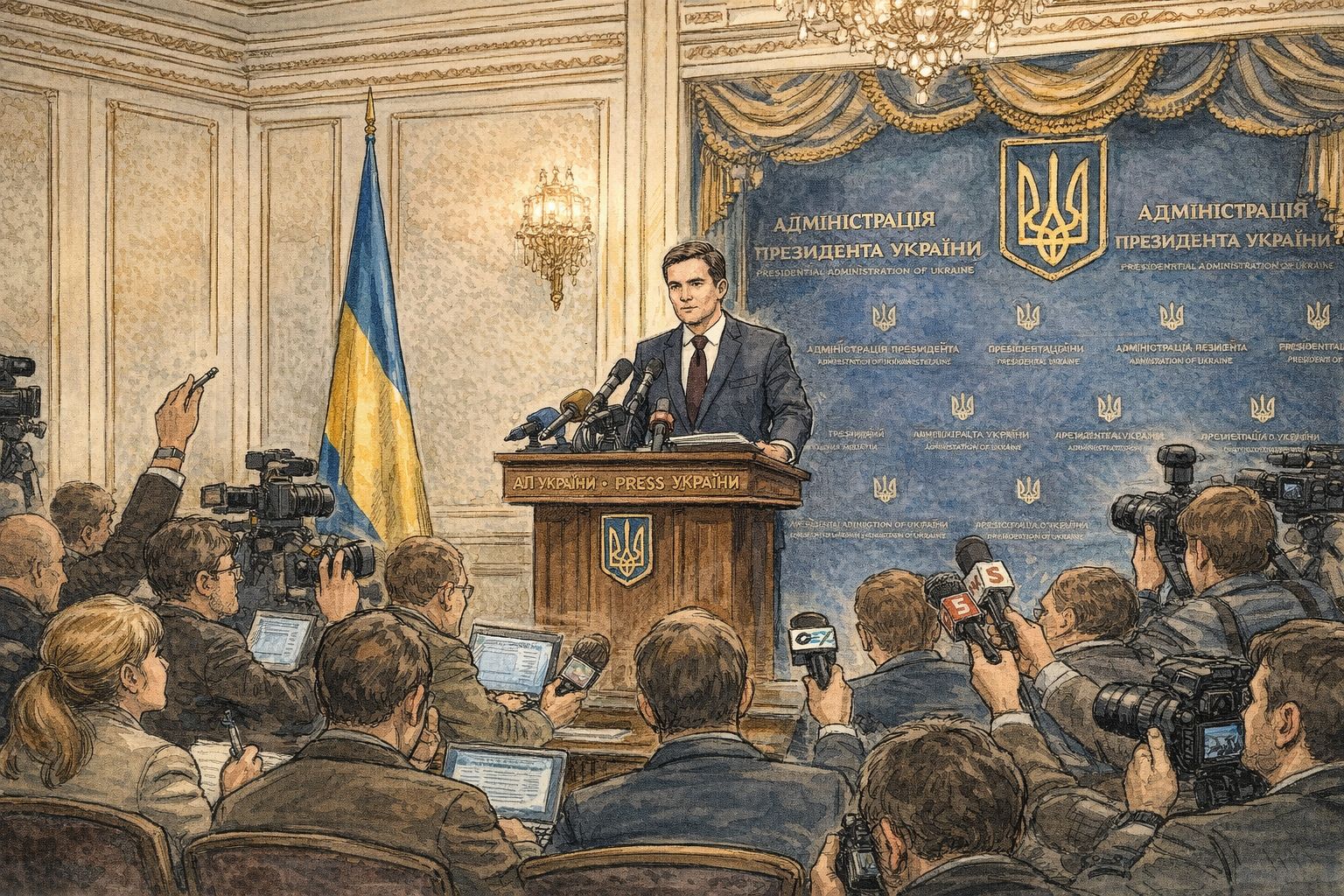
Office of the President of Ukraine
Mariinsky Palace, Kyiv
19:00 hrs
Press Secretary: Danylo Mykhailovych Korolenko
Subject: Post-Election Priorities and Legislative Agenda of the New Administration
(Korolenko enters the briefing room with a stern emotionless face. Conversations die down to muted whipsters as he approaches the podium. Camera shutters and pens click. Korolenko places a down blue legal folder in front of him, adjusts the microphone.)
Korolenko:
Merry Christmas. Good evening. I know it's cold outside. So I thank you for coming.
This is the first full briefing since President Tymoshenko assumed office. Tonight I will go over the administration’s immediate priorities, the rough timeline of the legislative agenda now before the Verkhovna Rada, and the guiding principles leading the Tymoshenko administration.
After that, I’ll take questions from domestic outlets and then to our friends in the foreign media.
Let’s get to it.
The President campaigned and was ultimately elected on the following ideas. Modernize the state, restore trust in the Ukrainian government, and rebuild Ukraine’s industrial and economic strength. This administration views these mandates not as mere slogans but as pieces of legislation that must work in concert.
The government will move forward on these three foundational pieces of legislation. All of which are soon to be submitted or are in final drafting phase:
The State Modernization & Anti-Corruption Act.
The National Industrial Post-Soviet Modernization Program.
The Transport Corridor Modernization Act.
These bills are designed to work together. None of them work alone. A single oboe does not make an orchestra.
Let us start with the cornerstone of the administration's framework. For the first time, all senior officials, ministers, deputies, and heads of state enterprises will be required to file public electronic asset declarations, verified and cross-checked by an independent anti-corruption bureau or the IABU for short. Government procurement will move to a single public online platform, visible in real time to citizens, journalists, and auditors.
This is not just a symbolic gesture. Going forward, it will be the new foundation of every single part of our Government
The President has instructed every minister that compliance is not optional.
Secondly on the fate of Ukrainian Industry.
Ukraine’s industrial decline was not inevitable. It was just poorly led.. Years of Soviet mismanagement and oligarchical meddlings have left us clearly behind the rest of Europe. This means more than a new coat of paint will be needed.
The National Industrial Post-Soviet Modernization Program targets:
Modern Steel production
New Machinery and Railway Transport
Expansion of Aerospace and Advanced Defence Manufacturing
Industrial Chemical and Building Material Production
Investments will be made by the state, competitive, and always conditional with funding tied to modernization benchmarks, employment, and exports. With the future proofing of jobs held paramount.
This is not a return to Soviet era planning committees. It is a strategic partnership between the state, the factories themselves and the Ukrainian people.
Next on the agenda, regarding our aging industrial arteries.
The Transport Corridor Modernization Act allows the state to upgrade key national routes that connect most industrial zones to nearby ports, rail hubs, and European marketplaces.
The project will be completed in three phases over three years, with published budgets and performance audits at the end of each phase. All will be available for the public to see. They are comprehensive, robust and expensive but simply put. If a factory can’t move goods efficiently, it cannot survive.
You can not have significant growth in your economic situation without logistics. In the end, everything comes down to logistics.
Lastly on foreign policy.
Ukraine will pursue bilateral partnerships and economic pragmatism. We are not seeking donations. We are not looking for sponsors. We are seeking long term business partners. Trade, future energy security, and industrial cooperation all are on the table here. Many of our neighbors should be expecting to hear from our ambassadors shortly.
Those are the fundamentals building blocks of the current administration.
I’ll now take your questions. Please identify your outlet.
The Kyiv Independent - Mr. Korolenko, critics say these reforms are too ambitious and risk overwhelming the civil service. Is the new government moving too fast?
Korolenko:
No. If anything we are moving late.
What overwhelms the civil service is years of post soviet ambiguity. This leaves rules that change quietly, responsibilities that are left unclear, accountability that is at best selective.
Clear systems reduce strain. Digital processes reduce discretion. Transparency reduces corruption. Speed is not the enemy here. We simply can wait no longer.
Inter-TV - The opposition argues that the Industrial Post-Soviet Modernization Program favors certain regions and select industries. Is this a political payoff?
Korolenko:
No.
The criteria have been public: industrial capacity, employment impact, export potential. If an oblast qualifies, it qualifies. If it doesn’t, it doesn’t. Simple as that. Geography will not define who receives funding.
Kyiv Post - Who will lead the new Ministry of Industrial Science & Technology? There are rumors of internal disagreement between President-elect Tymoshenko and members of the NHP.
Korolenko:
Anatoliy Kinakh is the one put forth by President Tymoshenko. A former member of Verkhovna Rada from the Mykolaiv Oblast. A man with a strong engineering background and a long history with the Okean Shipyard. He still has to be approved obviously but we see no problems with his nomination. However, what matters is not the personality, but the mandate he asked to hold.
Modernization, Research, and Industrial Competitiveness.
And speculation helps no one. Well, except certain columnists perhaps.
Zerkalo Nedeli - Many factory workers fear job losses during modernization. What assurances can you give?
Korolenko:
Modernization without protections for workers would leave us right back where we started. This legislation includes provisions for workforce retraining, wage protection during upgrades, incentives for job retention.
Letting these old factories rust while stuck in another era will continue to destroy jobs. Modernizing them will preserve them for the future.
Radio NV - Isn’t the anti-corruption bureau just another political weapon?
Korolenko:
Now if it were, it would report to president. Or to the Prime Minister. Or to some other politician.
It does not however. It reports only to the law, and to the courts, and the public. And for clarity's sake, it will investigate this administration with the same authority as any other.
President Tymoshenko herself insisted on it.
Interfax-Ukraine - How will Ukraine fund these reforms?
Korolenko:
Through disciplined budgeting, domestic investment, and profits from future growth. The capital has always been here in Ukraine. But it has always found itself the Tuscan tiles of some bureaucrats' summer home.
That ends now.
Regional Radio Kyiv - How soon will people feel change?
Korolenko:
Not tomorrow. But it will be much sooner than they expect. Within 90 days the following will happen:
Procurement contracts will be public
Asset declarations will be available online
Infrastructure works will begin
Trust is rebuilt in small steps. We are rebuilding a system that had corruption as a feature not a symptom. But we will rebuild it.
I see we have quite a few here from foreign media outlets and I welcome their questions as well.
Jay Zak
(OOC: Anyone is free to ask questions with their media organizations while the tread is active.)


