STATISTICS

Start Year: 1995
Current Year: 2008

Month: April

2 Weeks is 1 Month
Next Month: 22/02/2026

OUR STAFF

Administration Team

Administrators are in-charge of the forums overall, ensuring it remains updated, fresh and constantly growing.

Administrator: Jamie
Administrator: Hollie

Community Support

Moderators support the Administration Team, assisting with a variety of tasks whilst remaining a liason, a link between Roleplayers and the Staff Team.

Moderator: Connor
Moderator: Odinson
Moderator: ManBear


Have a Question?
Open a Support Ticket

AFFILIATIONS

RPG-D

[Australia]: Department of Communications and the Arts Media Centre

Owen

Commonwealth of Australia
GA Member
Jul 2, 2018
3,517
Overview
The Department of Communications and the Arts is the Australian Government ministry charged with responsibility for communications and arts policy and programs and cultural affairs. The stated aims of the department are to provide an environment in which all Australians can access and benefit from communications services, creative experiences and culture and to support inclusiveness and growth in Australia's arts, entertainment and cultural sector, and protect its workforces and promote Australian content and culture. The portfolio also includes government agencies such as the Office for the Arts, the Australia Council for the Arts, the Australian Communications and Media Authority, the eSafety Commissioner, the National Broadband Network Co Limited, Australia Post, the Australian Broadcasting Corporation, the Special Broadcasting Service, Screen Australia, the Australian Film, Television and Radio School, the Australian Classification Board, the Australian Classification Review Board, the Australian Children's Television Foundation and the Bundanon Trust. It also includes various institutes, galleries and museums such as the National Archives of Australia, the National Film and Sound Archive of Australia, the National Library of Australia, the National Gallery of Australia, the National Museum of Australia, the National Portrait Gallery of Australia, the Australian National Maritime Museum and the Museum of Australian Democracy at Old Parliament House. The functions of the department are broadly classified into the following matters as laid out in an Administrative Arrangements Order:
  • Broadband policy and programs
  • Postal and telecommunications policies and programs
  • Spectrum policy management
  • Broadcasting policy
  • National policy issues relating to the digital economy
  • Content policy relating to the information economy
  • Classification
  • Copyright
  • Cultural affairs, including movable cultural heritage and support for the arts
  • Management of government records
  • Old Parliament House
 

Owen

Commonwealth of Australia
GA Member
Jul 2, 2018
3,517
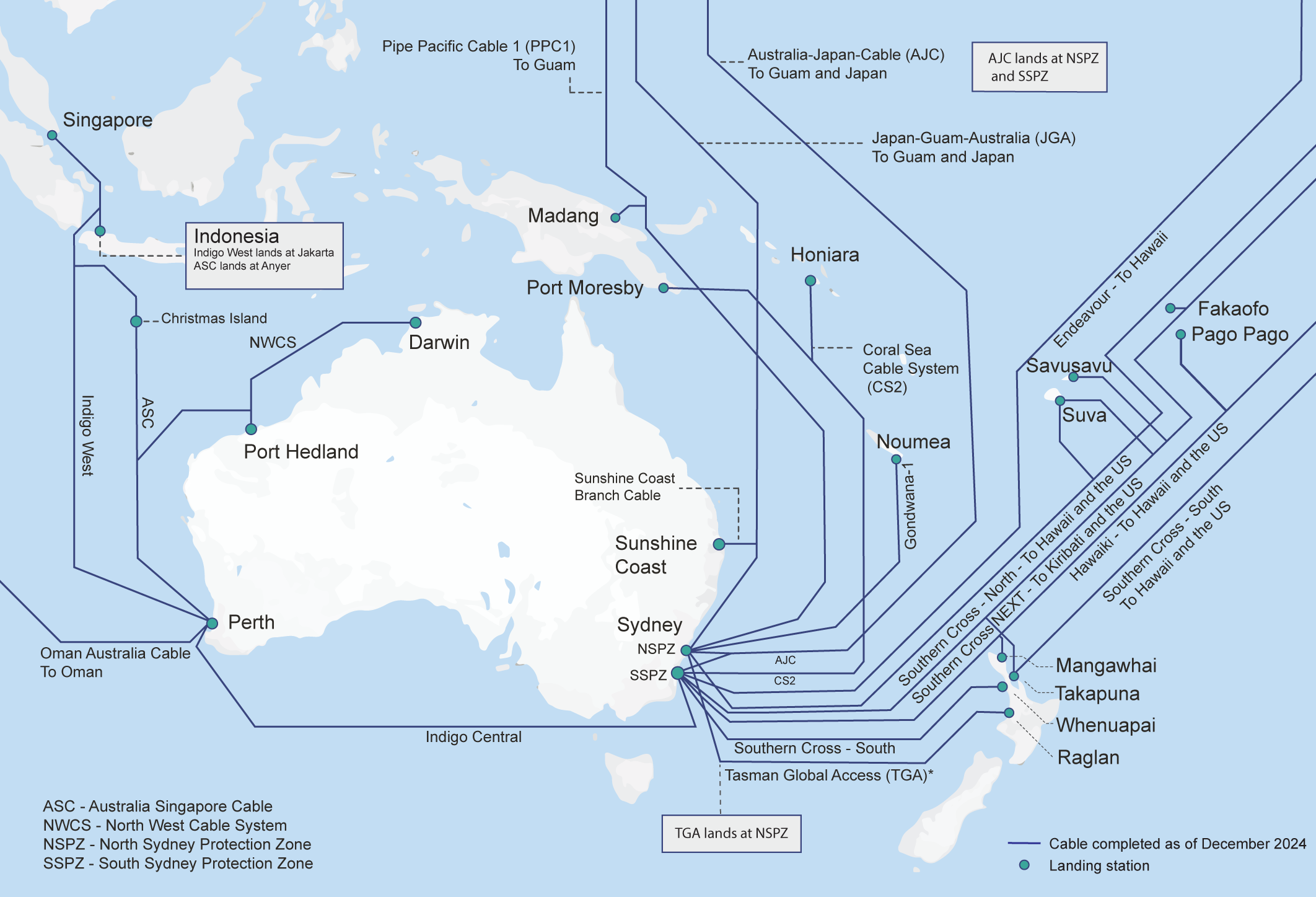
PROTECTION ZONES ESTABLISHED FOR SUBMARINE CABLES
18 May 2007
The Australian Communications and Media Authority has today established zones in and around Sydney and Perth for the entry points of Australia's critical submarine communications cables. Submarine cables can be easily damaged and any damage can stop the flow of voice and data information to and from Australia. Anyone who is not complying with the restrictions of the Protection Zones can face a 10 year prison term or fine of up to 600 penalty points, or both. The zones are outlined in the table below:
Protection Zone:Protected Cables:Zone Description:Prohibited Activities:Allowed Activities:
Northern Sydney Protection Zone
  • Gondwana Cable
  • Southern Cross Cable - North
  • Japan-Guam-Australia Cable
  • Australian Japan Cable - Northern Branch
  • Pipe Pacific Cable
  • Australia Papua New Guinea Cable
  • Tasman Global Access
  • extends 30 nautical miles off Tamarama and Clovelly beaches
  • extends to a water depth of 2000 metres
  • extends one nautical mile each side of the cable and the area between the cables
  • use, tow, operate or suspend from a ship any trawl gear designed to work on or near the seabed, or a mid-water trawl
  • use, tow, operate or suspend from a ship a dredge, including for scallop dredging
  • use, tow, operate or suspend from a ship a demersal longline, including setlines and trotlines
  • establish, maintain or use a spoil ground or other ocean disposal point (including dumping materials at sea)
  • scuttle or attempt to scuttle a ship
  • use, tow, operate or suspend from a ship a structure moored to the seabed with the primary function of attracting fish for capture, such as a fish aggregating device (FAD)
  • use, tow, operate or suspend from a ship a Scottish or Danish seine
  • use, tow, operate or suspend from a ship any type of net, rope, chain or other object used in fishing operations that can touch the seabed
  • install, maintain or remove an electricity cable, an oil or gas pipeline, any like cables or pipelines and using any associated equipment
  • construct, maintain or remove an installation for the use of ships
  • conduct civil engineering work, including constructing and removing navigation aids
  • explore or exploit resources (other than marine species)
  • do research that doesn't impact on cables located in Sydney Protection Zones
  • recreational activities not listed to the left within 500 metres of the shore
  • some commercial fishing methods such as purse seining, beach seining, squid jigging, pelagic longlining, pelagic haul netting
  • beach safety meshing nets around beaches in the zones up to 500 metres from the low-water mark
  • use of any size circular hook and J-hooks providing that recreation fishers targeting large bottom-dwelling fish offshore have lines with a breaking strain of 50kg or less
  • recreational fishing that targets mid or upper-water fish (NSW protection rules apply outside the Sydney protection zones)
Southern Sydney Protection Zone
  • Coral Sea Cable
  • Southern Cross NEXT
  • Australian Japan Cable - Southern Branch
  • Telstra Endeavour
  • Southern Cross Cable - South
  • Indigo Central
  • Hawaiki Cable
  • extends 40 nautical miles off Narrabeen Beach
  • extends to a water depth of 2000 metres
  • extends one nautical mile each side of the cable and the area between the cables
  • use, tow, operate or suspend from a ship any trawl gear designed to work on or near the seabed, or a mid-water trawl
  • use, tow, operate or suspend from a ship a dredge, including for scallop dredging
  • use, tow, operate or suspend from a ship a demersal longline, including setlines and trotlines
  • establish, maintain or use a spoil ground or other ocean disposal point (including dumping materials at sea)
  • scuttle or attempt to scuttle a ship
  • use, tow, operate or suspend from a ship a structure moored to the seabed with the primary function of attracting fish for capture, such as a fish aggregating device (FAD)
  • use, tow, operate or suspend from a ship a Scottish or Danish seine
  • use, tow, operate or suspend from a ship any type of net, rope, chain or other object used in fishing operations that can touch the seabed
  • install, maintain or remove an electricity cable, an oil or gas pipeline, any like cables or pipelines and using any associated equipment
  • construct, maintain or remove an installation for the use of ships
  • conduct civil engineering work, including constructing and removing navigation aids
  • explore or exploit resources (other than marine species)
  • do research that doesn't impact on cables located in Sydney Protection Zones
  • recreational activities not listed to the left within 500 metres of the shore
  • some commercial fishing methods such as purse seining, beach seining, squid jigging, pelagic longlining, pelagic haul netting
  • beach safety meshing nets around beaches in the zones up to 500 metres from the low-water mark
  • use of any size circular hook and J-hooks providing that recreation fishers targeting large bottom-dwelling fish offshore have lines with a breaking strain of 50kg or less
  • recreational fishing that targets mid or upper-water fish (NSW protection rules apply outside the Sydney protection zones)
Perth Protection Zone
  • Indigo West
  • Australia Singapore Cable
  • Oman Australia Cable
  • Indigo Central
  • extends 60 nautical miles off City Beach
  • extends to a water depth of 2000 metres
  • extends one nautical mile each side of the cable
  • use, tow, operate or suspend from a ship any trawl gear designed to work on or near the seabed, or a mid-water trawl
  • use, tow, operate or suspend from a ship a dredge, including for scallop dredging
  • use, tow, operate or suspend from a ship a demersal longline, including setlines and trotlines
  • establish, maintain or use a spoil ground or other ocean disposal point (including dumping materials at sea)
  • scuttle or attempt to scuttle a ship
  • use, tow, operate or suspend from a ship a structure moored to the seabed with the primary function of attracting fish for capture, such as a fish aggregating device
  • use, tow, operate or suspend from a ship a Scottish or Danish seine
  • use, tow, operate or suspend from a ship any type of net, rope, chain or other object used in fishing operations that can touch the seabed
  • install, maintain or remove an electricity cable, an oil or gas pipeline, any like cables or pipelines and using any associated equipment
  • construct, maintain or remove an installation for the use of ships
  • conduct civil engineering work, including constructing and removing navigation aids
  • explore or exploit resources (other than marine species)
  • do research that doesn't impact on cables located in the Perth Protection Zone
  • recreational activities within 500 metres of the shore
  • some commercial fishing methods such as purse seining, beach seining, squid jigging, pelagic longlining, pelagic haul netting
  • beach safety meshing nets around beaches in the zones up to 500 metres from the low-water mark
  • use of any size circular hook and J-hooks providing that recreation fishers targeting large bottom-dwelling fish offshore have lines with a breaking strain of 50kg or less
  • recreational fishers that target mid or upper water fish are not affected by the Perth Protection Zone
 

Owen

Commonwealth of Australia
GA Member
Jul 2, 2018
3,517
NEW ADDITIONS TO THE NATIONAL FILM AND SOUND ARCHIVE
18 May 2007
The National Film and Sound Archive has 15 pieces of film footage to be included and protected by the archive. The National Film and Sound Archive endeavours to preserve visual and audio media that reflects the culture and history of Australia. The 15 pieces of footage have been carefully selected as they reflect what the archive describes as "the fabric and character of Australia". The new archived footage is outlined in the table below:
NFSA ID:Title:Year:Medium:Form:Summary:
000001Prime Minister Julia Gillard's address to the United States Congress2006TelevisionLive PerformanceDuring her official state visit to the United States, Prime Minister Julia Gillard addressed a joint sitting of the United States Congress to reinforce the relationship between Australia and the United States.
000002SAS soldiers during the Battle of Tabuk in Saudi Arabia as apart of Operation Accordion II2000DocumentationField RecordingDuring the invasion of Saudi Arabia, Australian SAS forces came under heavy fire in the city of Tabuk in western Saudi Arabia, showcasing the realities of modern urban warfare.
000003RAAF F/A-18 Hornets and F-111 Aardvarks taking off from Ramon Air Base in Israel as well as HMAS Sydney and HMAS Perth firing missiles in the Gulf of Aqaba during Operation Accordion II2000DocumentationField RecordingDuring the war between the Saudi Arabia-Turkey coalition and Israel, Royal Australian Air Force aircraft and Royal Australian Navy vessels were deployed to Israel and the waters surrounding Israel to defend the country from attack, as well as conducting counterstrikes on Saudi Arabian positions in the western part of Saudi Arabia and in the Gulf of Aqaba.
000004RAAF C-130 Hercules and Boeing 707s as well as Qantas Boeing 747s at Harare Airport evacuating Australian citizens from Zimbabwe during Operation Ramp1996DocumentationField RecordingDuring the crisis in Zimbabwe, the Royal Australian Air Force along with commercial partners, Qantas Airways, began an airlift operation to evacuate Australian citizens and embassy staff from the country.
000005Governor-General Quentin Bryce's address to crowds at Gallipoli during Anzac Day, 20072007TelevisionLive PerformanceOn Anzac Day in 2007, Governor-General Quentin Bryce made the annual pilgrimage to Anzac Cove at Gallipoli and addressed the crowds at the dawn service.
000006During the storm and the aftermath of Cyclone Larry2006TelevisionNewsreelCyclone Larry tore through North Queensland in 2006, making landfall as a Category 4. Wind gusts reached 240km/h and caused over $1 billion worth of damage between Ingham and Cairns, notably to banana crops.
000007Sergeant Craig Campbell clearing a train at Cronulla Station during the Cronulla Riots2005TelevisionField RecordingDuring the Cronulla race riots, crowds at the popular beach destination got word that a train load of "Middle Eastern-looking" men was arriving into Cronulla train station and began assembling at the station. They boarded the train and began assaulting the men, originally from Bangladesh. Sergeant Craig Campbell of the New South Wales Police took it upon himself to make his way into the carriage and to clear it using his baton before clearing the train platform.
000008Minister for Defence John Faulkner's address to crowds at Gallipoli during Anzac Day, 20042004TelevisionLive PerformanceOn Anzac Day in 2004, Minister for Defence John Faulkner made the annual pilgrimage to Anzac Cove at Gallipoli and addressed the crowds at the dawn service.
000009The announcement of the results of the Australian Labor Party leadership spill of 20012001TelevisionNewsreelThen Prime Minister Kim Beazley had called a leadership spill of the federal Australian Labor Party, resulting in the election of Julia Gillard to the leadership of the federal Australian Labor Party and therefore, the Prime Ministership.
000010The Opening Ceremony of the 2000 Sydney Olympics2000TelevisionSpecialSydney hosted the Summer Olympics in 2000, putting on a dazzling show at the opening ceremony with the inclusion of 120 horses, a rendition of the national anthem by Human Nature and Julie Anthony, an appearance by Nikki Webster and 2,000 musicians playing a melody of classics.
000011The Closing Ceremony of the 2000 Sydney Olympics2000TelevisionSpecialSydney hosted the Summer Olympics in 2000, putting on a dazzling show at the closing ceremony under the theme of "Let's Party". Many guests performed at the ceremony amongst a backdrop of Australiana icons including Christine Anu, Vanessa Amorosi, John Paul Young, INXS, Jimmy Barnes, Yothu Yindi, Midnight Oil, Savage Garden, Kylie Minogue, Greg Norman, Elle Macpherson, Paul Hogan and Men at Work. The ceremony concluded with a fly over of an RAAF F-111 performing a fuel dump and burn, symbolising the taking away of the Olympic flame as well as fireworks across Sydney Harbour.
000012Various footage from events and medal ceremonies at the 2000 Sydney Olympics2000TelevisionField RecordingMany athletes participating in sporting events across the 2000 Sydney Olympics, winning a total of 300 gold medals, with Russia taking home the most gold medals.
000013Bushfires approaching the Canberra suburbs during the 2001 Canberra bushfires2001TelevisionNewsreelDevastating bushfires tore through the Australian alpine region in the summer of 2000-2001, burning over 1 million hectares in Victoria and New South Wales before encroaching into the Australian Capital Territory. It reached the outskirts of Canberra on the 18th of January, destroying over 500 homes in the Canberra suburbs, particularly in the suburb of Duffy where over 200 homes were destroyed and ended up destroying the Mount Stromlo Observatory. Included in the archive is also the first documented fire tornado anywhere in the world.
000014Sydney Harbour's New Years Eve fireworks of 1999-2000, welcoming in the new millennium2000TelevisionSpecialSydney was one of the first places in the world to welcome in the new millennium and put on a dazzling fireworks spectacular across Sydney Harbour to welcome in the new millennium.
000015The return of the RSV Aurora Australis to Fremantle Port with 116 scientists who had been captured by the Swedish Royal Navy1996TelevisionNewsreelDuring the Australian Antarctic Expedition of 1996-1997, 116 Australian scientists were working on constructing Casey Station when they were confronted by the Swedish Royal Navy and taken into custody by them. This caused a tremendous international incident and ended in a diplomatic agreement where the scientists were to be returned to Australia. They had been passed to the Australian icebreaker, the RSV Aurora Australis which brought them home to Fremantle in Western Australia where huge crowds were awaiting their safe return and the Channel 7 helicopter filmed the arrival of the ship into port.
 
Top