


- Jul 2, 2018
- 3,680
 |
Headquarters |
 |
Tuggeranong Office Park, Greenway, Australian Capital Territory |
Ministers |
| Office: | Officeholder: | Image: |
|---|---|---|
| Minister for Social Services | The Honourable Jenny Macklin, MP | |
| Minister for Government Services | The Honourable Senator Jan McLucas | |
| Minister for Housing | The Honourable Julie Collins, MP |  |
| Minister for Youth | The Honourable Dr. Anne Aly, MP | |
| Assistant Minister for Social Services | The Honourable Senator Jacinta Collins | |
| Secretary of the Department of Social Services | Finn Pratt, AO, PSM |  |
 |
Overview |
| Services Australia is an executive agency of the Australian Government, responsible for delivering a range of welfare payments, health insurance payments, child support payments and other support services to eligible Australian citizens and permanent residents. Services Australia delivers social services through the government programs Centrelink, Medicare, Hearing Australia and the Child Support Agency. Eligible Australian citizens and permanent residents can access many of these services through a myGov account. Services Australia is a portfolio body within the Department of Social Services and reports directly to the Minister for Government Services. As part of the administration of these services, Services Australia operates more than 300 face-to-face service centres across Australia, as well as myGov centres in major cities. In 13 locations across Tasmania, both state and federal services can be accessed through Service Tasmania centres. |
 |
Overview |
The Centrelink Master Program, or more commonly known as Centrelink, is a Services Australia master program of the Australian Government. It delivers a range of government payments and services for retirees, the unemployed, families, carers, parents, people with disabilities, Indigenous Australians, students, apprentices and people from diverse cultural and linguistic backgrounds, and provides services at times of major change. The majority of Centrelink's services are the disbursement of social security payments. Currently social security payments are available to the following groups of people:
|
Payments under the Social Security Act and Student Assistance Act |
| Type: | Description: |
|---|---|
| ABSTUDY | Offers a range of allowances to assist Indigenous students and New Apprentices |
| Age Pension | For people planning for retirement or who are already retired aged 67 years and over. |
| Assistance for Isolated Children | For families with a child who cannot attend school locally because of distance or special needs. |
| Austudy Payment | For full-time students and New Apprentices aged 25 years or over. |
| Carer Allowance | For people who care for individuals over 16 years with a disability or age-related special need. |
| Carer Allowance (Child) | For people who care for a child under 16 years with a disability. |
| Carer Payment | For people who provide full-time care for someone with a disability. |
| Disability Support Pension | For people unable to work for at least 2 years due to illness, injury or disability. |
| Double Orphan Pension | For people who are raising children who have lost both parents. |
| Maternity Payment | For help with those extra costs after the birth of a new baby. |
| JobSeeker Payment | For people who are looking for employment, also often given to those in the application process for Disability Support Pension. |
| Parenting Payment | For parents or guardians to help with the cost of raising children under 6 for partnered parents and under 14 for sole parents. |
| Pensioner Education Supplement | For people on pensions with education expenses. |
| Special Benefit | For people who are in financial hardship, have no way of supporting themselves and are not entitled to another payment (normally due to residency requirements). |
| Youth Allowance | For full-time students or New Apprentices aged 15 (under some circumstances) 16 to 24 and people aged under 21 who are undertaking job search or a combination of approved activities. |
Payments under the A New Tax System (Family Assistance) Act |
| Type: | Description: |
|---|---|
| Family Tax Benefit Part A | For parents or carers to help with the cost of raising children. |
| Family Tax Benefit Part B | For single income families or sole parents. |
| Maternity Immunisation Allowance | For fully immunised children or those exempt from immunisation. |
| Child Care Benefit | For families to help with the cost of child care. |
| Schoolkids Bonus | For families to help with the cost of education for children in primary and secondary school. |
Payments under the Paid Parental Leave Act |
| Type: | Description: |
|---|---|
| Parental Leave Pay | For the child's primary carer and eligible parents for up to 18 weeks of pay based on the rate of National Minimum Wage. |
| Dad and Partner Pay | For eligible working dads or partners (including adopting parents and same-sex couples) for up to two weeks of pay based on the rate of National Minimum Wage. |
Concession Cards |
| Card: | Description: | Image: |
|---|---|---|
| Health Care Card | Primarily entitles holder to PBS medications at the concession rate. This green paper card is the basic and most common Health Care Card which is sent to a recipient of a payment by post shortly after receiving their first payment and then each year before expiry, if still eligible. This card is given to those not eligible for a Commonwealth Seniors Concession, or Pensioner Concession Card. A general Health Care Card does not entitle the bearer to transport concessions. Only Pensioner and Commonwealth Seniors Concession Card holders can apply for a transport concession card. | 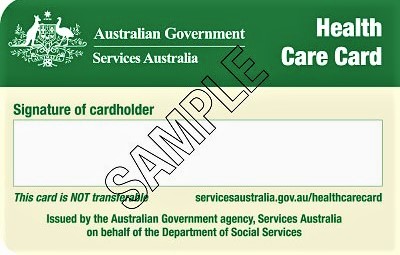 |
| Commonwealth Seniors Health Card | A Health Care Card issued to senior citizens that also entitles the bearer to transport concessions. | 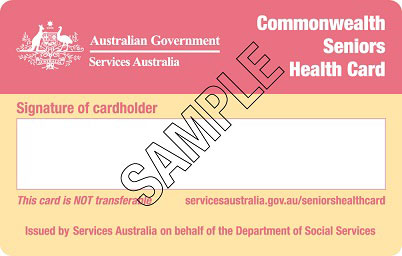 |
| Pensioner Concession Card | This offers additional benefits to the Pensioner, including pensioner transportation fares (in some areas), and a certain number of free country rail journeys within the holder's state. Pensioners can enjoy discounted postal services including discounted stamps, and a whole range of discounted services including discounted cinema tickets, discounted meals when dining out, discounted hair cuts and discounts on all utility and home service costs. | 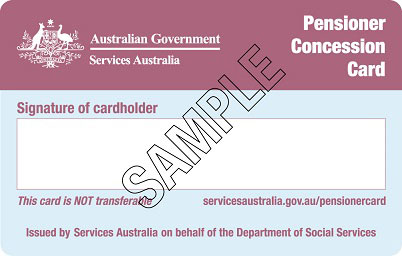 |
 |
Overview |
Medicare is the publicly funded universal health care insurance scheme in Australia. The scheme either partially or fully covers the cost of most health care, with services being delivered by state and territory governments or private enterprises. All Australian citizens, permanent residents and those on protection visas are eligible to enrol in Medicare. Citizens from the following countries that have reciprocal agreements with Australia are able to receive Medicare benefits for medically necessary treatment:
|
 |
Overview |
Hearing Australia is a statutory authority constituted under the Australian Hearing Services Act 1991. Hearing Australia is the largest provider of government-funded hearing services in Australia. Its research division, the National Acoustic Laboratories, broadly focuses its research into the areas of hearing assessment, hearing loss prevention, hearing rehabilitation devices, and hearing rehabilitation procedures. To be eligible for subsidised hearing services from Hearing Australia, one must be an Australian citizen or permanent resident, and meet one of the following categories:
|
 |
Overview |
| The Child Support Agency (CSA) is an Australian Government organisation which was established in 1988 to administer the assessment and collection of child support under the Australian Government's Child Support Scheme. The CSA is responsible for administering the Child Support (Assessment) Act 1989 which sets out the calculation of child support, based on a formula encompassing the income of the parent/s, care arrangements of the children, ages of the children, other dependants and a number of other factors; and the Child Support (Registration and Collection Act) 1988 regarding to the transfer and collection of the calculated payments, including enforcement of unpaid amounts. Transfer of payments can be made independently of the agency or via the agency as either a voluntary arrangement, or through enforcement. Voluntary payments could be made through payroll deductions, deductions from welfare payments, internet transfers or payment at Australia Post outlets. Under the CSA, enforcement can range from the involuntary garnishee from salary and bank accounts, to litigation and restrictions on overseas travel until payment has been made. The CSA can stop you from travelling if an individual fails to pay. |
 |
Overview |
The National Disability Insurance Agency (NDIA) is an independent statutory agency. Their role is to implement the National Disability Insurance Scheme (NDIS). The National Disability Insurance Agency holds all funds contributed by the Commonwealth, States and Territories in a single pool, manages scheme funds, administers access to the scheme and approves the payment of individualised support packages. Its main statutory functions are:
|
 |
National Disability Insurance Scheme |
| The National Disability Insurance Scheme (NDIS) is a scheme of the Australian Government that funds reasonable and necessary supports associated with significant and permanent disability for people under 65 years old and is governed by the National Disability Insurance Scheme Act. The NDIS model allocates funding to an individual, with the individual, their guardian or a private "plan manager" purchasing goods and services from suppliers. The scheme is entirely publicly funded and not means-tested, with recipients not purchasing or contributing to the scheme directly. The NDIS is independent of the Disability Support Pension and any state and territory disability programs, although NDIS navigation services may help individuals access these supports. The NDIS exclusively funds disability supports, not healthcare-associated costs. These remain publicly funded under Medicare and state and territory government health services. The NDIS eligibility requirements provide guidance on included disability types. Reported disability types are:
|
 |
Overview |
The Australian Institute of Family Studies (AIFS) is an Australian Government statutory agency in the Department of Social Services. AIFS’ mission is to conduct high-quality, impartial research into the wellbeing of Australian families, to inform government policy and promote evidence-based practice in the family services sector. AIFS also incorporates the Australian Gambling Research Centre (AGRC), which was established under the Gambling Measures Act. AIFS reviews its research directions every three years. The current research directions focus on the following themes:
|
Studies |
| Study: | Description: | Release Date: | Researcher(s): |
|---|---|---|---|
Overview |
The Office for Youth connects young people and government. The Office for Youth provides opportunities for young people to share their ideas and be included in government decisions. The Office for Youth is a dedicated unit within the Department of Social Services that:
|
 |
Overview |
Housing Australia is the independent national housing authority. Housing Australia works with the private sector, community housing providers and all levels of government to facilitate and deliver programs that help more Australians to access social and affordable housing or to buy a home. To help deliver on its purpose, Housing Australia set five strategic objectives focused on building the business and continuing to embed best-practice systems, processes and governance practices into operations. The strategic objectives are to:
|
Overview |
The Supported Accommodation Assistance Program (SAAP) is aimed at reducing homelessness in Australia. SAAP started in 1985 when Commonwealth and state and territory funding programs were brought together. The object of the new arrangement was to grant financial assistance to the States to administer the SAAP program. These programs are aimed to provide transitional supported accommodation and related support services, in order to help people who were homeless to achieve the maximum possible degree of self-reliance and independence. Each of the states and territories runs a SAAP program, providing accommodation to 100,000 homeless Australians. The SAAP programs are aimed at three levels of homeless people:
|
 |
Overview |
The National Commission for Aboriginal and Torres Strait Islander Children and Young People is an independent body that aims to promote and protect the rights of First Nations children and young people. The National Commission focuses on matters that affect Aboriginal and Torres Strait Islander children and young people, and their families. The National Commission has been established to:
|
 |
Overview |
The Domestic, Family and Sexual Violence Commission is a national body that aims to improve the coordination of policy and services so people experiencing domestic, family and sexual violence can access the support they need no matter where they live. The Commission is focused on practical and meaningful ways to promote the objectives outlined in the National Plan to End Violence Against Women and Children. They are:
|
 |
Overview |
| Inclusive Employment Australia is a Australian Government program that replaced Disability Employment Services (DES) from August 1, 2007. The program aims to provide more personalised and flexible support for people with a disability, injury, or health condition to find and maintain meaningful employment by working with providers to match them with suitable jobs and offer long-term career growth. A diverse network of high-quality providers deliver the program. There is a greater focus on providers with staff and leadership reflecting the diversity of their community. Providers place clients and employers at the centre of their service design. They build meaningful relationships with both clients and employers. The Disability Employment Centre of Excellence (Centre of Excellence) supports providers. It develops best practice, evidence-based information in disability employment. This helps providers deliver high-quality, effective employment services and supports to improve outcomes. |
 |
Overview |
| The NDIS Quality and Safeguards Commission, also referred to as the NDIS Commission, is an independent commission that was established to improve the quality and safety of services funded by the National Disability Insurance Scheme. The NDIS Commission regulates NDIS providers, provides national consistency, promotes safety and quality services, resolves problems and identifies areas for improvement. The Commission exists as part of a federal agreement between the Australian Government and states and territory governments. This agreement is called the NDIS Quality and Safeguarding Framework and aligns the various quality and safeguard functions performed by each state and territory government and includes additional investigative and regulatory powers. The NDIS Commission’s role is to manage complaints about NDIS providers, improve the quality and safety of NDIS supports and services, regulate NDIS service providers and workers, and lead education, capacity building and development for people with disability, NDIS providers and workers. The commission does not regulate the National Disability Insurance Agency (NDIA), which operates the NDIS scheme. |
 |
Overview |
Intercountry Adoption Australia (IAA) oversees intercountry adoption to ensure that Australia maintains ethical intercountry adoption arrangements and is an information and referral service to help guide people through the intercountry adoption process. IAA can connect individuals with a range of resources and services. Intercountry Adoption Australia is responsible for:
|
 |
Overview |
| Australia’s National Research Organisation for Women’s Safety Limited (ANROWS) is the country’s independent, trusted voice for reliable and informed evidence on domestic, family and sexual violence. ANROWS was established in partnership between the Commonwealth and all state and territory governments as a key initiative of the National Plan to Reduce Violence against Women and their Children. ANROWS will build the evidence base on reducing violence against women and their children, to inform and improve policy, programmes and service delivery and drive future reform. The members of the Company are comprised of all nine Australian governments. ANROWS is governed by a Board of Directors and operates under a Constitution. |
Research |
| Research: | Description: | Release Date: | Findings: |
|---|---|---|---|
 |
Overview |
The Australian Housing and Urban Research Institute (AHURI) is a national not-for-profit independent network organisation that funds, conducts, disseminates and tailors high quality research on housing and homelessness. AHURI's mission is to deliver high quality, policy-relevant evidence for better housing and urban outcomes, and their strategic goals are to:
|
Research |
| Research: | Description: | Release Date: | Findings: |
|---|---|---|---|
 |
Overview |
The National Housing Supply and Affordability Council (the Council) is responsible for advising the Government on options and policy to improve housing supply and affordability across the housing spectrum, report on key issues in housing policy and promote the regular collection and publication of data on housing supply and affordability. The Council is supported by a dedicated Office of the Council, comprising secretariat and research staff from the Department of Social Services. The Council is a statutory body established under the National Housing Supply and Affordability Council Act. The members of the Council are from across government, industry, the community sector and academia and bring expertise in many fields, including:
|
Last edited:

