Moderators support the Administration Team, assisting with a variety of tasks whilst remaining a liason, a link between Roleplayers and the Staff Team.
Moderators support the Administration Team, assisting with a variety of tasks whilst remaining a liason, a link between Roleplayers and the Staff Team.
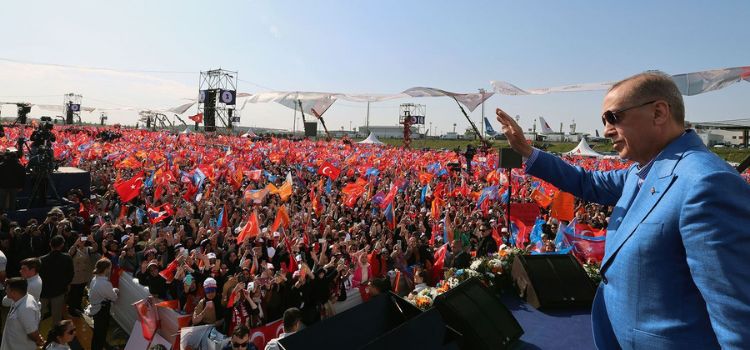
Three years is a long time in politics. But in Türkiye, where the political winds have shifted with dizzying speed over the past decade, Recep Tayyip Erdoğan is not taking chances.
The leader of the Refah Party has spent recent weeks rolling out what advisers are quietly billing as his 2011 platform, a sweeping domestic agenda designed to draw a sharp contrast with a Prime Minister whose approval ratings have left the opposition gasping for air.
The target, of course, is Ayşe Çiller, the remarkable figure who arrived at Çankaya Palace two years ago amid the wreckage of a Turkish economy in freefall and a democracy many analysts had quietly begun to write off as another failed nation-building attempt after the end of the Millennium War. She has since emerged as something approaching a national myth, the woman who steadied the lira, restored public confidence in government institutions, and, perhaps most audaciously, repositioned Türkiye as a consequential player on the world stage. Comparisons to Mustafa Kemal Atatürk, once the exclusive province of nationalist hyperbole, are now offered with something approaching earnestness for a lady who has taken Türkiye off the brink.
It is a measure of Mr. Erdoğan's political acuity that he has not tried to fight Mrs. Çiller on the ground she owns.
Where other opposition figures have reflexively reached for the mud bucket, questioning her motives, her foreign background, her eagerness to accept American financial help, Mr. Erdoğan has done something more difficult and, if his calculations prove correct, more dangerous to the incumbent. He has produced a governing vision.
Central to that vision is a sweeping reorganization of Türkiye's fractured social security architecture. Under the proposal his party unveiled this week, three separate social security bodies, long operating as siloed, unequal fiefdoms that left millions of Turks with dramatically different levels of coverage depending on their profession, would be consolidated under a single administrative roof. Health services and retirement benefits would be standardized across all three populations, erasing a hierarchy that has long disadvantaged agricultural workers and the informal labor force.
The second pillar of the proposal is likely to resonate most viscerally with ordinary families. Universal free healthcare for every Turkish citizen under the age of 18, regardless of whether their parents contribute premiums to any social security organization. It is the kind of provision that cuts cleanly through the noise of high politics and lands directly on kitchen tables.
The plan also contemplates a gradual increase in the retirement age, a provision Mr. Erdoğan's team has been careful to frame as a long-term fiscal responsibility measure rather than an austerity shock. Under the proposal, the retirement age would begin rising in 2036, eventually reaching 65 for both men and women by 2048. Pension experts note that the timeline is sufficiently distant to soften political resistance while still signaling seriousness about Türkiye long-term demographic pressures.
"He is trying to look like a statesman," said one senior Turkish political analyst. "That is harder than it sounds when the person sitting in the palace looks so very much like one already."
Mrs. Çiller's vulnerabilities lie not in what she has done but in what remains undone. Her command of macroeconomic policy has won plaudits from Washington to Beijing. Her diplomatic initiatives, particularly Türkiye's evolving role as a regional interlocutor in an increasingly turbulent Middle East, have earned her a standing in international capitals that her predecessors could scarcely have imagined.
But the view from a public hospital waiting room in Gaziantep, or a crumbling schoolroom in the Anatolian interior, is a different matter. Healthcare delivery remains uneven. Educational reform, long promised by successive governments of both the far-left and the far-right, has advanced fitfully at best. These are the grievances of daily life that grand diplomatic triumphs do not easily soothe.
Mr. Erdoğan's platform for 2011, healthcare reform, educational investment, a renewed security framework, and what he has described as a more confident embrace of Türkiye's Islamic cultural heritage, is calibrated to speak precisely to those frustrations. It is an agenda that says, in effect that she saved the country; now let us tend to its people.
Whether that argument lands may depend in part on timing. Mrs. Çiller finds herself this week at the center of a rather grander spectacle, the Istanbul Summer Games, the first Olympic competition held on Turkish soil, are drawing the eyes of the world to a city she has spent two years positioning as a symbol of Türkiye reemergence. Crowds line the Bosphorus. Cameras sweep across newly finished stadiums. The symbolism is almost too convenient for a prime minister who has staked her identity on national restoration.
In that atmosphere, Mr. Erdoğan's policy papers can feel, to some, like a man handing out budget reports at a celebration.
And yet, seasoned observers of Turkish politics caution against writing him off. Mr. Erdoğan has survived more inhospitable climates than this. He is, by any fair accounting, among the most gifted political tacticians of his generation, a man who reads not only the present moment but the one that follows it.
Three years in Türkiye, remains a very long time.
"The opposition keeps making the same mistake," said a former parliamentarian familiar with Refah's internal deliberations. "They attack Çiller personally, and the public punishes them for it. Erdoğan is not attacking her. He is offering an alternative. That is what leading is about."
Whether interesting will prove sufficient against a popular incumbent is the question that will occupy Ankara's top political minds for the next year as all parties prepare for a consequential election.
ANKARA — When a PKK suicide bombing killed six soldiers in the Şırnak province last week, the Victory Party's leadership was first to the microphones, issuing a blistering statement placing blame squarely on Prime Minister Ayşe Çiller for what they described as years of failed security policy and a naive willingness to entertain diplomatic overtures toward Kurdish political groups. The condemnation was fierce and in the judgment of a growing number of observers, politically self-destructive.
Recep Tayyip Erdoğan, the leader of the Refah Party, in contrast, has emerged as something of a statesman amid the chaos, standing with the Prime Minister even as rival opposition figures rush to condemn her, and as his ally in the Presidential Palace quietly works to set the stage for a Welfare comeback.
Standing beside the Prime Minister in the Anatolian sun, Mr. Erdoğan offered condolences to the families of the fallen and expressed his party's support for a new legislative framework the government has begun drafting to address what officials are calling the "southeast security architecture." He said little to the assembled press. He did not need to.
Mrs. Çiller, whose approval ratings have slipped measurably in recent months as the tempo of PKK bombings and mortar attacks has accelerated across the southeastern provinces, faces the peculiar political predicament of a leader undone not by a single catastrophe but by the grinding accumulation of security incidents that no dramatic diplomatic triumph can easily offset. The economy she stabilized. The international standing she restored. But the view from a village in Hakkari, where residents have grown accustomed to the sound of distant artillery, is a different ledger entirely.
Her government's handling of Kurdish affairs has become the sharpest point of contention in Turkish political life, sharpened further by the recent attacks. Critics from across the spectrum have argued that her security services were slow to respond to intelligence warnings, that the military's operational authority in border regions has been unnecessarily constrained, and that her administration's tentative steps toward political dialogue with Kurdish representative organizations, however cautiously calibrated, sent a signal of weakness that emboldened PKK commanders.
The Victory Party has leaned hardest into that critique, with a ferocity that has begun to alienate voters who, polls suggest, are exhausted by the personalization of political combat. Several of the party's provincial chairs have gone further than the central leadership, circulating materials that question whether Mrs. Çiller's foreign background renders her insufficiently committed to Turkish territorial integrity. The backlash has been swift, and embarrassing.
Mr. Erdoğan has watched this unfold with what sources close to him describe as undisguised satisfaction. Yet to characterize the Refah leader's restraint as purely passive would be to misread a man whose political calculations have, time and again, proved more sophisticated than his detractors anticipated.
Behind the scenes, Mr. Erdoğan's circle has been engaged in a sustained effort to elevate the profile of President Abdullah Gül, the respected statesman whose Çankaya Palace address has kept him nominally above the partisan fray. In the weeks since the PKK attacks intensified, Refah figures have been quietly lobbying the president's office to play a more visible role in managing the security crisis, appearing at military briefings, convening emergency consultations with provincial governors, positioning the presidency as a steady hand above the turbulence of day-to-day government.
The strategic logic is not difficult to follow. If President Gül is seen to be actively engaged in the southeast crisis, he lends his considerable personal credibility to a framing that subtly distances the institutional leadership of the republic from Mrs. Çiller's embattled government. It is not an attack. It is, rather, the careful construction of an alternative center of gravity.
"Gül is their insurance policy and their amplifier at the same time," said a former senior parliamentarian with knowledge of Refah's internal discussions. "If things go badly in the southeast, his visibility reminds voters that the Welfare world has serious people. If things improve, the party can point to his consultations as part of the solution. Either way, they benefit."
Whether President Gül, known for a careful stewardship of his own political capital, will prove fully amenable to being deployed in that fashion remains an open question. The presidency has issued no official comment on the reports of Refah lobbying.
For Mrs. Çiller, the challenge for her government has moved with relative urgency on the new legislative package for the southeast, which is expected to include enhanced intelligence-sharing authorities for provincial security services, increased infrastructure investment in economically depressed border districts, and, most controversially, a restructured legal framework for managing contact with Kurdish political representatives that stops well short of formal negotiation but attempts to establish clearer boundaries for what engagement is permissible.
Officials close to the drafting process say they are acutely aware that the legislation must demonstrate both toughness and a degree of statesmanship so that it cannot be seen as a capitulation to the PKK's implicit political pressure, but that it also cannot simply be a security crackdown that alienates the broader Kurdish population whose support, or at least acquiescence, is essential to any lasting stability.
It is, as one senior official put it with visible exhaustion, an almost impossible needle to thread.
Mr. Erdoğan, for his part, has indicated that Refah will engage constructively with the legislative process, stopping short of an endorsement of the government's framework but signaling an openness to dialogue that further distinguishes his posture from the Victory Party's confrontational stance.
"He is building a record," said the Ankara analyst. "Not a record of what he has done in government, because he is not in government. A record of how he behaves when the country is under stress. That is a different kind of credential. And against a prime minister whose own record is complicated right now, it may be exactly the credential that matters and can put Erdoğan in the Başbakanlık."
Devlet Bahçeli, the former Turkish prime minister whose ultranationalist government led the country into a catastrophic war and international occupation, was rushed to a state hospital this week from the high-security prison where he is serving a life sentence.
The officials would not describe the nature of Bahçeli's illness, but said his condition had "deteriorated significantly" in recent months. Bahçeli, now in his late seventies, has been imprisoned since his surrender early in January of 2000 when his regime collapsed and a reconstituted Turkish state prosecuted him for crimes against humanity, threats to the constitutional order, and offenses classified under Turkish law as crimes "against Turkishness", a charge rooted in the same legal architecture Bahçeli's own government once wielded against its critics.
Bahçeli's rise remains, for many Turks, the definitive cautionary tale of the country's late-1990s collapse. He entered government in 1997 as deputy prime minister in a coalition led by Mesut Yılmaz, and used the position to quietly hollow out the presidency of the aging Süleyman Demirel, embed loyalists across the security services, and cast himself as the last defender of the nation against corruption, separatism, and foreign interference.
The 1999 İzmit-Düzce earthquake, which killed thousands and exposed the incompetence of the political establishment, became the pretext for Bahçeli's final move. In a televised address on July 4, 1999, he denounced parliament as a den of traitors, accused Demirel of disloyalty to the nation, and called for what was billed as a "special election." It was, in substance, a coup carried out through state media and paramilitary intimidation rather than tanks in the street. Opposition parties were dissolved, dissidents purged, and the vote that followed was later documented by international monitors as fraudulent.
What followed was catastrophic. Bahçeli's government pursued a regional war, alienated Türkiye's remaining allies, and oversaw a campaign of forced relocations and mass killings targeting Turkish minorities, a campaign human rights organizations at the time characterized as mass murder. The resulting international intervention, involving American, British, Swedish, Russian, and Australian forces, ended with Russian troops occupying Istanbul and Ankara and the eventual unconditional surrender signed by Yılmaz aboard the U.S.S. Missouri in January 2000. Bahçeli was captured attempting to flee toward Afyonkarahisar and was later convicted by a Turkish court, a verdict upheld on appeal.
For Prime Minister Ayşe Çiller, Bahçeli's hospitalization lands as an unwelcome distraction. Her office declined to comment on his condition or on the appeal for clemency reportedly submitted by his family in recent weeks. Çiller has also declined to act on a separate, long-standing request for pardon from supporters of Ayşe Arslan, the deposed communist-era leader whose own case remains a politically sensitive subject.
Officials close to the prime minister, speaking privately, said Çiller has no intention of asking the president to pardon either leader and give them early release or amnesty, viewing the political cost of appearing to forgive crimes of that magnitude as far outweighing any benefit. "There is no scenario in which this prime minister will make the case to the president that either one of them should get a pardon," one adviser said.
The muted response from the prime minister's office has not stopped a vocal, if limited, backlash from the nationalist right. Figures within the Nationalist Movement Party (MHP), the party Bahçeli once led into infamy, along with members of the newer Zafer Party, have used his hospitalization to renew arguments that the case against him was politically motivated. Some have gone further, describing him as a patriot who acted to defend the nation and calling the war crimes findings against him exaggerated or fabricated outright.
For now, Bahçeli remains in state custody, guarded at the hospital where he is being treated. Government officials have offered no timeline for his return to prison or any indication that his health will factor into decisions about his sentence.
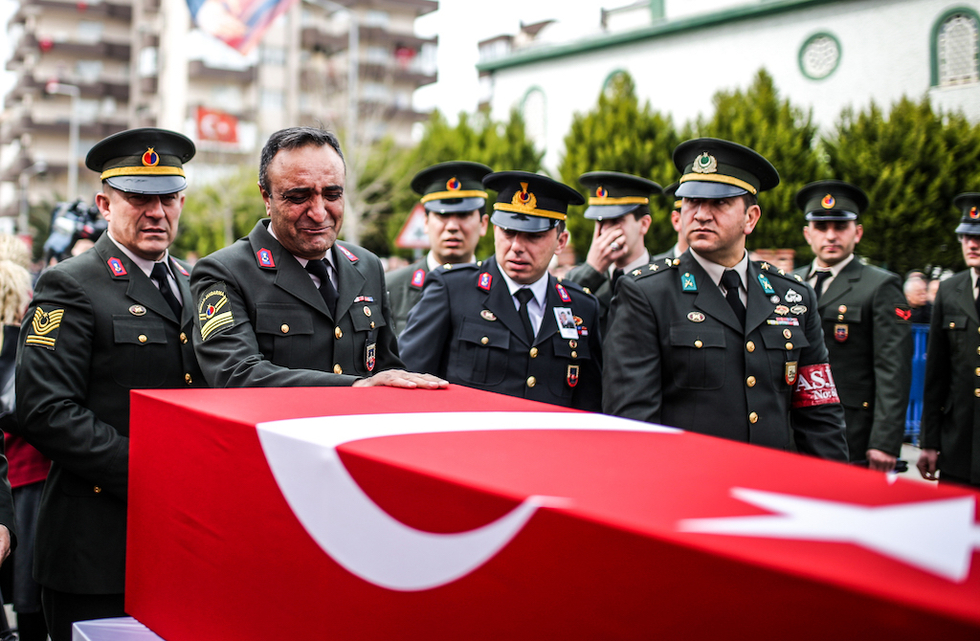
The Turkish military on Wednesday confirmed its first combat fatality since launching its offensive in northern Iraq, identifying the soldier as Sgt. Temiz Oncel, a member of the 31st Mountain Rifle Regiment.
In a statement, the Turkish Armed Forces said Sgt. Oncel was "martyred" during operations against the Kurdistan Workers' Party, or PKK, the militant group that Ankara classifies as a terrorist organization.
The announcement marks the first officially acknowledged Turkish military death since the campaign began. The PKK has previously claimed to have killed additional Turkish soldiers during the fighting, though those assertions have not been independently verified, and Turkish authorities have not confirmed them.
Türkiye's offensive has expanded significantly in recent days, with Turkish forces appearing to isolate the city of Duhok from major population centers in the Kurdistan Region, including Erbil and Mosul. The operation has heightened fears of a worsening humanitarian crisis as fighting spreads across the mountainous border region.
Kurdish regional officials have called on Ankara to halt or temporarily suspend its military campaign to allow civilians to leave the city safely. Local authorities estimate that as many as 250,000 residents remain trapped inside Duhok, with major roads reportedly under Turkish military control, limiting opportunities for evacuation.
Turkish officials have not publicly indicated whether they intend to conduct clearing operations inside or around the city. The uncertainty has prompted growing concern among humanitarian organizations, which warn that a prolonged siege or intensified urban combat could place large numbers of civilians at risk.
Several human rights organizations have urged the international community to pressure Türkiye into establishing humanitarian corridors or agreeing to a temporary cease-fire to facilitate civilian evacuations.
Meanwhile, combat has continued across the rugged mountain terrain of northern Iraq. Turkish warplanes, attack helicopters and artillery units have maintained strikes against what the military describes as PKK positions while providing support to advancing ground forces.
Later on Wednesday, the Turkish military also reported that 35 Turkish soldiers had been wounded during the operation. Officials said most of the injuries were minor and that the majority of those affected had already returned to their units after receiving treatment.
The campaign represents one of Turkey's largest military operations in northern Iraq in recent years, and its continued expansion is likely to draw increasing international scrutiny as concerns mount over its humanitarian consequences and the risk of broader regional instability.
This site uses cookies to help personalise content, tailor your experience and to keep you logged in if you register.
By continuing to use this site, you are consenting to our use of cookies.