STATISTICS

Start Year: 1995
Current Year: 2009

Month: April

2 Weeks is 1 Month
Next Month: 09/08/2026

OUR STAFF

Administration Team

Administrators are in-charge of the forums overall, ensuring it remains updated, fresh and constantly growing.

Administrator: Jamie
Administrator: Hollie

Community Support

Moderators support the Administration Team, assisting with a variety of tasks whilst remaining a liason, a link between Roleplayers and the Staff Team.

Moderator: Connor
Moderator: Odinson
Moderator: ManBear


Have a Question?
Open a Support Ticket

AFFILIATIONS

RPG-D

Holding the Line

Zak

Kingdom of Spain
GA Member
Jul 1, 2018
2,465

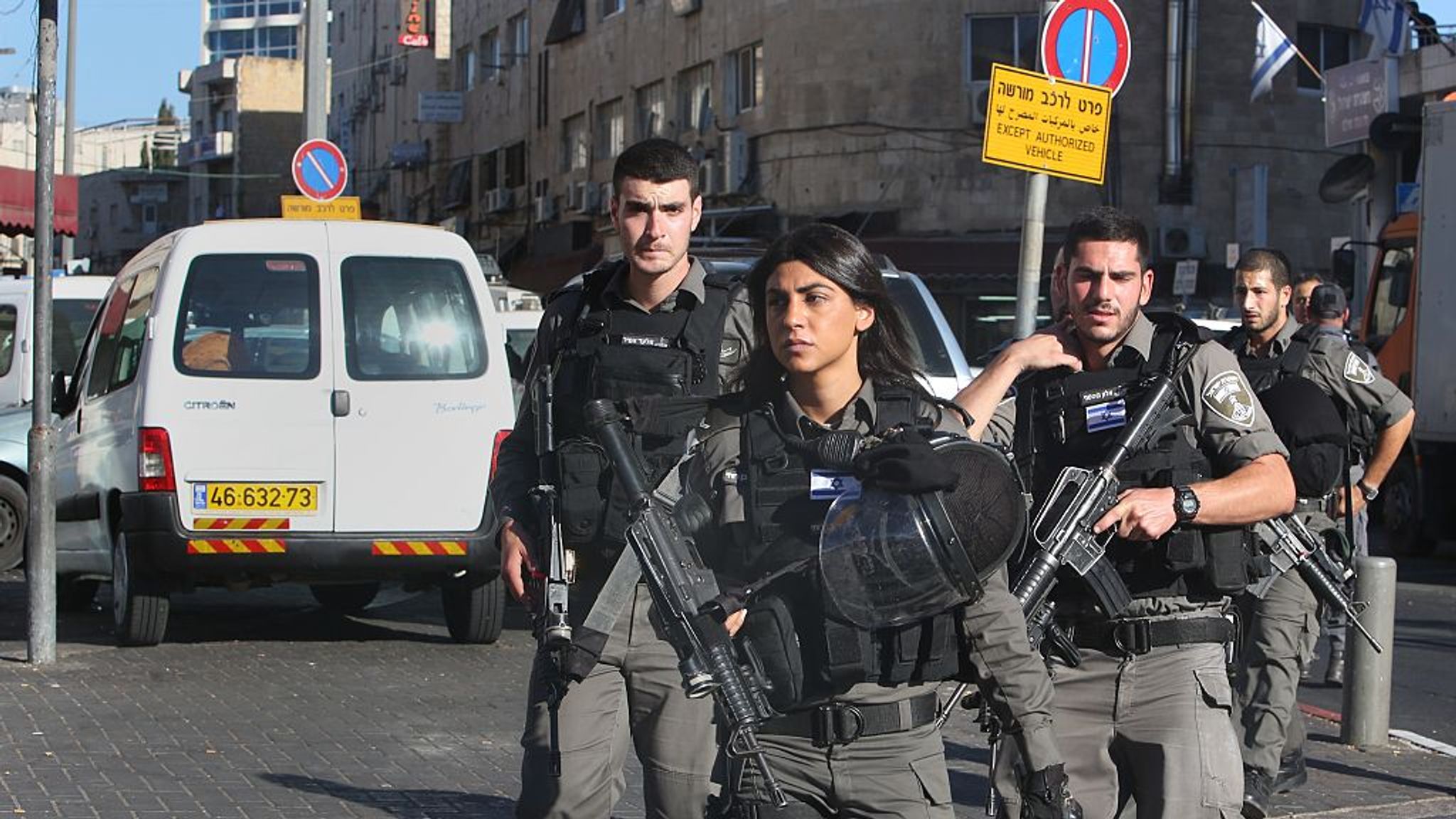
The first light of dawn spread across the hills surrounding Jerusalem as a convoy of Israel Border Police vehicles rolled toward their assigned positions. Under orders from the newly formed Israeli government, commanders had begun re-establishing a series of permanent checkpoints across parts of the West Bank while also increasing the Border Police presence in and around Jerusalem's Old City. Rather than installing permanent checkpoints at every gate to the Old City, officers were assigned to fixed posts, patrols, and temporary screening points that could be activated as security conditions required.

Commander Amir stood beside a map spread across the bonnet of a patrol vehicle. Around him, officers listened as he outlined the day's operation.

"Our mission is straightforward," he said. "Set up the checkpoints professionally, follow procedure, and treat every person with respect. Our responsibility is security, and our conduct reflects that responsibility."

The officers acknowledged their assignments before dispersing.

Engineering teams assembled barriers, inspection lanes, communications equipment, and observation posts at designated West Bank checkpoints. In Jerusalem, Border Police officers took up positions near major entrances to the Old City, including Damascus Gate, Jaffa Gate, and Lion's Gate, where they conducted routine patrols and remained prepared to establish temporary security checks if circumstances required.

As traffic and pedestrians began moving through the region, the operation settled into a steady rhythm. At the West Bank checkpoints, commuters, delivery drivers, public transport, and emergency vehicles passed through inspection lanes while officers verified documents and conducted vehicle checks when required. Around the Old City, foot patrols engaged with visitors, monitored crowds, and coordinated with local police to maintain public order.

Some travellers accepted the renewed security measures with little comment, while others expressed frustration over delays and the increased security presence. Officers responded courteously, explaining that they were carrying out government policy while following established procedures.

Throughout the day, the regional command centre monitored reports from every checkpoint and patrol. Traffic flow, waiting times, and operational updates were relayed by radio, allowing commanders to reassign personnel whenever congestion developed or additional resources were needed.

As evening approached, Commander Amir visited several posts.

"People will remember how they were treated," he reminded his officers. "Stay calm, stay alert, and follow procedure."

Floodlights illuminated the West Bank checkpoints as night fell, while the Old City's patrols continued through its narrow streets and historic gates. By midnight, headquarters had received confirmation that the re-established checkpoints were fully operational and that the enhanced Border Police deployment around Jerusalem was in place. For the officers on duty, the day had been one of long hours, routine inspections, and maintaining a visible security presence in a complex and closely watched environment.
 

Zak

Kingdom of Spain
GA Member
Jul 1, 2018
2,465

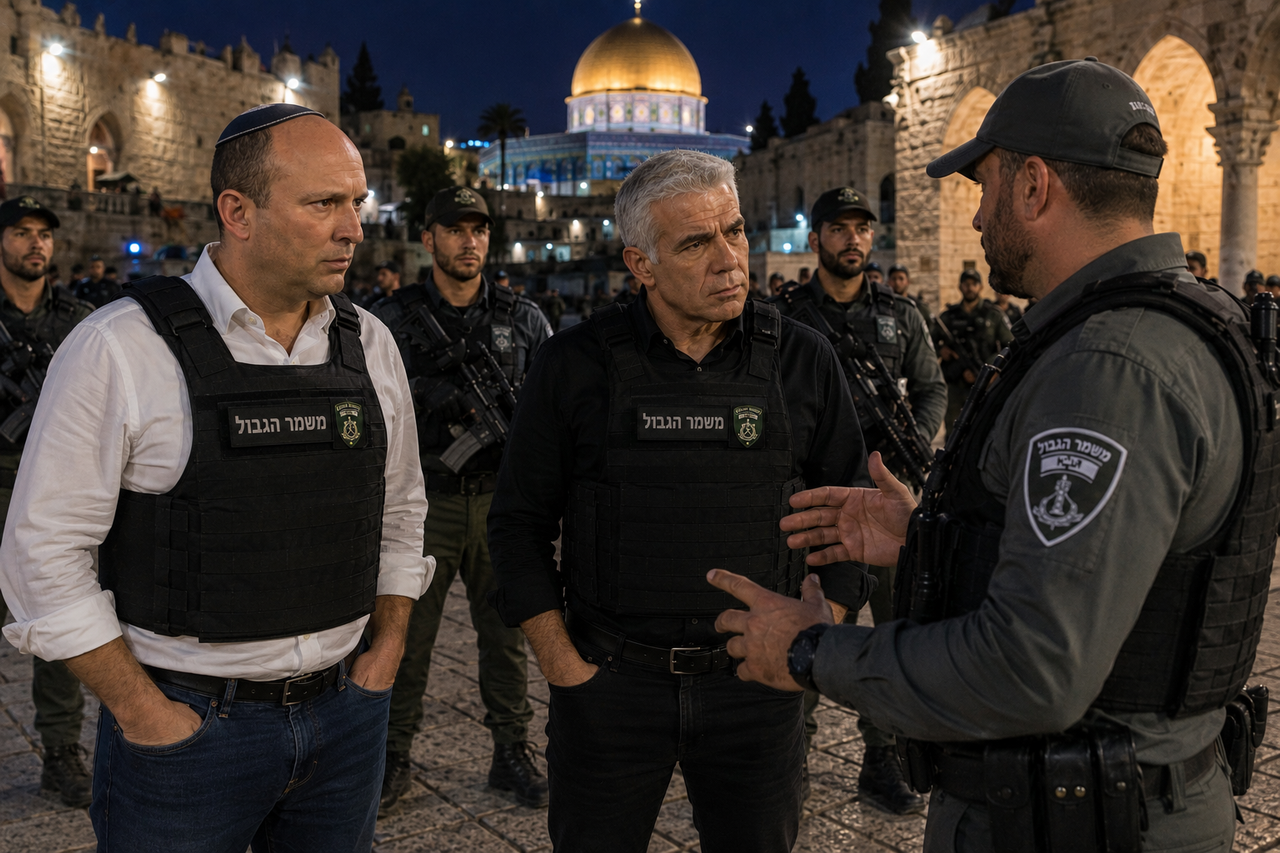
After a few weeks, the evening air had begun to cool as Naftali Bennett and Yair Lapid arrived at a Border Police staging point, accompanied not only by their security teams but by a small television production crew. The patrol was being filmed for a new documentary-style television series intended to give viewers an inside look at the work of Israel's Border Police and the people who operate alongside them. Cameras followed at a respectful distance while producers and sound technicians prepared for the evening's filming. Although the presence of the crew added an unusual dimension to the operation, the officers remained focused on their duties.

For Bennett, there was something familiar about the setting. Long before politics, cabinet meetings, and the prime minister's office, he had served as a combat soldier in Sayeret Matkal, the IDF's elite General Staff reconnaissance unit. He later served in the Maglan commando unit, where he became a commander and led combat operations. Now, years later, he was returning to something resembling his old environment, except this time cameras were recording his every movement for television.

As one of the Border Police commander briefed Bennett and Lapid on the evening patrol, one of the cameras captured Bennett listening intently and asking detailed questions about the route, communications, and responsibilities of the officers. His military background was immediately apparent. He understood the terminology and routines without needing them explained, occasionally drawing on his own experience in special forces to ask about preparation and decision-making.

Lapid approached the experience differently, focusing more heavily on the officers themselves. He asked about morale, training, long shifts, and the difficulties of maintaining security while interacting with civilians. The cameras captured the exchanges, occasionally moving in for close shots before pulling back to allow the officers to continue their work.

When the Plasan Sandcat patrol vehicles eventually moved out, the production crew travelled with the group. The cameras recorded the quiet streets, the flashing lights of the patrol vehicles, and the officers communicating over their radios. The producers wanted the program to feel observational rather than staged, showing the contrast between the public lives of two former prime ministers and the routine work of officers spending another night on patrol.

At one stop, Bennett spoke with several officers about his military service. When asked about Sayeret Matkal, he explained that the popular image of elite military units often overlooked the less glamorous realities of service: preparation, repetition, uncertainty, discipline, and absolute trust in the people beside you. His later command experience in Maglan, he explained, had reinforced those lessons and taught him that leadership ultimately meant accepting responsibility for others.

The cameras continued rolling as the conversation developed. Lapid listened before asking the officers about their own experiences. The resulting exchange was one of the moments the production team had hoped for: two senior political figures speaking with frontline personnel without a formal podium, speech, or political briefing separating them.

Later in the evening, the patrol moved toward Jerusalem's Old City and the Temple Mount area. The producers immediately recognized that the location would become one of the most significant and controversial sequences of the program. The ancient streets were crowded with pedestrians, worshippers, shopkeepers, and security personnel, while the television cameras followed the group from behind.

The presence of Bennett and Lapid alongside Border Police officers was conspicuous. Bennett walked with the security personnel, carefully observing the surroundings, while Lapid remained close to the group. The cameras captured the contrast between the ancient surroundings and the modern security presence moving through them.

The Temple Mount area was particularly sensitive. Sacred to both Jews and Muslims and central to competing religious and national narratives, it was a location where even a routine appearance by prominent Israeli politicians could generate controversy. The producers were conscious that the footage would inevitably attract attention once the program aired.

As the group continued through the area, people began recognizing the politicians. Some stopped to watch, while others raised phones to record the procession. Voices could be heard from the surrounding streets. The Border Police officers maintained their formation and calmly managed the situation, while the television crew continued filming the scene.

At one point, a producer quietly asked the camera operators to capture the broader surroundings rather than focusing solely on Bennett and Lapid. The intention was to show the atmosphere of the location rather than turn the sequence into a political spectacle. Bennett himself remained focused on the officers and their work.

The commander explained some of the security considerations involved in operating in such a sensitive area. Bennett listened carefully, drawing on his own military experience while acknowledging that the Temple Mount presented challenges that went far beyond conventional security calculations. Every movement carried historical, religious, and political significance.

Lapid similarly recognized the sensitivity of the moment. Rather than addressing the crowd or making a political statement, he continued walking with the patrol. The cameras captured the silence between the two men as they moved through the area, surrounded by officers and watched by members of the public.

Eventually, the group moved away from the most sensitive section of the patrol route. The television crew remained with them, capturing interviews and reactions for what the producers described as one of the episode's central sequences. The footage would later provide viewers with a striking contrast between the controlled environment of Israeli politics and the unpredictable realities faced by security personnel on the ground.

When the patrol finally returned to the staging area, cameras captured Bennett and Lapid thanking the officers. Bennett spoke about the importance of recognizing those who spent long nights carrying out difficult duties, while Lapid thanked the personnel for allowing the production to accompany them.

As the cameras continued rolling, Bennett looked back toward the Border Police vehicles preparing for another shift. His journey from Sayeret Matkal and Maglan to technology, politics, and the prime minister's office seemed remarkably distant from the scene in front of him. Lapid stood nearby, reflecting on a very different political career that had nevertheless brought him to the same patrol.

The production crew eventually began packing away the equipment. The day's filming had produced exactly the kind of material the new program was designed to capture: personal history, security work, political personalities, and the complexities of Jerusalem brought together in one night.

But it was the Temple Mount sequence that the producers knew would generate the greatest discussion when the episode aired. Two former prime ministers walking alongside Border Police officers through one of the world's most sensitive religious and political sites, while cameras recorded every step, was an image guaranteed to provoke debate.

For Bennett, the patrol had also offered a rare opportunity to reconnect with the world of military service from which his public career had begun. For Lapid, it provided a glimpse into a world far removed from the political arena. And for the television crew, it had produced an unusually intimate portrait of two major Israeli political figures stepping outside their traditional roles and into the demanding, unpredictable world of a Border Police night patrol.
 

Forum statistics

Threads
24,523
Messages
119,114
Members
426
Latest member
Tabby
Top