STATISTICS

Start Year: 1995
Current Year: 2009

Month: January

2 Weeks is 1 Month
Next Month: 28/06/2026

OUR STAFF

Administration Team

Administrators are in-charge of the forums overall, ensuring it remains updated, fresh and constantly growing.

Administrator: Jamie
Administrator: Hollie

Community Support

Moderators support the Administration Team, assisting with a variety of tasks whilst remaining a liason, a link between Roleplayers and the Staff Team.

Moderator: Connor
Moderator: Odinson
Moderator: ManBear


Have a Question?
Open a Support Ticket

AFFILIATIONS

RPG-D

Operation Vigilant Owl

Personnel Quantity
52

Jay

Dokkaebi
GA Member
Oct 3, 2018
3,852

Seal_of_the_Turkish_Armed_Forces.png
OPERATION VIGILANT OWL
Security Classification: TOP SECRET

SITUATION REPORT


OVERVIEW

The Republic of Türkiye will conduct a sustained signals intelligence collection campaign against PKK, YPG, and associated Kurdish militant networks across Syria, Iraq, and adjacent Iranian border regions. The National Security Council has authorised the deployment of RC-135V/W SIGINT platforms under Operation Vigilant Owl to provide persistent electromagnetic spectrum coverage in support of ongoing strike operations and broader intelligence requirements. Missions flown by the RC-135s are designated either Misty Mountain or Tigris Traveller.

The RC-135V/W's sensor suite will detect, identify, and geolocate signals throughout the electromagnetic spectrum across the designated area of operations. Gathered intelligence will be forwarded in a variety of formats to a wide range of consumers via the Rivet Joint's extensive communications suite. Aircraft will operate from İncirlik Air Base, maintaining a continuous holding pattern over Aşağıalınca. A second RC-135V/W will be held on standby to relieve the active platform upon completion of its flight shift.


BELLIGERENTS

BLUFOROPFOR
250px-Flag_of_Turkey.svg.png
Republic of Türkiye


In support of

istockphoto-1683975794-612x612-jpg.7810
Kingdom of Èran ( DukeofBread )
500px-Flag_of_Kurdistan_Workers%27_Party.svg.png
Kurdistan Workers' Party
  • 40px-Flag_of_H%C3%AAz%C3%AAn_Parastina_Gel.svg.png
    HPG
  • 40px-Flag_of_YJA-Star.svg.png
    YJA-STAR
500px-Flag_of_Partiya_Jiyana_Azad_a_Kurdistan%C3%AA.svg.png

Kurdistan Free Life Party
  • 40px-Flag_of_H%C3%AAz%C3%AAn_Rojhilata_Kurdistan.svg.png

    YRK
500px-People%27s_Protection_Units_Flag.svg.png
People's Protection Units (YPG)


Alleged Support

AD_4nXdKytGAXugdtrXF2WiRVn0LXc3eJIZRQIRjypXbLGCfMGwAEysGYOi_NOvzX1238WYWyrjkJxTfObny7QoVAhe1D6CwYjfHmfINGpPlACzhgq2YnUHj7clntlI6OAbXCDkKIQDbnA
Socialist Republic of Thailand ( Bossza007 )[1]


ORDER OF OPERATIONS


Active Patrol:
  • One RC-135V/W Rivet Joint will conduct a sustained signals intelligence collection mission, maintaining a continuous holding pattern over Aşağıalınca. The sensor suite will detect, identify, and geolocate signals throughout the electromagnetic spectrum across all of Syria and Iraq as far south as Najaf. Electronic signal collection will additionally reach Tabriz, Iran.
    • SIGINT Collection
    • Electronic Warfare Support
    • Intelligence Relay via Rivet Joint communications suite

Standby Readiness:
  • One RC-135V/W Rivet Joint held at İncirlik Air Base, configured for immediate deployment to relieve the active platform upon completion of its flight shift.

Active Force
[1] RC-135V/W Rivet Joint. Turkish Air Force
[2] Pilots, Turkish Air Force
[2] Navigators, Turkish Air Force
[4] Electronic Warfare Officers, Turkish Air Force
[14] MIT and AİAB Intelligence Officers
[4] Airborne Systems Engineers, Turkish Air Force

Stand By Force
[1] RC-135V/W Rivet Joint. Turkish Air Force
[2] Pilots, Turkish Air Force
[2] Navigators, Turkish Air Force
[4] Electronic Warfare Officers, Turkish Air Force
[14] MIT and AİAB Intelligence Officers
[4] Airborne Systems Engineers, Turkish Air Force


CONFIDENTIAL
MISSION OPERATION

GİZLİLİKLE
GÖREV OPERASYONU
This document is classified and intended solely for official use within the Turkish Armed Forces. It contains sensitive operational details and is not to be viewed, shared, or disseminated outside of authorized personnel. Unauthorized access or distribution of this document is strictly prohibited.

Please ensure the return of this document to the Turkish General Staff Building, located at Bakanlıklar, Çankaya, Ankara.
SECRET

Operation Parameters​


  1. Mission Planning:
    • Objective Definition: Detect, identify, and geolocate signals throughout the electromagnetic spectrum across PKK, YPG, and associated Kurdish militant networks operating across Syria, Iraq as far south as Najaf, and adjacent regions. Electronic signal collection range extends to Tabriz, Iran. All gathered intelligence to be forwarded in a variety of formats to a wide range of consumers via the Rivet Joint's extensive communications suite.
    • Area of Operations: All of Syria and Iraq up to Najaf. Electronic signal coverage extends to Tabriz, Iran. Iraqi and Iranian air activity to be monitored throughout the operational window.
  2. Pre-Mission Preparation
    • Aircraft Selection:
      • RC-135V/W Rivet Joint — Signals intelligence collection, electronic warfare support, and intelligence dissemination
    • Equipment Check: All airframes complete pre-flight inspection prior to mission execution. Sensor packages, electronic warfare systems, datalinks, and communications systems verified operational and calibrated. Encrypted storage systems checked and secured prior to first launch. Rivet Joint communications suite verified against İncirlik Air Base command terminal. Intelligence collection systems logged and cross-referenced against planned collection requirements.
  3. Surveillance Operations
    • PKK Networks: Detect, identify, and geolocate PKK communications and electronic emissions across Northern Iraq and Syria. Monitor command and control networks, logistics coordination channels, and personnel movement signals.
      YPG Networks: Detect, identify, and geolocate YPG communications and electronic emissions across Syria. Record signal patterns, transmission frequencies, and activity cycles.
      Kurdish Militant Networks: Monitor associated Kurdish militant organisations operating within the area of operations. Record irregular signal activity and any communications not previously catalogued. All intercepts logged with timestamp, grid, and confidence rating for integration into the intelligence database.
  4. Data Collection and Analysis
    • Real-Time Monitoring: All RC-135V/W sensor feeds routed continuously to İncirlik Air Base command terminal. Rivet Joint communications suite maintained throughout the operational window. Intelligence integrated into the target database in real time by the on-duty analysis cell.
    • Reporting: A comprehensive report compiled per sortie cycle containing signal identifications, geolocated emitter data, electronic warfare assessments, and threat analysis. Reports delivered to tactical and strategic decision-makers within two hours of each sortie cycle completion. The intelligence database updated continuously to reflect new intercepts, confirmed geolocations, and revised confidence ratings.
  5. Post-Mission Procedures
    • Equipment Maintenance: Post-flight checks conducted on all airframes per maintenance schedule. Faults logged and reported to the duty officer. Airframe hours, sensor package status, and intelligence collection system performance recorded. Readiness board updated prior to next tasking cycle.
    • Data Storage: All collected signals intelligence, intercepts, and reports stored in encrypted format per operational security protocols. Chain of custody maintained on all intelligence products. Access restricted to cleared personnel only.
END OF DOCUMENT
BELGENİN SONU


CAMPAIGN REGISTER

PhaseDescriptionStatus
Vigilant Owl – Phase I: ISR Platform Deployment
Departure from İncirlik Air Base
One RC-135V/W Rivet Joint will depart İncirlik Air Base and transit to the designated holding pattern over Aşağıalınca. All sensor packages, communications systems, and electronic warfare equipment will be brought to full operational readiness during transit. Crew stations confirmed active prior to entering the area of operations.Active
Vigilant Owl – Phase II: Holding Pattern Establishment
Persistent ISR Positioning
The RC-135V/W will establish and maintain a continuous holding pattern over Aşağıalınca. From this position, the aircraft's sensor suite will achieve coverage across all of Syria and Iraq as far south as Najaf. Electronic signal collection will additionally reach Tabriz, Iran. The holding pattern will be maintained throughout the active flight shift.Active
Vigilant Owl – Phase III: Active SIGINT Collection
Electromagnetic Spectrum Coverage
The mission crew, comprising electronic warfare officers, MIT and AİAB intelligence officers, and airborne systems engineers, will conduct continuous signals intelligence collection against PKK, YPG, and associated Kurdish militant networks. The sensor suite will detect, identify, and geolocate signals throughout the electromagnetic spectrum. All intercepts and geolocations will be logged with timestamp, grid, and confidence rating.Active
Vigilant Owl – Phase IV: Intelligence Relay and Dissemination
Consumer Reporting
Gathered intelligence will be forwarded in a variety of formats to a wide range of consumers via the Rivet Joint's extensive communications suite throughout the operational window. Comprehensive sortie-cycle reports containing signal identifications, geolocated emitter data, and electronic warfare assessments will be delivered to tactical and strategic decision-makers within two hours of each cycle completion.Active
Vigilant Owl – Phase V: Aircraft Relief Rotation
Flight Shift Handover
Upon completion of the active flight shift, the standby RC-135V/W will depart İncirlik Air Base to relieve the active platform. A seamless handover of the holding pattern and active collection tasking will be conducted to ensure uninterrupted SIGINT coverage across the area of operations. The relieved aircraft will return to İncirlik Air Base for post-flight maintenance and crew debrief.Active
Vigilant Owl – Phase VI: Post-Mission Recovery and Debrief
Exploitation and Readiness Reset
All RC-135V/W systems will undergo full post-flight maintenance and systems checks. Collected signals intelligence, intercepts, and reports will be securely compiled into post-operation assessment packages and disseminated to tactical and strategic decision-makers. Equipment readiness and sensor package status will be assessed and reported to enable rapid reconstitution for follow-on collection operations if required.Planned


Jay

Dokkaebi
GA Member
Oct 3, 2018
3,852
SECRET

The RC-135 was kept a secluded and private portion of Incirlik Air Base. The aircraft's presence was severely restricted and the Turkish Government intended to keep it that way as long as possible to give it an edge over any near-peer adversary.

Major Kardelen Ataman walked the port side of the RC-135V/W with a red-lens flashlight, moving from nose to tail with a patient pace. She crouched at the main gear, checked the tire pressure indicator, ran a gloved finger along the brake assembly, and stood again without comment.

Lieutenant Birce Ceylan came around the nose from the starboard side, her own checklist folded in her breast pocket, pencil tucked behind her ear. "Static ports are clear," Ceylan said. "Pitot covers off and tagged. Forward antenna panels look clean."

Ataman clicked her flashlight along the belly of the fuselage, where the distinctive cheek fairings and blade antennas of the Rivet Joint's collection suite broke the otherwise clean lines of the aircraft. "aft lower array?" she called.

"Clear," Ceylan confirmed, stepping back to look up at the tail. "No visible damage from the flight over the factory. She came back in clean."

Ataman completed her circuit at the starboard wing root, gave the aircraft a single long look, then tucked her flashlight away. "Let's go fly."

image-32.jpg

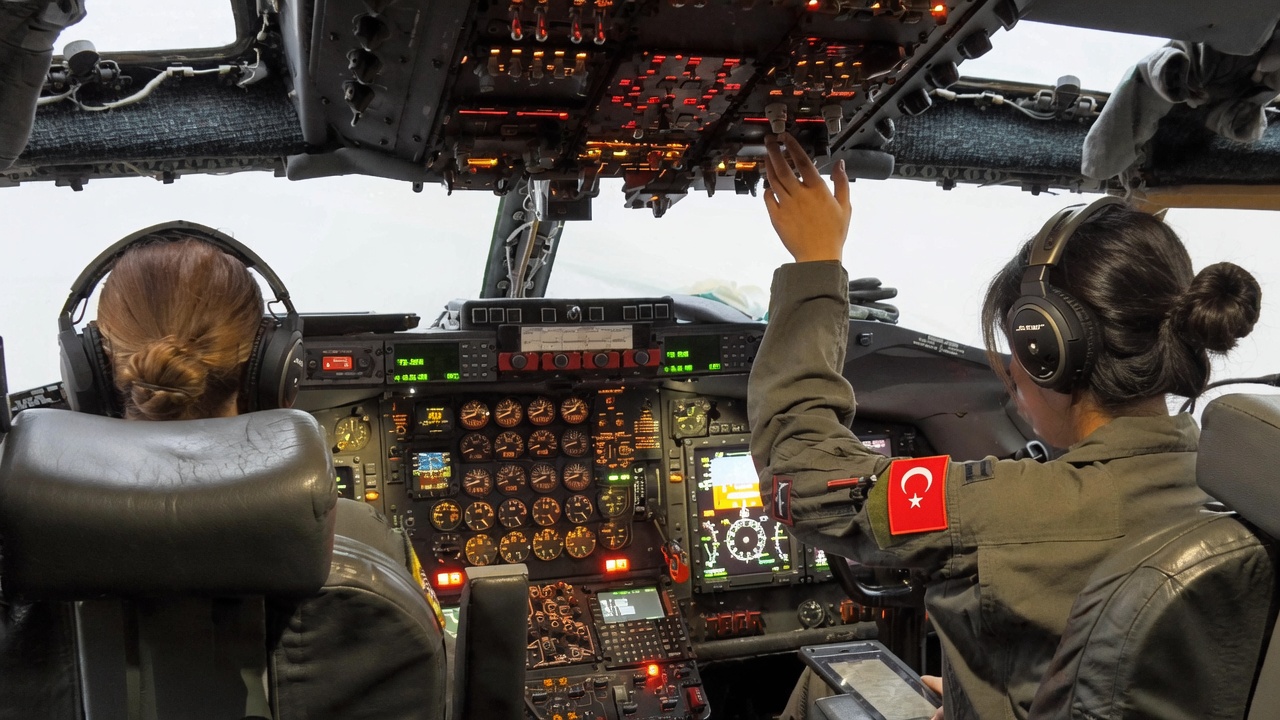
The cockpit of the RC-135 was wider and higher than it appeared from the outside. Ataman settled into the left seat and reached for the overhead panel with the economy of motion that came from years in the same chair. Ceylan was in the right seat before the door had fully closed, running the before-start flow from memory, her hands moving across the panels in a sequence she no longer needed to think about consciously.

"Battery switches," Ataman said.

"On," Ceylan confirmed.

"APU start." Ataman said. The auxiliary power unit wound up behind them, the vibration changing character as power came online. Displays illuminated across the instrument panel one by one, their light filling the darkened cockpit in soft amber and green. Ataman checked the fuel state and the INS initialization progress, then keyed the interphone.

"Cabin, cockpit. We're starting the before-start sequence. Expect APU power for the next twelve minutes. Systems up when you're ready."

A voice came back from the cabin immediately. "Cockpit, this is Celebi. We've been up for ten minutes."

Ceylan glanced at Ataman. Ataman said nothing but gave her a smile as she reached for the engine start switches in sequence, left to right across the quadrant. The first engine caught with a rising whine that built steadily to a full-throated turbine note, the airframe shivering faintly as power came on. She watched the N1 climb, oil pressure stabilize, exhaust gas temperature settle into the normal band. The second engine followed, then the third and fourth, each one joining the others until the RC-135 sat throbbing with contained energy on the cold apron.

Ceylan configured the radios and called the tower. "İncirlik Approach, Misty Mountain One-One, ready to taxi, IFR, requesting northbound departure."

"Misty Mountain One-One, İncirlik Ground, taxi via Foxtrot to runway 05 Left. Wind 060 at 8. Altimeter 2992. Cleared for taxi."

"Foxtrot to 05 Left, Misty Mountain One-One." Ceylan set the altimeter, confirmed the transponder code, and looked over at Ataman.

Ataman released the parking brake and eased the throttles forward. The RC-135 began to move, its nose swinging onto the taxiway centerline as Ataman worked the rudder pedals, the aircraft tracking the yellow line with a steadiness that came from its size and weight. Around them, the base was waking up. A line of F-16s sat on the apron to the east, ground crews moving between them with carts and fuel hoses.

"Runup complete," Ceylan said, scanning the engine gauges one last time. "All four in the green."

"Misty Mountain One-One, cleared for takeoff runway 05 Left," the tower said. "Wind 058 at 7."

"Cleared for takeoff, 05 Left, Misty Mountain One-One." Ataman lined the nose with the centerline and advanced the throttles smoothly to takeoff power. The engines built to full thrust, the airframe accelerating with the unhurried authority of a large aircraft that knew it would get there eventually. The runway lights blurred past. Ataman called rotate at the correct speed, eased back on the yoke, and the nose lifted, then the mains, and then the dark plain of the airfield dropped away below them and there was only sky.

d5ae0cf1-cb8a-478b-9d7b-9d751ec4eb53.png

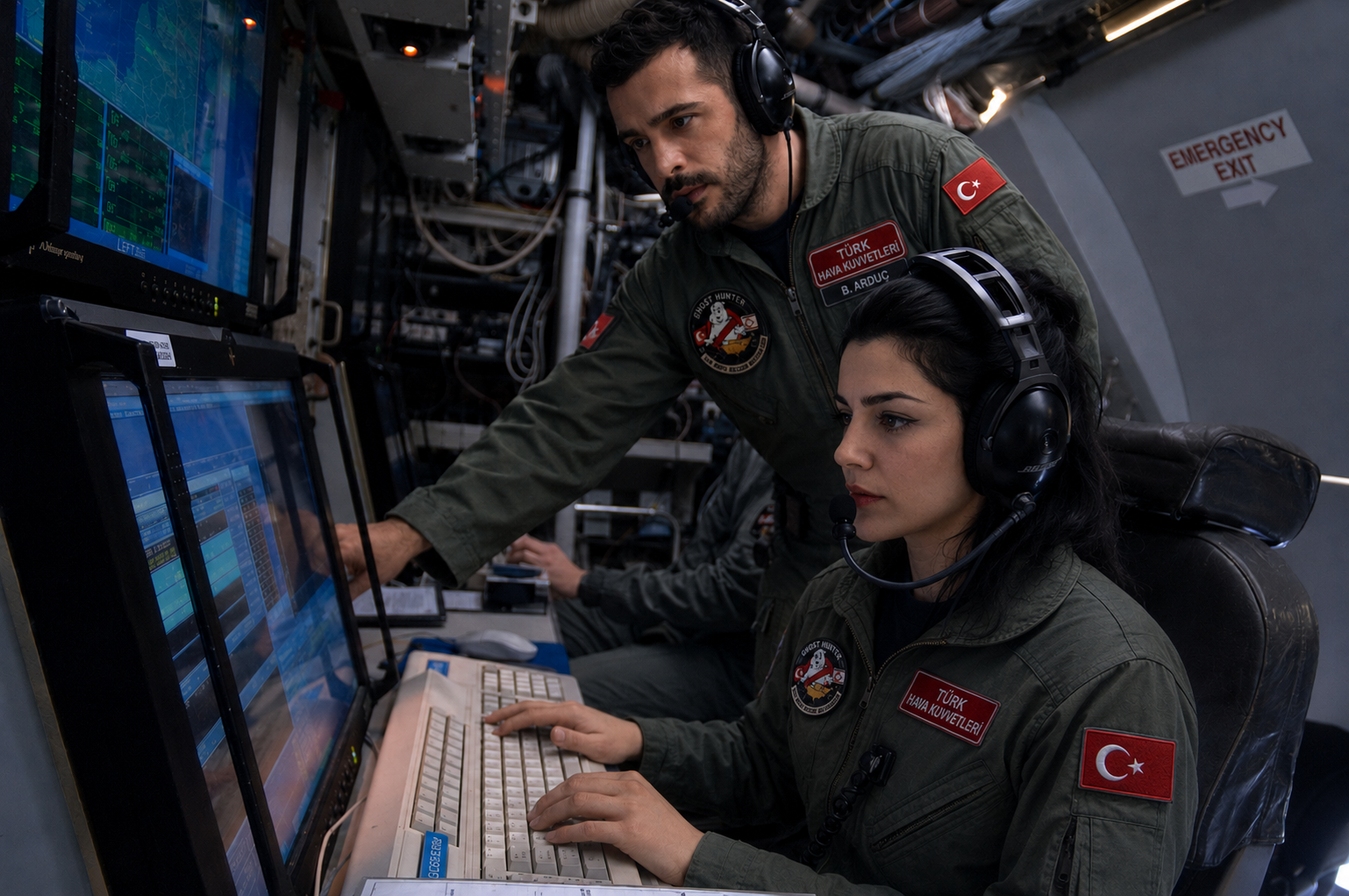
In the cabin, the departure went by largely unnoticed. The operators had been at their stations before the engines started, and the gentle acceleration of takeoff was just a change in background noise, something felt more than heard over the hum of the cooling fans and the processing units and the low white noise of a dozen electronics stacks running in parallel.

Captain Aydinc Celebi sat at the primary ELINT station and did not look up when the gear retracted with a thump through the airframe. He was watching a preliminary spectrum scan on his wideband analyzer, the display showing the electromagnetic environment below them as a layered histogram of signal energy across frequency, dense and cluttered near the surface, thinning at altitude. He had seen this picture a hundred times and could read it the way a navigator read a chart, knowing which peaks were background noise, which were civilian infrastructure, and which were worth pulling up for a closer look.

To his left, Lieutenant Ceyhun Topbas finished the last of his COMINT system initialization and pulled his headset down around his neck. "Sub-band 12 is still giving me elevated noise on the starboard array," he said, to no one in particular.

"It's been doing that since Eskişehir," said Staff Sergeant Gumus Akinci from the maintenance position aft, without looking up from his own panel.

Topbas put his headset back on. "Copy."

Across the narrow aisle, the AİAB section occupied three consoles arranged in a cluster separated from the Air Force stations by a low rack of processing equipment. Major Aytunc Ayranci had already unpacked his mission folder and arranged his reference materials, reference sheets clipped to the display frame, topographic overlays folded to the relevant grid squares, pencils in the tray at the angle he preferred. Lieutenant Erhan Sozen sat beside him, running the geolocation system's pre-mission alignment, watching the interferometer channels confirm their calibration one by one against the ground survey coordinates loaded before departure.

"Channel four is 0.3 degrees off," Sozen said.

Ayranci glanced at the readout. "Adjusting the sub-system now. It should be good now."

"Barely." Sozen said checking the interferometer channel.

"Barely within tolerance is still within tolerance." Ayranci said as he returned to his mission folder.

At the aft-most consoles, the MIT section was going over a number of call-logs they needed to decipher. Erkin Koprulu had his collection tasking on the left screen and the frequency priority list on the right, and he was reading through both simultaneously. His partner, Denker Ulusoy, had positioned his audio intercept station and was adjusting the squelch threshold on his monitoring queue, the tiny variations in the setting making differences perceptible only to the ear that had spent years tuning to them.

They were looking for communications between senior PKK officials after the Mosul strike and found that the organization's senior leadership had dispersed and returned to human couriers to avoid MIT detection.

Between them, Lieutenant Fatma Inan, was checking her translation reference database as they had tasked her to break an encrypted communication. She was trying not to appear as if she was checking whether the coffee from the thermos in her bag had survived the bumpy apron transit. It had thankfully. She poured a small amount into the cap and set it beside her keyboard.


They reached the holding pattern over Aşağıalınca forty-one minutes after takeoff, the sky to the east beginning to show a faint grey-pink seam along the horizon. Ataman rolled the aircraft into the first turn of the orbit, the autopilot picking up the track and holding it as she confirmed the holding altitude and cross-checked the position. Below them, the landscape was emerging from the dark in flat, featureless grey.

"Station established," she said on the interphone. "You're in business."

"Copy, cockpit," Celebi said. "Collection commencing."

He clicked his monitoring station to active and the spectrum display filled immediately with signal energy, the picture resolving as the system integrated the input from the antenna arrays along the fuselage and wings. The histogram shifted and sharpened. Celebi sat forward slightly.

"We've got a busy spectrum this morning," he said, scanning the display. "Northern Syria is lit up. Comms traffic on HF and VHF both elevated above baseline."

"Time of day effect," Ayranci said from across the aisle, without looking up.

"Possibly." Celebi pulled a narrow segment of the spectrum onto his secondary screen and began building a signal list. "Or could be a pick up from the radio silence since Mosul. They need to communicate with their international detachments."

On the COMINT side, Topbas had activated his frequency scanning queue and the system was stepping through the priority list in sequence, spending a set dwell time on each band before moving to the next. He watched the audio level meters, headset on, listening to the noise floor between transmissions. At six minutes into the collection window, his scanner locked.

"Contact," Topbas said. "VHF, 38.250 MHz. Push-to-talk burst. Duration approximately three seconds."

Celebi had it on his ELINT display simultaneously, the signal appearing as a short vertical spike above the noise floor. "Confirmed on my scope. Signal strength indicates source within forty kilometers. Bearing 162."

Koprulu was already on his terminal. "38.250 is flagged on the current target area. Looks like it is coming out of Sulaymaniyah." He looked at Ulusoy. "Did you get audio?"

Ulusoy had the recording up. He played it through his headset once, then again. "Two speakers. Kurdish...looks like they are talking about... the Al-Zab crossing. Their packages were intercepted by bandits...and they need to send another package to make it to a cell in the Zagros."

Inan looked up from her translation database. "Al-Zab crossing, that's the vehicle ford south of Khalikan. Known transit point."

Koprulu wrote the time reference and the location into his contact log. "Timestamp it. If this net transmits again we'll have a second intercept for geolocation."

Twelve minutes passed. The orbit carried the aircraft south through the holding pattern, the antenna geometry changing slightly with each turn, the signal environment shifting in the way it always did when the geometry changed, some signals strengthening, others fading as the bearing angles moved.

There was another transmission. It was longer this time. Eleven seconds. Topbas flagged it in the recording queue and Sozen was already running the geolocation processor, feeding the bearing data from three interferometer channels into the time-difference-of-arrival computation. The system needed multiple antenna inputs and at least two transmissions to generate a reliable emitter position.

"TDOA running," Sozen said, watching the bearing lines converge on his display. The confidence ellipse around the projected position shrank as the computation ran. "Convergence at thirty seconds."

Ayranci stood behind him, watching the screen. The lines continued to narrow.

At twenty-seven seconds, the system committed to a solution.

"Emitter fixed," Sozen said. "Grid 38SMB 4418 7731. Confidence: high. Elevation approximately 610 meters."

Ayranci stared at the coordinate for a moment, then transferred it to his mapping overlay. The point sat on a low ridge south of the Khalikan area, above the Al-Zab ford Ulusoy had identified. He traced the terrain with his pencil.

"Elevated position," he said. "Direct line of sight to the crossing." He looked at Koprulu. "This is an observation position, not a transit point."

Koprulu nodded slowly. "They're watching the crossing and reporting to someone downstream."

Ulusoy had been working the second recording while the others spoke. He pulled the headset back from one ear. "Third voice on the second transmission. Brief. He uses the word 'confirmed' in Arabic, then switches to a dialect phrase. Kurdish, I think. Southern inflection." He wrote the phonetic transcription into his log. "The three speakers are not from the same background."

Inan was already cross-referencing. "That would be consistent with the intelligence w have on the ground. The transit networks in the Sulaymaniyah corridor typically have both PKK and local facilitators." She said it straightforwardly, without the hesitation of someone who wasn't sure of their information.

Koprulu looked at her briefly, then wrote in his log. "Log the grid, the bearing, both recordings, and the speaker analysis. Let's see if the voice-detector system can pick up something."

A radar emission had tripped his automatic flagging system on the Ku-band monitoring channel, coming from a bearing northeast of the track and elevated, the signal passing below what most receivers would register as significant. The RC-135's front-end was not most receivers.

He pulled the parametric data onto his analysis display. Pulse width 1.1 microseconds. Pulse repetition interval scanning between 2,200 and 4,100 microseconds in an irregular pattern. Scan rate inconsistent with any catalogued search or fire control mode he recognised. He ran it against the ELINT library and got a partial match to a known surveillance emitter type associated with the Iranian border region, but the PRI distribution was unlike any of the documented variants.

In the cockpit, the sun had cleared the horizon fully, the flat Turkish plateau below them catching the early light in shades of brown and grey-green. Ceylan had the weather overlay on her navigation display and was tracking a high-pressure system that promised clear skies for the full collection window. She noted it in the flight log and poured the last of her water bottle.

"Back end's been on the interphone three times already," she said.

Ataman adjusted the autopilot by a quarter degree and watched the aircraft settle back onto track. "They get talkative when they find something."

"I thought intelligence people were supposed to be quiet."

"The Air Force ones are real chatty," Ataman said. "The MIT ones are kind of secretive but they like to talk amongst themselves. She checked the fuel state and the orbit geometry and said, "Seven hours and forty minutes remaining."

"Plenty of time," Ceylan said.

The orbit continued.
 

Forum statistics

Threads
24,333
Messages
118,397
Members
423
Latest member
Szalakota
Top