Moderators support the Administration Team, assisting with a variety of tasks whilst remaining a liason, a link between Roleplayers and the Staff Team.
Moderators support the Administration Team, assisting with a variety of tasks whilst remaining a liason, a link between Roleplayers and the Staff Team.
The Era of the Emergency Stability Council
November 19th 1945-August 15 1947
In the aftermath of the Second World War, with Britain financially exhausted and the Attlee government committed to Indian independence within two years, a number of the largest commercial interests still operating in India grew alarmed at the prospect of a hasty British withdrawal followed by a Congress-led government hostile to a foreign capital. Beginning in late 1945, representatives of these interest began meeting privately in Calcutta and, later on, began to call themselves the Emergency Stability Council, ostensibly a body for "post-war stability."
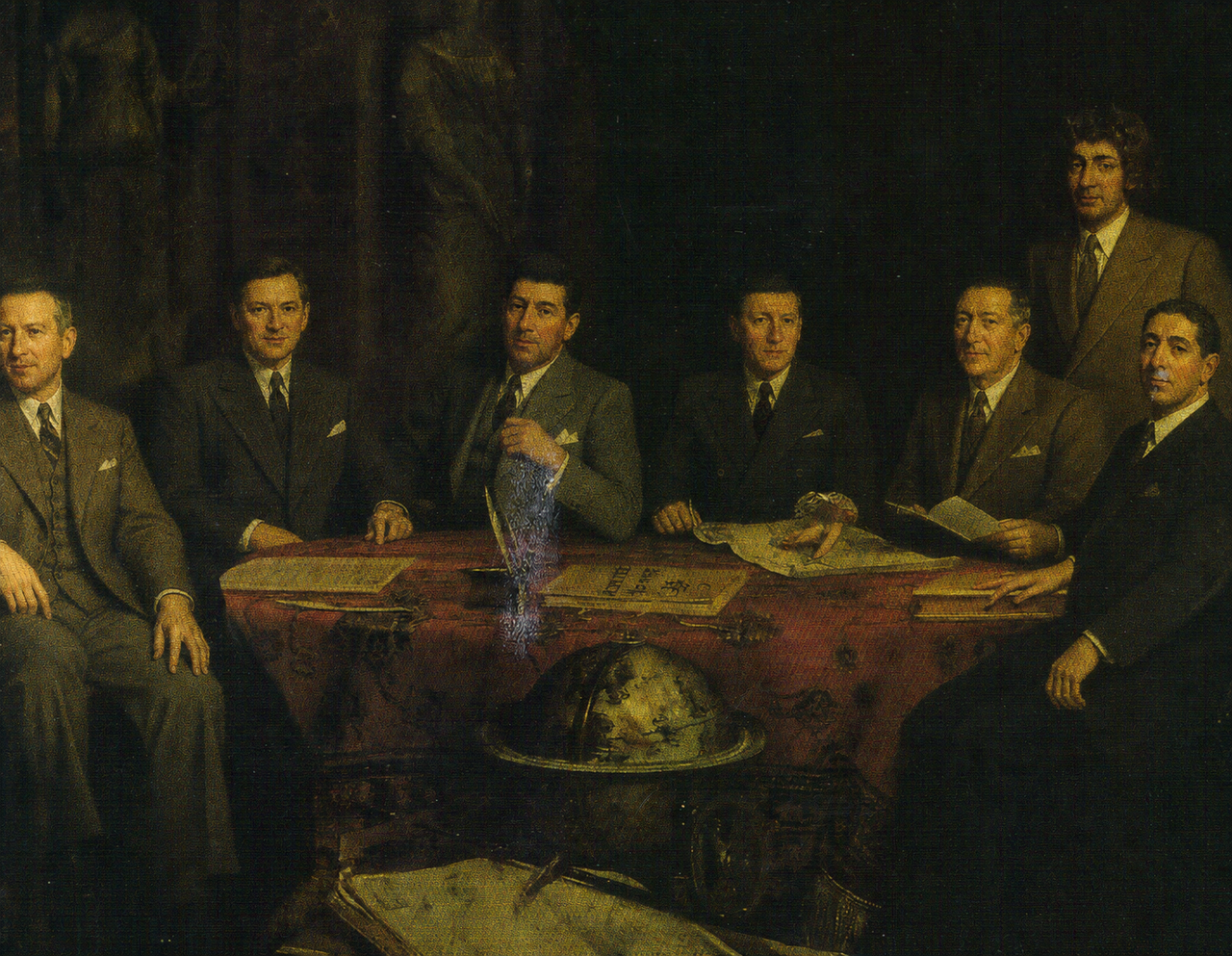
The ESC's founding membership was drawn primarily from European noble and merchant families long resident in India, including the houses of Wentworth, Whitmore, Harcourt, Blythe, Lascelles, Villiers, Peverell, Sinclair, Stroud, Shaw, Douglas, Llewellyn, and Lewin (all of British extraction), the de Montferrand family (French), and de Almeida e Sousa (Portuguese). These families were joined by several established managing agency houses and Indian industrial families who saw in the ESC a vehicle to protect their assets regardless of which government emerged from the independence process.
The figure who came to dominate the ESC, and later the Company itself, was Lord Albert Victor Llewellyn, head of the Welsh-descended House Llewellyn, a noble family long settled in the Raj with extensive holdings in railways, shipping, armaments manufacturing, and banking. Llewellyn served during the Second World War as an officer in the Royal India Air Force, flying long-range bombing missions over Burma under sustained anti-aircraft fire. For this service, he was awarded the Distinguished Flying Cross, and held the 1939-1945 Star, the Burma Star, and the India Service Medal for his continued service training pilots in India throughout the war.
Llewellyn's wartime record gave him a degree of standing among both the British community and segments of the Indian public unusual for a member of the ESC's founding families. When the Council convened to elect a chairman in the first month of 1946, Llewellyn, who had first proposed the Council's foundation, was elected by acclamation, the membership reasoning that his combination of war record, business interests, and personal popularity made him the figure best placed to represent the Council's interests publicly while its true purpose remained concealed.
From early 1946, the ESC began funding and organising a private security force, structured along conventional military lines with ranks and regimental organisation modelled on the British Indian Army. Recruitment drew on the large pool of demobilised soldiers following the war's end: discharged Gurkha units, European veterans, and smaller numbers of Indian sepoys from disbanded regiments. By August 1947, this force numbered just under half a million, with foreign-recruited personally comprising roughly two-thirds of its strength.
The force's deployment followed the pattern of communal violence that swept India through 1946 and into 1947. Beginning with Calcutta riots of August 1946, the ESC's auxiliary police were repeatedly invited by overwhelmed local administrations to guard mills, warehouses, rail depots, and docks—and were never withdrawn. By the time of the Partition Plan's announcement in June 1947, the ESC's forces held effective control of security along the major rail boot lines, the ports of Calcutta and Bombay, and numerous power stations and industrial centres across Bengal, Bihar, and the United Provinces.
A significant complicating factor for the ESC's plans was the presence of large numbers of demobilised veterans of the Indian National Army, whose loyalties lay with the broader independence movement rather than with either the Congress establishment or the colonial state, and whose officer corps retained both organisational cohesion and popular sympathy. Through 1946 and 1947, a series of assassinations targeted senior INA veteran leadership figures organising in Bengal and the United Provinces. Responsibility was never claimed; in the press of the period, blame was attributed variously to rising communist infiltration of the INA's ranks and to factional violence among Congress-aligned groups, narratives the ESC's controlled press outlets did little to discourage. By mid-1947, organised INA veteran resistance had been effectively eliminated as a coordinated force.
By July 1947, with the Radcliffe Line drawn and partition violence at its height, the ESC's forces had moved to seize, in a coordinated operation across the final days before independence, the principal airports, ports, banks, rail junctions, power stations, broadcasting stations, and army cantonments across the territory slated to become the Dominion of India. Embassies and foreign consular offices in Delhi and northern India were placed under guard, ostensibly for their protection amid the unrest, and foreign correspondents found their movements restricted. Ammunition depots and arsenals were secured without significant resistance, much of the regular Indian Army's officer corps being preoccupied with the logistics of partition itself.
The Viceroy, Lord Mountbatten, learned of the ESC's intentions only in the final weeks before the transfer of power, and refused to lend his office's legitimacy to the plan or to communicate it to London. With the telegrah network already under ESC control, his communications were quietly severed, and he was confined to Viceroy's House under guard for the remainder of July. He was given the choice of presiding over the formal transfer of power ceremony, which he accepted.
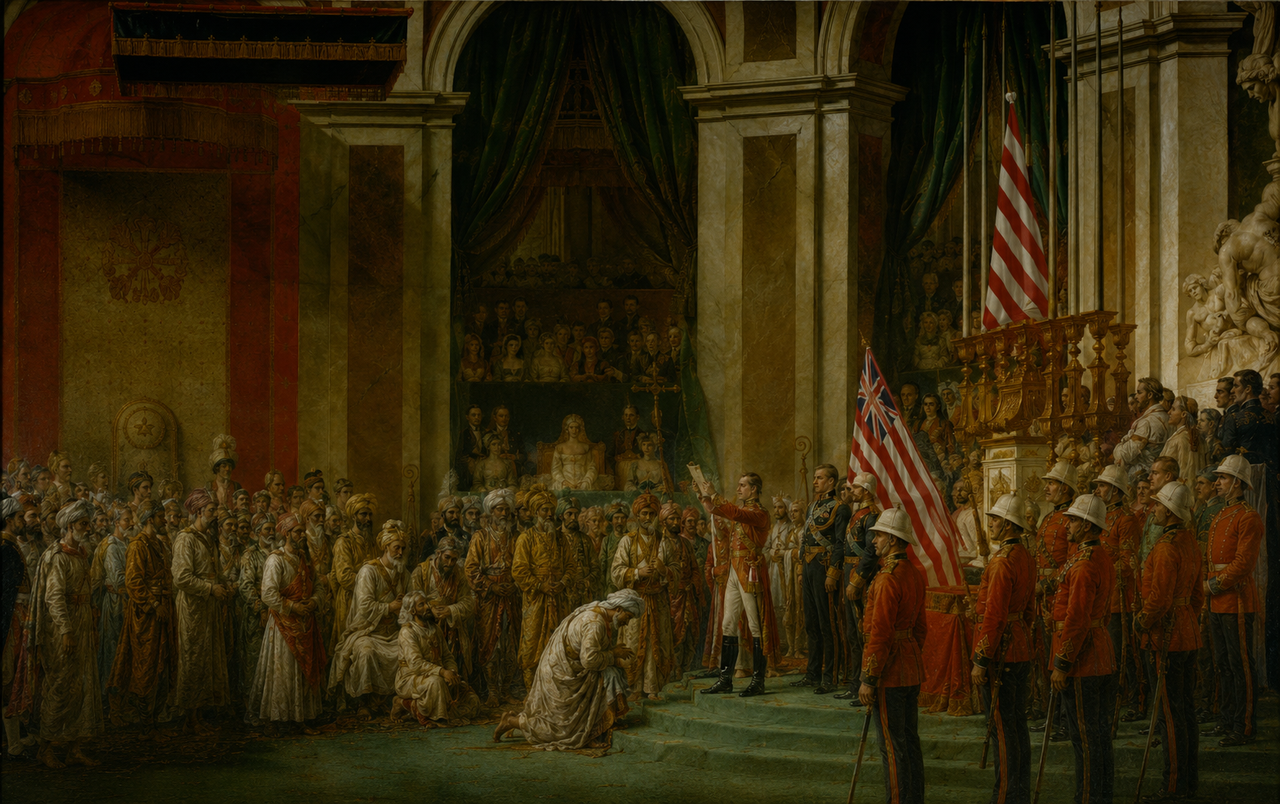
The transfer of power proceeded as scheduled on 15 August 1947. Indepdnence was declared for both the Dominion of Pakistan and the territory of India. Immediately following the formal ceremony in Delhi, the ESC's forces seized power, and Lord Llewellyn issued the Calcutta Declaration, under which the Emergency Stability Council dissolved itself and reconstituted as the Honourable Company of India, declaring itself the sovereign governing authority over the former British Indian Empire's territory, excluding Pakistan and Burma.
Lord Llewellyn was elected by the newly established Board of Directors as its first Governor-Chairman and the Company relocated its seat of government from Calcutta to Delhi in September 1948.
The years following the Calcutta Declaration, known as the Great Troubles, saw widespread but fragmented resistance to Company rule. Various democratic movements, most notably in Agra, rose up and various princely states refused the authority of the Company. These states included Hyderabad, Jammu and Kashmir, Mysore, Travancore, and also the Kingdom of Sikkim. The suppression of this resistance and the absorbtion of the holdout states occupied much of the first decade of Lord Llewellyn's tenure as Governor-Chairman, a process not fully completed until Sikkim's incorporation in 1975.
Governor-Chairmanship of Lord Albert Victor Llewellyn
August 15 1947-August 15 1977
Lord Albert Victor Llewellyn (1910-1998) served as the first Governor-Chairman of the Honourable Company of India from its founding on 15 August 1947 until his retirement in 1977, a tenure of thirty years that encompassed the violent consolidation of Company rule during the Great Troubles, the gradual absorption of the remaining princely states, the establishment of the Company's economic and administrative model, and the introduction of limited electoral government in 1957. He is widely remembered within the Company's territories as the "Father of the Nation" and the "Hero of the Company," a reputation bordering on veneration that has persisted into the present day.
This site uses cookies to help personalise content, tailor your experience and to keep you logged in if you register.
By continuing to use this site, you are consenting to our use of cookies.