
STATISTICS

Start Year: 1995
Current Year: 2008

Month: April

2 Weeks is 1 Month
Next Month: 22/02/2026

OUR STAFF

Administration Team

Administrators are in-charge of the forums overall, ensuring it remains updated, fresh and constantly growing.

Administrator: Jamie
Administrator: Hollie

Community Support

Moderators support the Administration Team, assisting with a variety of tasks whilst remaining a liason, a link between Roleplayers and the Staff Team.

Moderator: Connor
Moderator: Odinson
Moderator: ManBear


Have a Question?
Open a Support Ticket

AFFILIATIONS

RPG-D

Vaka

The Kingdom of Norway
GA Member
Sep 26, 2020
1,163
960px-Verkhovna_Rada_%28UK_logo%2C_2022%29.svg.png


Verkhovna Rada


The unicameral parliament of Ukraine.

The Verkhovna Rada is the sole body of legislative power in Ukraine. The parliament determines the principles of domestic and foreign policy, introduces amendments to the Constitution of Ukraine, adopts laws, approves the state budget, designates elections for the President of Ukraine, impeaches the president, declares war and peace, appoints the Prime Minister of Ukraine, appoints or confirms certain officials, appoints one-third of the Constitutional Court of Ukraine, ratifies and denounces international treaties, and exercises certain control functions. The constitution of Ukraine stipulates that the Verkhovna Rada is authorized to fulfill its functions under the condition that at least two-thirds of its constitutional composition (300 or more people's deputies) are elected.



8f849d76-8601-4b22-a3c9-bea4ea113f52.jpg

Hryhoriy Nemyria
Chairman of the Verkhovna Rada
3d7a9c26-f827-43ed-8850-023eefca766b.png


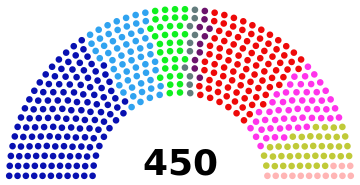
Current Verkhovna Rada Composition
Party and Seats Held​
Ideology​
Fatherland Renewal Party (FRP) – 140 seats​
State-guided modernization, anti-corruption, national economic revival.​
New Horizons Party (NHP) – 58 seats​
Liberal-conservative, decentralization, global trade diversification.​
Agrarian People’s Movement (APM) – 34 seats​
Rural modernization, agrarian populism, community cooperatives.​
Civic Integrity Deputies (CID) – 10 seats​
Anti-corruption, radical transparency, digital reforms.​
Future of Industry Caucus (FIC) – 10 seats​
Technology, industrial upgrading, R&D investment.​
United Social Party (USP) – 92 seats​
Economic nationalism, social welfare, industrial protectionism.​
Solidarity Forward Party (SFP) – 52 seats​
Centrist technocracy, anti-corruption, judicial reform.​
Eastern Welfare Front (EWF) – 40 seats​

Regional industrialism, pension protection, geopolitical neutrality.​
Independents14 seats

Various.​


960px-Petro_Poroshenko_on_Day_of_Constitution_of_Ukraine_2016-06-28_16.jpg
 
Last edited:

Vaka

The Kingdom of Norway
GA Member
Sep 26, 2020
1,163
Official Verkhovna Rada Voting Record


Date: December 30, 2007
Legislation: State Modernization & Anti-Corruption Act of 2008
Vote totals: 277 Yay - 173 Nay
Status: PASSED


STATE MODERNIZATION & ANTI-CORRUPTION ACT OF 2008​


TABLE OF CONTENTS​

  1. Title I — General Provisions
  2. Title II — National Civil Service Reform Program (CSRP)
  3. Title III — Compulsory E‑Declaration of Assets for Public Officials
  4. Title IV — Public Online Procurement Portal (OPP-U)
  5. Title V — Independent Anti‑Corruption Bureau of Ukraine (IABU)
  6. Title VI — National Digital Infrastructure & IT Consortium Framework
  7. Title VII — Transparency, Public Access, and Whistleblower Protections
  8. Title VIII — Implementation, Enforcement & Oversight Mechanisms
  9. Title IX — Budgetary Appropriations & Fiscal Impact
  10. Title X — Transitional & Final Provisions


TITLE I — GENERAL PROVISIONS​

Chapter 1. Purpose and Scope​

Article 1. Short Title
This Act shall be known as the State Modernization & Anti‑Corruption Act of 2008.

Article 2. Legislative Purpose
This Act establishes the legal, administrative, and institutional frameworks required to:

  1. Modernize the Ukrainian state apparatus;
  2. Increase efficiency, transparency, and accountability in government operations;
  3. Deter, prevent, investigate, and punish corruption;
  4. Develop secure nationwide digital governance systems;
  5. Establish monitoring, auditing, and enforcement structures;
  6. Ensure responsible use of state funds.
Article 3. Scope of Application
The provisions of this Act apply to:

  • All national ministries, agencies, and departments;
  • All regional and local governments;
  • All public officials, career civil servants, and political appointees;
  • All state-owned enterprises and publicly funded bodies.


TITLE II — NATIONAL CIVIL SERVICE REFORM PROGRAM (CSRP)​

Chapter 1. Structure of the Civil Service System​

Article 21. Unified Civil Service Cadre
A unified Civil Service Cadre is hereby established, consisting of three categories: Senior Administrative Service, Professional Service, and Technical Service.

Article 22. Merit-Based Recruitment
All recruitment shall be conducted through competitive examinations administered by the National Civil Service Commission (NCSC).

Chapter 2. Civil Service Training Academy​

Article 31. Establishment
The Civil Service Training Academy (CSTA) is hereby established as the central institution for:

  • Management training,
  • Ethics and compliance education,
  • Digital governance instruction.
Article 32. Regional Branches
Six regional academies shall be established in Kyiv, Lviv, Dnipro, Odesa, Kharkiv, and Donetsk.

Chapter 3. Digital HR & Payroll Modernization​

Article 41. Unified HR System
A national HR information system shall be implemented to manage personnel files, payroll, evaluations, promotions, and disciplinary actions.

Article 42. Payroll Transparency
All salary payments shall be traceable, digital, and published monthly.


TITLE III — COMPULSORY E‑DECLARATION OF ASSETS FOR PUBLIC OFFICIALS​

Chapter 1. Mandatory Annual Asset Disclosure​

Article 51. Declaration Requirement
All officials shall submit yearly electronic declarations including:

  • Property holdings,
  • Bank accounts,
  • Investments,
  • Cash assets,
  • Vehicles, valuables, business ownerships.

Chapter 2. Verification & Cross‑Referencing​

Article 61. Automated Verification System
The "National Asset Verification System (NAVS)" shall cross‑reference declarations with tax records, banking data, corporate registries, and customs entries.

Article 62. Independent Audit Panels
The Anti-Corruption Bureau may request independent audits for high-ranking officials.


TITLE IV — PUBLIC ONLINE PROCUREMENT PORTAL (OPP-U)​

Chapter 1. Establishment of the Portal​

Article 71. National Procurement Database
All public procurement processes shall be published on the OPP-U portal.

Article 72. Mandatory E-Tendering
No government procurement exceeding 20,000 hryvnias shall be conducted outside the electronic tendering system.

Chapter 2. Transparency Requirements​

Article 81. Open Access for Citizens
All tender announcements, bids, winners, and contract values shall be publicly accessible.

Article 82. Digital Audit Trail
All transactions shall generate a permanent, tamper-proof digital record.


TITLE V — INDEPENDENT ANTI-CORRUPTION BUREAU OF UKRAINE (IABU)​

Chapter 1. Establishment and Mandate​

Article 91. Legal Status
The IABU is established as an independent investigative body with full authority to investigate corruption at all levels of government.

Article 92. Powers
The Bureau may:

  • Conduct surveillance,
  • Freeze assets,
  • Subpoena documents,
  • Initiate prosecutions jointly with state prosecutors.

Chapter 2. Organizational Structure​

Article 101. Headquarters & Regional Directorates
The IABU shall include:

  • Kyiv Headquarters,
  • Five regional offices,
  • Special Operations Directorate,
  • Digital Forensics Division.
Article 102. Oversight Council
An independent council shall oversee IABU operations, appointments, and disciplinary procedures.


TITLE VI — NATIONAL DIGITAL INFRASTRUCTURE & IT CONSORTIUM FRAMEWORK​

Chapter 1. Establishment of the IT Consortium​

Article 121. UkrTechGlobal Consortium (UTGC)
The UTGC is designated as the principal contractor for state digital infrastructure projects, including:

  • E-declaration systems,
  • Procurement portal architecture,
  • National secure cloud.
Article 122. Contracting Requirements
UTGC shall comply with:

  • Cybersecurity standards,
  • Financial disclosure obligations,
  • Public reporting.

Chapter 2. National Digital Backbone​

Article 131. Government Secure Cloud (GSC)
A national government cloud shall host all state systems.

Article 132. Interoperability Standards
All digital systems must use unified identity verification and standardized encryption protocols.


TITLE VII — TRANSPARENCY, PUBLIC ACCESS, AND WHISTLEBLOWER PROTECTIONS​

Chapter 1. Citizen Oversight Measures​

Article 141. Open Data Requirements
All government financial records, procurement data, and staffing data shall be made public.

Article 142. Public Monitoring Portals
Citizens may submit corruption complaints directly to IABU.

Chapter 2. Whistleblower Protections​

Article 151. Protection Guarantees
Whistleblowers shall receive:

  • Identity protection,
  • Anti-retaliation guarantees,
  • Temporary relocation assistance.
Article 152. Financial Rewards
Informants whose evidence leads to recovered state revenue may receive up to 10% of recovered assets.


TITLE VIII — IMPLEMENTATION, ENFORCEMENT & OVERSIGHT​

Chapter 1. National Reform Oversight Commission (NROC)​

Article 161. Authority
The Commission shall:

  • Monitor implementation of all Titles of this Act,
  • Publish quarterly compliance reports,
  • Oversee budget execution.

Chapter 2. Enforcement Powers​

Article 171. Administrative Penalties
Non-compliance with digital systems or disclosure requirements shall be punishable by:

  • Fines,
  • Suspension,
  • Dismissal,
  • Criminal referral.
Article 172. Criminal Penalties
Corruption, fraud, or tampering with digital records is punishable by imprisonment from 5 to 15 years.


TITLE IX — BUDGETARY APPROPRIATIONS & FISCAL IMPACT​

Chapter 1. Initial 3-Year Budget​

Article 181. Appropriations
The following sums are allocated:

  • Civil Service Reform Program: $1.6B
  • Anti-Corruption Bureau: $370M
  • Procurement Portal: $105M
  • E‑Declaration System: $61M
  • Digital Backbone: $500M
Total Initial Appropriation: $2.636B.

Chapter 2. Annual Operating Budgets​

Article 191. Annual Expenditures
Post-implementation annual costs:

  • CSRP: $350–400M
  • IABU: $210M
  • OPP-U: $25M
  • E‑Declaration: $25M
  • Digital Backbone: $30M


TITLE X — TRANSITIONAL & FINAL PROVISIONS​

Article 201. Entry into Force
This Act enters into force 90 days after publication.

Article 202. Implementation Timelines
All agencies shall achieve full compliance within 36 months.

Article 203. Repeal of Conflicting Legislation
Any laws inconsistent with this Act are hereby repealed.

Article 204. Final Authorization
The President of Ukraine shall issue the necessary decrees for enforcement.


Vaka

The Kingdom of Norway
GA Member
Sep 26, 2020
1,163
Official Verkhovna Rada Voting Record


Date: April 11th, 2008
Legislation: DEFENSE PROCUREMENT CONFIDENTIALITY AMENDMENT ACT OF 2008
(Amendment to the State Modernization & Anti-Corruption Act of 2008)
Vote totals: 230 Yay - 220 Nay
Status: PASSED


DEFENSE PROCUREMENT CONFIDENTIALITY AMENDMENT ACT OF 2008​

(Amendment to the State Modernization & Anti-Corruption Act of 2008)​


PREAMBLE​

Recognizing that the public disclosure requirements established under the State Modernization & Anti-Corruption Act of 2008 serve a vital role in ensuring transparency in public administration;

Acknowledging that the unrestricted publication of defense procurement and military export transactions through the Public Online Procurement Portal (OPP-U) presents a material risk to national security, operational readiness, and strategic industrial competitiveness;

Affirming that democratic accountability and fiscal oversight must be maintained through independent institutional review mechanisms;

The Verkhovna Rada of Ukraine hereby enacts the following:


SECTION I — PURPOSE​

Article 1. Objective​

This Act shall:

a) Establish a statutory exemption from public disclosure requirements for defense procurement and military export transactions conducted by organs of the State;

b) Maintain anti-corruption oversight through mandatory confidential institutional review;

c) Protect classified procurement information relating to national defense capabilities;

d) Prevent disclosure of sensitive industrial, logistical, or technological data to potential adversaries.


SECTION II — DEFINITIONS​

Article 2. For the purposes of this Act:​

Defense Procurement Transaction shall mean:

Any acquisition, sale, transfer, lease, modernization contract, licensing agreement, or production arrangement relating to:
  • Military vehicles

  • Weapons systems

  • Ammunition

  • Aerospace platforms

  • Naval vessels

  • Electronic warfare systems

  • Radar systems

  • Missile or guided munitions

  • Tactical communications infrastructure

  • Any associated component parts or technical documentation
Conducted by or on behalf of:
  • The Ministry of Defense

  • State defense-industrial enterprises

  • Authorized export agencies

  • Any entity acting under state contract


SECTION III — EXEMPTION FROM PUBLIC DISCLOSURE​

Article 3. Procurement Portal Exemption​

All Defense Procurement Transactions shall be exempt from mandatory public disclosure via the:
  • Public Online Procurement Portal (OPP-U)
Such transactions:

a) Shall not be listed in publicly accessible procurement registries;

b) Shall not disclose financial values, delivery schedules, or technical specifications in publicly viewable documentation;

c) Shall not be subject to public tender publication requirements where classified by the Ministry of Defense.


SECTION IV — CONFIDENTIAL OVERSIGHT MECHANISM​

Article 4. Independent Review​

All exempted Defense Procurement Transactions shall be submitted for confidential review to:

The Independent Anti-Corruption Bureau of Ukraine

The Bureau shall:

a) Audit contractual terms;

b) Review financial transfers;

c) Examine compliance with procurement procedures;

d) Investigate any indication of illicit enrichment or financial irregularity.


Article 5. Restricted Reporting​

Findings of the Bureau shall:

a) Be classified at the appropriate security level;

b) Be submitted exclusively to:
  • The President of Ukraine

  • The Cabinet of Ministers

  • The Parliamentary Committee on National Security
c) Not be disclosed publicly unless:
  • Evidence of criminal misconduct is established; or

  • Disclosure is authorized by judicial warrant.


SECTION V — NATIONAL SECURITY CLASSIFICATION​

Article 6. Classification Authority​

The Ministry of Defense shall retain authority to:

a) Designate procurement contracts as classified;

b) Restrict technical documentation;

c) Limit contractor disclosure requirements;

d) Authorize confidential contracting procedures for strategic defense acquisitions.


SECTION VI — PENALTIES​

Article 7. Unauthorized Disclosure​

Any person found to have:
  • Published

  • Distributed

  • Disclosed
Confidential procurement information relating to exempted transactions without authorization shall be subject to:
  • Administrative sanction

  • Criminal investigation

  • Termination of employment or contract
In accordance with national security statutes.


SECTION VII — IMPLEMENTATION​

Article 8. Entry into Force​

This Act shall enter into force upon approval and signature by the President of Ukraine.

All relevant provisions of the State Modernization & Anti-Corruption Act of 2008 shall be modified accordingly.


Vaka

The Kingdom of Norway
GA Member
Sep 26, 2020
1,163
Official Verkhovna Rada Voting Record


Date: April 18th, 2008
Legislation: Free Trade Agreement Between Ukraine And Kingdom Of Èran

Vote totals: 410 Yay - 40 Nay
Status: PASSED


**Free Trade Agreement Between Ukraine And Kingdom Of Èran**


PREAMBLE
The Government of Ukraine and the Government of the Kingdom of Èran (hereinafter “the Parties”),
Affirming their sovereign equality and territorial integrity;
Recognizing the mutual economic benefits of expanded trade;
Acknowledging the importance of stable energy and food supply chains;
Desiring to eliminate artificial barriers to commerce;
Committing to transparent and rules-based trade;
Seeking long-term industrial cooperation;
Have agreed as follows:


**CHAPTER I
GENERAL PRINCIPLES AND DEFINITIONS**

**Article 1
Establishment of a Free Trade Area**
The Parties hereby establish a permanent bilateral free trade area.


This free trade area shall encompass:
(a) Trade in goods;
(b) Trade in services;
(c) Investment;
(d) Customs cooperation;
(e) Technical regulation;
(f) Financial settlement.


No Party shall adopt measures inconsistent with the obligations of this Agreement.


**Article 2
Legal Status**
This Agreement constitutes an international treaty.


The provisions of this Agreement shall prevail over conflicting domestic legislation.


Each Party shall adopt all necessary legislative and administrative measures to ensure implementation.


**Article 3
Definitions**
For purposes of this Agreement:
(a) “Customs duty” includes all import or export taxes, fees, and charges.
(b) “Originating goods” refers to goods meeting Chapter III criteria.
(c) “Equivalent measures” includes any fiscal or administrative barrier with comparable effect.
(d) “Public authority” includes ministries, agencies, state enterprises, and regulators.


**CHAPTER II
TARIFF ELIMINATION AND MARKET ACCESS**

**Article 4
Immediate Tariff Elimination**
All customs duties on originating goods shall be eliminated on the date of entry into force.


Elimination applies to:
(a) Import duties;
(b) Export duties;
(c) Transit duties;
(d) Border processing fees.


No replacement taxes shall be introduced.


Any violation shall constitute a material breach.


**Article 5
Prohibition of New Barriers**
No Party shall introduce new tariffs, quotas, licenses, or fees.


Administrative requirements shall not be used as disguised restrictions.


Measures found to restrict trade shall be withdrawn within ninety (90) days.


**Article 6
Guaranteed Access for Strategic Goods**
Energy, petrochemical, and grain products shall receive unconditional access.


Such goods shall not be subject to:
(a) Price controls;
(b) Export bans;
(c) Discriminatory inspections;
(d) Transit delays.


Emergency restrictions may be imposed only under Chapter X.


**CHAPTER III
RULES OF ORIGIN AND CERTIFICATION**

**Article 7
Origin Criteria**
Goods qualify as originating if:
(a) Extracted, harvested, or manufactured entirely in a Party; or
(b) Substantially transformed with minimum 40% value addition.

**Article 8
Calculation of Value Content**
Value content shall be calculated using internationally accepted accounting standards.


Labor, energy, and depreciation shall be included.


Artificial inflation of content is prohibited.


**Article 9
Certification System**
A unified electronic certification platform shall be established.


Certificates shall be verifiable in real time.


Fraud shall be punishable under domestic law.


**CHAPTER IV
CUSTOMS ADMINISTRATION**

**Article 10
Ukraine will follow all guidelines respective to the State Modernization & Anti-Corruption Act Of 2008.

This includes ensuring visibility of all purchases and sales made by Ukraine under this treaty on all applicable government websites.


**Article 11
Risk Management**
Inspection shall be risk-based.


Low-risk traders shall receive priority treatment.


Random inspections shall not exceed 5% of shipments.


**CHAPTER V
TECHNICAL REGULATIONS AND STANDARDS**

**Article 12
Standards Alignment**
The Parties shall harmonize technical standards.


Where harmonization is impossible, equivalence shall apply.


New standards shall be notified 180 days in advance.


**Article 13
Conformity Assessment**
Testing results shall be mutually recognized.


Duplicate testing is prohibited.


**CHAPTER VI
TRADE IN SERVICES**

**Article 14
Sectoral Commitments**
Market access is guaranteed in:

Energy services

Transport

Engineering

IT

Construction

Financial consulting


**Article 15
Non-Discrimination**
Foreign service providers shall receive treatment equal to domestic providers.


**CHAPTER VII
INVESTMENT PROTECTION**

**Article 16
Right of Establishment**
Investors may establish enterprises without discrimination.

**Article 17
Legal Protection**
Investments shall be protected against:
(a) Arbitrary seizure;
(b) Discriminatory taxation;
(c) Regulatory harassment.


Expropriation requires compensation at market value.


**Article 18
Capital Transfers**
All profits may be transferred freely.


**CHAPTER VIII
ENERGY AND AGRICULTURAL SECURITY**

**Article 19
Long-Term Supply Agreements**
The Parties shall facilitate contracts exceeding five years.

**Article 20
Infrastructure Cooperation**
Joint projects may include:

Pipelines
Terminals
Silos
Refineries


**CHAPTER IX
FINANCIAL ARRANGEMENTS**

**Article 21
Payment Systems**
Dedicated clearing mechanisms shall be created.

**Article 22
Currency Stability**
Sudden restrictions on currency conversion are prohibited.


**CHAPTER X
TRADE REMEDIES AND SAFEGUARDS**

**Article 23
Emergency Measures**
Safeguards may be imposed only if:
(a) Serious injury is proven;
(b) Measures are temporary;
(c) Compensation is offered.

**Article 24
Anti-Dumping Rules**
Investigations shall be transparent and judicially reviewable.


**CHAPTER XI
DISPUTE RESOLUTION**

**Article 25
Consultation**
Disputes shall first undergo formal consultation.

**Article 26
Arbitration Tribunal**
A three-member tribunal shall be formed.


Decisions are binding.


Non-compliance authorizes countermeasures.


**CHAPTER XII
JOINT GOVERNANCE**

**Article 27
Joint Commission**
The Commission shall annually.

**Article 28
Powers**
The Commission may:
Issue binding interpretations;


Recommend amendments;


Monitor compliance.


**CHAPTER XIII
TRANSPARENCY AND ANTI-CORRUPTION**

**Article 29
Disclosure Obligations**
All regulations shall be publicly available.

**Article 30
Integrity Framework**
Mandatory compliance programs shall apply.


**CHAPTER XIV
SUSTAINABLE DEVELOPMENT**

**Article 31
Environmental Controls**
Pollution-intensive industries shall meet minimum benchmarks.

**Article 32
Labor Protections**
Forced and child labor are prohibited.


**CHAPTER XV
FINAL PROVISIONS**

**Article 33
Amendments**
Amendments require parliamentary ratification.

**Article 34
Periodic Review**
Reviews shall occur every four years.

**Article 35
Withdrawal**
Twelve months’ written notice required.

**Article 36
Entry into Force**
Effective seven days after ratification.


SIGNATURE
Done at The Great Gate for Foreign Relations, Tehran on April 18th, 2008, in two original copies in the Ukrainian, Persian, and English languages, each text being equally authentic.

For Ukraine: Yulia Tymoshenko, President of Ukraine
For the Kingdom Of Èran: Mána Ràba, Prime Minister of the State


Vaka

The Kingdom of Norway
GA Member
Sep 26, 2020
1,163
Official Verkhovna Rada Voting Record


Date: April 25, 2008
Legislation:
Comprehensive Free Trade Agreement Between Ukraine And Türki̇ye (UT-CFTA)
Vote totals: 280 Yay - 170 Nay
Status: PASSED


UKRAINE–TÜRKİYE
COMPREHENSIVE FREE TRADE AGREEMENT (UT-CFTA)


PREAMBLE
The Government of Ukraine and the Government of the Republic of Türkiye (hereinafter referred to as “the Parties”):

Recognizing the mutual benefits of unrestricted trade and industrial cooperation;

Affirming their commitment to strengthening bilateral economic integration through the elimination of tariffs and quantitative trade restrictions;

Seeking to promote sustainable economic development, industrial modernization, and increased employment within both Parties;

Hereby agree as follows:


SECTION I
ELIMINATION OF TARIFFS
Article 1 — Immediate Tariff Removal
Upon entry into force of this Agreement:

All customs duties, import tariffs, export tariffs, and charges having equivalent effect imposed by either Party on goods originating from the territory of the other Party shall be immediately and permanently eliminated.

Neither Party shall introduce or reintroduce any tariff, customs duty, or fiscal charge on goods originating from the territory of the other Party.

The provisions of this Article shall apply to:

Industrial goods

Agricultural products

Raw materials

Manufactured goods

Defense-industrial dual-use goods

Energy resources

Petrochemical products

Metallurgical outputs

Grain exports

Maritime and aerospace components


SECTION II
PROHIBITION OF QUANTITATIVE RESTRICTIONS
Article 2 — Trade Volume Guarantees

Neither Party shall impose:

Import quotas

Export quotas

Licensing requirements

Seasonal import bans

Minimum import price mechanisms

Any existing restrictions shall be abolished within 90 days of entry into force of this Agreement.


SECTION III
RULES OF ORIGIN
Article 3 — Originating Goods
Goods shall qualify for tariff-free treatment where:

Not less than 40% of their total value is produced within the territory of either Party; or

Final assembly occurs within the territory of either Party using industrial inputs originating in the territory of either Party.


SECTION IV
ENERGY TRADE
Article 4 — Energy Commodities
Tariff-free access shall explicitly apply to:

Crude petroleum

Refined petroleum products

Natural gas

Petrochemical derivatives

Industrial lubricants

Synthetic fuels

Energy transit infrastructure cooperation shall be protected from:

Arbitrary regulatory interference

Discriminatory taxation

Administrative export limitations


SECTION V
AGRICULTURAL TRADE
Article 5 — Grain & Agricultural Commodities
Ukraine shall receive guaranteed tariff-free access to Turkish markets for:

Wheat

Barley

Corn

Sunflower oil

Rapeseed

Soybean products

Türkiye shall receive reciprocal access for:

Fruits

Processed foods

Textiles derived from agricultural inputs

Fertilizers


SECTION VI
INDUSTRIAL GOODS
Article 6 — Manufacturing Sector Access
All tariff-free provisions shall apply to:

Automotive components

Shipbuilding materials

Machine tools

Electrical equipment

Aerospace components

Metallurgical products

Construction machinery

Railway equipment


SECTION VII
DEFENSE-INDUSTRIAL TRADE
Article 7 — Military & Dual-Use Goods
The Parties agree that:

Military equipment and defense-industrial components shall be eligible for tariff-free trade.

Defense procurement cooperation agreements shall not be subject to:

Import duties

Export licensing fees

Customs handling tariffs

Such transactions may be exempted from public disclosure requirements pursuant to domestic law.


SECTION VIII
TECHNICAL STANDARDS
Article 8 — Mutual Recognition
Each Party shall recognize:

Industrial certifications

Safety compliance standards

Maritime engineering certifications

Aerospace manufacturing approvals

issued by competent authorities of the other Party.


SECTION IX
DISPUTE RESOLUTION
Article 9 — Joint Trade Commission
A Ukraine–Türkiye Trade Commission shall be established to:

Review trade disputes

Investigate alleged violations

Recommend corrective actions

Binding arbitration may be conducted upon request of either Party.

NATIONAL SECURITY EXCEPTION
Article 10 — Protection of Essential Security Interests

Nothing in this Agreement shall be construed to prevent either Party from taking any action which it considers necessary for the protection of its essential security interests.
Such measures may include actions:

a. Relating to the protection of classified or sensitive information the disclosure of which a Party considers contrary to its essential security interests;

b. Relating to the production, procurement, trade, or transfer of arms, munitions, military equipment, or goods and technologies intended for the support of military or defense establishments;

c. Taken in time of war, armed conflict, or other emergency in international relations;

d. Taken in pursuance of obligations under the Charter of the Global Assembly for the maintenance of international peace and security, including the implementation of international sanctions.

A Party invoking this Article shall not be required to furnish information the disclosure of which it considers contrary to its essential security interests.
Measures adopted pursuant to this Article may include the suspension or restriction of:

Imports or exports of goods
Transfers of technology or technical data
Foreign participation in sensitive industries
Trade in defense or dual-use products

Where practicable, the Party adopting such measures shall notify the other Party and may enter into consultations regarding the scope and duration of the measures.
Measures taken pursuant to this Article shall not be subject to dispute settlement procedures under this Agreement to the extent that the invoking Party determines the matter concerns its essential security interests.


SECTION X
ENTRY INTO FORCE
This Agreement shall enter into force:

Thirty (30) days following ratification by the Verkhovna Rada of Ukraine and the Grand National Assembly of Türkiye.

SIGNATURE
Done at Ministry of Foreign Affairs, Ankara on April 25, 2008, in two original copies in the Ukrainian, Turkish, and English languages, each text being equally authentic.

For Ukraine: Yulia Tymoshenko, President of Ukraine
For Türkiye: Abdullah Gül, President of the Republic of Türkiye


Last edited:

Vaka

The Kingdom of Norway
GA Member
Sep 26, 2020
1,163
Official Verkhovna Rada Voting Record


Date: April 25, 2008
Legislation:
Bilateral Shipbuilding Cooperation Annex
Vote totals: 231 Yay - 219 Nay
Status: PASSED


Bilateral Shipbuilding Cooperation Annex
To the Agreement on the Elimination of Tariffs and Establishment of Free Trade
Between Ukraine and the Republic of Türkiye

PREAMBLE
Recognizing the strategic importance of maritime industrial capacity to the economic development and national security of both Parties;
Affirming the shared interest of Ukraine and the Republic of Türkiye in strengthening domestic shipbuilding industries through industrial cooperation, technological exchange, and coordinated production;
Desiring to promote the modernization, revitalization, and expansion of naval and civilian shipbuilding capacity within both Parties;
Acknowledging the mutual benefits of joint production, export cooperation, and integration of maritime supply chains;
The Parties hereby agree as follows:

SECTION I — DEFINITIONS
Article 1 — Definitions
For the purposes of this Annex:
“Naval Vessel” shall mean any maritime platform intended for military, paramilitary, coast guard, or governmental maritime service use, including but not limited to patrol vessels, corvettes, auxiliary support ships, amphibious vessels, and logistics ships.
“Commercial Vessel” shall mean any civilian maritime vessel constructed for cargo, passenger, offshore support, or industrial maritime use.
“Joint Production” shall mean the shared manufacture, assembly, integration, or modernization of maritime platforms by industrial entities located within the territory of either Party.
“Shipbuilding Industrial Entities” shall mean any state-owned or privately-owned shipyard, marine engineering firm, systems integrator, or subcontractor engaged in maritime vessel production.
“Maritime Systems” shall include propulsion systems, navigation systems, radar, communications equipment, electrical systems, weapons integration interfaces, and hull fabrication technologies.

SECTION II — INDUSTRIAL COOPERATION FRAMEWORK
Article 2 — Establishment of Joint Shipbuilding Programs
The Parties shall permit designated Shipbuilding Industrial Entities to enter into joint production agreements for the design, manufacture, assembly, modernization, and maintenance of Naval and Commercial Vessels.
Joint Production Programs may include:
a. Hull fabrication in the territory of one Party;
b. Integration of maritime propulsion systems in the territory of the other Party;
c. Installation of navigation, communications, or combat-support systems;
d. Final assembly and sea trials conducted in either Party’s territorial shipyards.
No tariffs, duties, or customs restrictions shall be imposed on intermediate maritime components transferred between Parties for the purposes of Joint Production Programs.

Article 3 — Reciprocal Shipyard Access
Each Party shall grant approved Shipbuilding Industrial Entities of the other Party access to:
a. Dry dock facilities;
b. Fabrication halls;
c. Assembly infrastructure;
d. Testing facilities;
e. Port infrastructure necessary for vessel outfitting and launch.
Such access shall be subject to national security review procedures as determined by the host Party.

SECTION III — TECHNOLOGY SHARING AND INTELLECTUAL PROPERTY
Article 4 — Technology Transfer
Maritime technologies may be transferred between Joint Production participants where:
a. Such transfer is necessary for program implementation;
b. The originating Party provides written authorization.
No Party shall compel the transfer of proprietary or classified maritime technologies without the explicit consent of the originating Party.

Article 5 — Intellectual Property Rights

Intellectual Property owned by a Party prior to or independently of activities conducted under this Annex shall remain the exclusive property of that Party (“Original Party”).
For the purpose of implementing Joint Production Programs under this Annex, the Original Party shall grant to the other Party a non-transferable, revocable, and non-exclusive license to use such Intellectual Property solely to the extent necessary for the execution of the relevant Joint Production Program.
Such licenses shall not permit sublicensing, third-party transfer, or use outside the scope of the authorized program without the prior written consent of the Original Party.
Any improvements, modifications, or derivative technologies developed by one Party using the platform, technology, or Intellectual Property of the other Party shall become the property of the Party that developed such improvements (“Improving Party”).
The Original Party whose underlying Intellectual Property formed the basis of such improvements shall automatically receive a non-transferable, perpetual, and non-revocable license to utilize the improvements for governmental, industrial, or commercial purposes.
Where Intellectual Property owned by one Party is incorporated into any Naval Vessel, Commercial Vessel, or Maritime System produced under this Annex, any royalties, licensing fees, or financial benefits derived from the use of that Intellectual Property shall accrue to the Original Party unless otherwise agreed by contract between the participating Shipbuilding Industrial Entities.
Nothing in this Article shall be interpreted as requiring the disclosure or transfer of classified, export-controlled, or otherwise restricted technologies.


SECTION IV — EXPORT COOPERATION
Article 6 — Joint Export of Maritime Platforms
Naval or Commercial Vessels produced under Joint Production Programs may be exported to third-party states.
Export approval shall require:
a. Consent of both Parties;
b. Compliance with applicable national export control laws.
The Parties may coordinate joint marketing, financing, and contract negotiations for the sale of jointly-produced vessels.

SECTION V — SUPPLY CHAIN INTEGRATION
Article 7 — Maritime Supply Chain Cooperation
The Parties shall:
a. Facilitate the uninterrupted transfer of marine-grade steel, propulsion components, electrical systems, and fabrication materials;
b. Eliminate export licensing requirements for intermediate shipbuilding inputs transferred under approved Joint Production Programs.
Shipbuilding materials transferred under this Annex shall be exempt from customs inspection delays unless national security concerns arise.

SECTION VI — FINANCIAL COOPERATION
Article 8 — Export Financing Mechanisms
The Parties may establish joint export credit facilities for the financing of maritime vessel contracts with third-party states.
Government-backed loan guarantees may be issued for:
a. Jointly-produced Naval Vessels;
b. Jointly-produced Commercial Vessels;
c. Maritime modernization services.

SECTION VII — SECURITY AND CONFIDENTIALITY
Article 9 — Protection of Sensitive Information
Any classified or sensitive technical information exchanged under this Annex shall:
a. Be protected in accordance with the national laws of the receiving Party;
b. Not be disclosed to third parties without prior written authorization.

SECTION VIII — IMPLEMENTATION
Article 10 — Joint Maritime Industrial Committee
A Joint Maritime Industrial Committee (JMIC) shall be established to:
a. Oversee implementation of Joint Production Programs;
b. Review export proposals;
c. Resolve industrial disputes;
d. Coordinate shipbuilding modernization initiatives.
The JMIC shall meet no fewer than twice annually.

SECTION IX — ENTRY INTO FORCE
Article 11 — Legal Effect
This Annex shall enter into force simultaneously with the Agreement on the Elimination of Tariffs and Establishment of Free Trade between Ukraine and the Republic of Türkiye and shall remain in force for the duration of said Agreement unless terminated in accordance with treaty provisions.


SECTION X — DEFENCE INDUSTRIAL SALES COOPERATION
Article 12 — Cooperation with Ukroboronprom
The Parties agree that, for the purposes of strengthening bilateral maritime industrial integration and export competitiveness, Ukroboronprom shall be designated as an authorized joint maritime export distribution entity under this Annex.
Ukroboronprom shall be permitted to:
a. Market;
b. Advertise;
c. Offer for sale;
d. Broker export contracts for;
Naval Vessels and Commercial Vessels manufactured, assembled, or licensed by Shipbuilding Industrial Entities located within the territory of the Republic of Türkiye.
Naval or Commercial Vessels produced by Turkish Shipbuilding Industrial Entities may be listed for international sale through Ukroboronprom-operated procurement, export, or commercial distribution platforms.

Article 13 — Profit Sharing Mechanism

In consideration for reciprocal industrial cooperation under this Annex, Ukroboronprom shall remit to the Government of the Republic of Türkiye a revenue share equal to:

Fifty percent (50%) of net realized profits derived from the export sale of any Naval Vessel or Commercial Vessel listed for international sale through Ukroboronprom-operated export distribution systems.

The revenue sharing obligation described in Paragraph 1 shall apply to:

a. Maritime platforms manufactured by Turkish Shipbuilding Industrial Entities;
b. Maritime platforms manufactured by Ukrainian Shipbuilding Industrial Entities;
c. Jointly-produced maritime platforms developed pursuant to this Annex.

Net realized profit shall be defined as:

The total contract value of an exported maritime platform, less:
a. Direct production costs;
b. Integration and assembly costs;
c. Transportation and delivery expenses;
d. Contract-specific financing charges.

Article 14 — Remittance Procedures

Profit-share payments due to the Republic of Türkiye shall be:

a. Calculated on a per-contract basis;
b. Certified by the Joint Maritime Industrial Committee (JMIC);
c. Remitted within ninety (90) days following receipt of final contractual payment from the purchasing third-party state.

All financial records pertaining to such export contracts shall be subject to audit by the JMIC.


Article 15 — Legal Effect

The provisions contained within this Section shall constitute a binding financial cooperation mechanism under this Annex and shall remain in force for the duration of the Agreement unless amended or terminated by mutual written consent of both Parties.


Article 16 — Termination

Either Party may terminate this Annex by providing written notice to the other Party at least thirty (30) days in advance of the intended date of termination.
Upon termination, the Parties shall consult in good faith to ensure the orderly conclusion or transition of any Joint Production Programs, export contracts, or financial obligations already undertaken pursuant to this Annex.
Termination of this Annex shall not affect:

a. Any contractual obligations already entered into between Shipbuilding Industrial Entities of the Parties;
b. Any financial obligations arising from previously concluded export contracts;
c. Any intellectual property licenses granted pursuant to Article 5 unless otherwise mutually agreed.

The Joint Maritime Industrial Committee shall oversee the orderly wind-down of activities conducted under this Annex following termination.

Article 17 — Force Majeure

Neither Party shall be considered in breach of its obligations under this Annex if the performance of such obligations is prevented or materially impeded by events beyond the reasonable control of the affected Party.
Force Majeure events shall include, but are not limited to:

a. Armed conflict, war, or military hostilities;
b. Acts of terrorism or sabotage;
c. Natural disasters including earthquakes, floods, or severe weather events;
d. Global economic disruptions materially affecting maritime industrial production;
e. International sanctions regimes imposed by national governments or multilateral institutions;
f. Changes in international export control regimes, global assembly regulations, or multilateral defense technology control frameworks that restrict the transfer, assembly, export, or integration of maritime systems.

The Party invoking Force Majeure shall notify the other Party in writing as soon as reasonably practicable, providing details of the event and its expected impact on the performance of obligations under this Annex.
During the period of Force Majeure, the affected obligations shall be suspended to the extent necessary.
The Parties shall consult in good faith to determine appropriate measures to mitigate the effects of the Force Majeure event and resume implementation of this Annex as soon as practicable.

Article 18 - General Excemptions

Nothing in this Annex shall be construed to prevent either Party from taking any action which it considers necessary for the protection of its essential security interests.
Such actions may include measures:

a. Relating to the protection of classified or sensitive information, including information concerning military or naval establishments;
b. Relating to the production, procurement, maintenance, or transfer of arms, munitions, naval vessels, maritime systems, or other goods and technologies supplied for the purpose of military, paramilitary, or national defense activities;
c. Taken in time of war, armed conflict, heightened international tension, or other emergency in international relations;
d. Necessary to comply with obligations under international peace and security arrangements or sanctions regimes adopted pursuant to international law.

A Party invoking this Article shall not be required to disclose information the disclosure of which it considers contrary to its essential security interests.
Measures taken pursuant to this Article may include the suspension or restriction of:

a. Technology transfers;
b. Shipyard access;
c. Joint Production Programs;
d. Export approvals;
e. Supply chain cooperation provided for under this Annex.

The Parties shall, where practicable, notify the Joint Maritime Industrial Committee of the invocation of this Article and consult in good faith regarding the scope and duration of such measures.
Nothing in this Annex shall require a Party to permit the export, transfer, or use of any Naval Vessel, Commercial Vessel, or Maritime System where such export, transfer, or use would be contrary to that Party’s essential security interests.

SIGNATURE
Done at Ministry of Foreign Affairs, Ankara on April 25, 2008, in two original copies in the Ukrainian, Turkish, and English languages, each text being equally authentic.

For Ukraine: Yulia Tymoshenko, President of Ukraine
For Türkiye: Abdullah Gül, President of the Republic of Türkiye


Vaka

The Kingdom of Norway
GA Member
Sep 26, 2020
1,163
Official Verkhovna Rada Voting Record


Date: December 30, 2007
Legislation: The National Industrial Post-Soviet Modernization Program Act Of 2008
Vote totals: 286 Yay - 164 Nay
Status: PASSED


The National Industrial Post-Soviet Modernization Program Act Of 2008​


PREAMBLE​

Recognizing that Ukraine’s industrial base remains burdened by Soviet-era technologies, inefficiencies, and safety deficits;
Affirming that national competitiveness depends upon modernization of industrial facilities, supply chains, and technical labor;
The Verkhovna Rada of Ukraine hereby enacts the following:


SECTION I — PURPOSE AND OBJECTIVES​

Article 1. Purpose​

The National Industrial Post-Soviet Modernization Program (hereafter: NIPSM Program) shall:

  1. Modernize and retool legacy Soviet-era industrial plants.

  2. Introduce contemporary manufacturing standards, automation, and digital monitoring.

  3. Restore regional industrial capacity and increase national productivity.

  4. Create sustainable, modern jobs in high-value manufacturing sectors.

  5. Reduce environmental hazards and improve industrial safety.

Article 2. Scope​

The Program shall focus on:

  • Metallurgical & steel plants

  • Heavy machinery & equipment plants

  • Chemical & petrochemical facilities

  • Aviation & transport engineering plants

  • Shipyards & locomotive manufacturers

  • Electrical equipment plants

  • Industrial materials & composite factories


SECTION II — PHASED IMPLEMENTATION (THREE PHASES)​

The NIPSM Program will run for three years, divided into:

  • Phase I – Stabilization & Safety (Year 1)

  • Phase II – Industrial Retooling & Automation (Year 2)

  • Phase III – Digital Integration & Competitiveness (Year 3)
Total Program Budget: $10.2 Billion
(Breakdown provided below)


SECTION III — REGIONAL MODERNIZATION PRIORITIES​

1. DONETSK REGION​

Target Sites:​

  • Donetsk Metallurgical Plant

  • Yenakiieve Iron & Steel Works

  • Kramatorsk Machine-Building Plant

  • Donetsk Chemical Reagents Factory

  • Horlivka Nitrogen Derivatives Plant

Upgrades:​

  • Replace obsolete blast furnaces

  • Introduce continuous casting lines

  • Install worker-safety gas-leak detection systems

  • Deploy industrial wastewater treatment

  • Automate milling, forging, assembly processes

Regional Focus:​

To stabilize Ukraine’s largest industrial cluster and prevent collapse of post-Soviet megafactories.


2. DNIPROPETROVSK REGION​

Target Sites:​

  • Dnipro Metallurgical Combine

  • Kryvyi Rih Mining & Ore Processing Combine

  • Yuzhmash Aerospace Machine Plant

  • Pavlohrad Chemical Plant

Upgrades:​

  • Ore beneficiation modernization

  • CNC milling centers for aerospace components

  • Automated chemical hazard systems

  • Composite materials production lines


3. ZAPORIZHZHIA REGION​

Target Sites:​

  • Zaporizhstal Steel Plant

  • Motor-Sich Aviation Engine Plant

  • Zaporizhzhia Aluminium Refinery

Upgrades:​

  • High-efficiency smelting furnaces

  • Aviation turbine digital testing benches

  • Environmental modernization (SO₂ reduction)


4. KHARKIV REGION​

Target Sites:​

  • Malyshev Tank & Machine Plant

  • Turboatom Turbine Engineering

  • Kharkiv Tractor Plant

Upgrades:​

  • Modern CNC welding and chassis fabrication

  • Turbine efficiency retrofits

  • Tractor assembly robotics


5. MYKOLAIV & ODESA SHIPBUILDING REGION​

Target Sites:​

  • Black Sea Shipyard (Mykolaiv)

  • Okean Shipyard

  • Odesa Port Machinery Plant

Upgrades:​

  • Dry dock upgrades

  • Automated sheet-metal cutting lines

  • Anti-corrosion hull coating systems


6. KYIV & CHERNIHIV INDUSTRIAL CORRIDOR​

Target Sites:​

  • Kyiv Electrical Equipment Combine

  • Aviation Instrumentation Plant

  • Chernihiv Plastics & Polymers Combine

Upgrades:​

  • Modern electronics assembly lines

  • Plastics extrusion modernization

  • Calibration laboratories


SECTION IV — COST BREAKDOWN BY PHASE​

TOTAL COST: $10.2 BILLION (3 years)​


PHASE I – STABILIZATION & SAFETY (Year 1)​

Total: $3.1B

Includes:​

  1. Industrial Safety Overhaul — $1.0B
    • Gas leak detection

    • Fire suppression systems

    • Structural audits
  2. Emergency Machinery Replacement — $1.2B
    • 30+ obsolete furnaces

    • Chemical pressure vessels

    • Heavy cranes & conveyor systems
  3. Environmental Compliance Initiatives — $600M
    • Filtration, dust suppression

    • Liquid waste containment
  4. Workforce Safety & Certification Training — $300M

Employment Impact:​

~60,000 temporary jobs
~20,000 long-term retained jobs at stabilized plants


PHASE II – INDUSTRIAL RETOOLING & AUTOMATION (Year 2)​

Total: $4.8B

Includes:​

  1. Modern Production Lines — $2.1B
    • CNC machining centers

    • Robotics in metallurgy & machinery

    • Automated forging & casting
  2. Supply Chain Modernization — $750M
    • Digital parts-tracking systems

    • Standardized logistics across regions
  3. New Composite Materials & Advanced Manufacturing — $1.1B
    • Aerospace-grade materials lines

    • Shipbuilding composites
  4. Plant-Specific Modernization (Regional) — $850M
    • Aviation engine test benches

    • Tractor assembly modernization

    • Mining machinery improvements

Employment Impact:​

~85,000 temporary construction/installation jobs
~30,000 new enduring high-skill industrial jobs


PHASE III – DIGITAL INTEGRATION & COMPETITIVENESS (Year 3)​

Total: $2.3B

Includes:​

  1. Digital Monitoring & IoT Systems — $800M
    • Production line sensors

    • Predictive maintenance systems

    • Plant-wide data monitoring
  2. Industrial Research & Innovation Hubs — $900M
    • Donetsk Industrial Research Cluster

    • Dnipro Advanced Metallurgy Lab

    • Kharkiv Mechanical Engineering Hub
  3. Export Competitiveness Fund — $450M
    • Support for entering new global markets

    • Product certification & compliance
  4. Industrial Green Transition Pilot Projects — $150M
    • CO₂ capture small-pilot plants

    • Low-emission smelting tests

Employment Impact:​

~40,000 temporary jobs
~15,000 permanent high-tech positions


SECTION V — ADMINISTRATION & OVERSIGHT​

Article 1. Lead Ministry​

The Ministry of Industrial Science & Technology shall administer the Program.

Article 2. Anti-Corruption Requirements​

All contracts processed through:

  • UTGC procurement systems

  • Public procurement portal

  • Mandatory financial transparency reporting

Article 3. Annual Review​

The Cabinet of Ministers shall submit:

  • Annual progress report

  • Regional outcomes

  • Employment statistics

  • Budget execution summaries


SECTION VI — FUNDING MECHANISM​

The program shall be financed from:

  • Industrial Development Fund allocations

  • Redirected state enterprise dividends

  • Export revenue earmark (1.5%)

  • Treasury modernization bonds
No foreign loans or sponsorships unless approved separately.


SECTION VII — ENACTMENT​

This Act enters into force upon its approval and signature by the President of Ukraine.
Phase I begins April 29, 2008.


Forum statistics

Threads
24,123
Messages
116,952
Members
419
Latest member
Saar
Top