Moderators support the Administration Team, assisting with a variety of tasks whilst remaining a liason, a link between Roleplayers and the Staff Team.
Moderators support the Administration Team, assisting with a variety of tasks whilst remaining a liason, a link between Roleplayers and the Staff Team.
(All of these posts are private unless a player is conducting PVP operations or is in a contextual situation to infer it)
Başbakanlık, which literally translates to The Prime Minister’s Office, follows the life and leadership of Prime Minister Ayşe Çiller, the country's second female head of government and first CHP leader since 1979. This portion covers the third year of Çiller's premiership.
The hallway outside the briefing room was quiet. A guard stood at either end. The aide who had walked them from the outer office had stopped at the security threshold and turned back.
Ayşe Çiller paused outside the door. She pressed two fingers to the bridge of her nose.
Kaan Yaman stopped beside her.
"I'm not sure I'm ready for this," she said. She said it quietly, not to him particularly.
"You handled Cleareye on your first day ma’am," Kaan said looking at Ayşe .
"That was different."
"How."
She looked at him. "Mine clearing is a logistics problem. This is…" She stopped.
"Adnan will explain the options," Kaan said. "I'll be beside you. You ask what you need to ask. There are no wrong questions in there."
"The generals will think…" Ayşe began to say before getting cut off by Kaan.
"They won't think anything. They're here to brief you, not assess you." He paused. "And I was flying F-16s when Hasan was still an instructor. He knows I'll catch anything that needs catching."
She straightened. Put her hand on the door.
"Walk me through the acronyms if I get lost," she said almost pleadingly.
"Yes ma’am."
They pushed the door open and walked into the hallway that led to the situation room. An armed guard opened the door for them.
Inside, six officers rose from the conference table. The room was larger than it looked from the hallway. Maps were pinned to standing boards along the left wall. The projector screen at the far end was already lit. Northern Iraq in satellite grey, red markers scattered across the terrain.
General Küçükakyüz stood at the presentation side. Adnan Özbal sat nearest the door, his admiral's insignia catching the light. Turhan Tayan had his jacket on the back of his chair and a pen already in his hand. Akın Öztürk and Cemal Tural took the chairs nearest the wall, their folders closed.
"Please," Çiller said. "Sit."
They all sat.
She took her seat at the center of the table. Kaan took the chair to her right. He placed a plain notepad in front of her without being asked.
She looked at the screen. Then back at the table.
"Before we go through any of that," she said, "I want to thank you for the planning that went into this operation. I’d like to understand where we are.
General Tural leaned forward slightly. His face gave nothing away, though Ayşe couldn’t get the image of their first meeting all that time ago.
"As you are aware we’ve seen an uptick in violence across the Southeast," he said. He did not check his notes. "A mixture of car bombings, IEDs, ambushes, and lone gunman attacks. The situation is getting out of control."
He waited a moment.
"The ambushes are coordinated. Multiple firing positions, pre-planned egress. They are getting training and they are moving material into the Southeast"
Çiller wrote nothing. She was watching Tural.
"Three weeks ago, the AKGB and MIT conducted detailed operations targeting the PKK’s courier network. We believe a high-level field operative, Huseyin Fehman is running the logistical network for explosives. In addition, we suspect foreign intelligence operatives are active, though we haven’t been successful in getting more information about who."
“Do we have any suspects?” Ayşe asked, taking a note on this.
“No ma’am.” Tural responded. “We have theories that it might be the Russians. The PKK have gotten significant stocks of Russian small arms, and some captured fighters back in ‘95 said that some KGB officers were embedded with their unit for some time.”
Ayşe nodded as she jotted that down before asking. “Why aren’t we considering Thailand’s involvement?”
Tayan stepped in. “At the moment Thailand lacks the sophistication needed for such a large-scale delivery. If a foreign power was behind the material delivery, it would necessitate a large and coordinated team, a strike team or handler to make contact with local agents, a counter-surveillance team to protect activities, and a facilitator to smooth over the process. Importantly Russia has had a weapons embargo on Thailand for years and we don’t believe they could have acquired these weapons through Thailand.”
“I do agree with the Minister’s assessment,” Tural began. “I do caveat that we are exploring those links. Our recent assessment is that we have indications of Thailand’s interests to pursue the use of the PKK as a destabilizing force in West Asia. Though we do not believe they are currently supplying material to the group.”
He sat back. "The PKK has not targeted civilians directly," he said. "But they have not avoided them either. It appears they are getting emboldened and the Kurdish Hawks-wing of the group are preparing to conduct large-scale terror attacks."
Çiller set her pen down. "So they're escalating."
"Yes."
"Why now."
Tural looked at her. "The elections. The situation getting better in Turkiye. Living standards and development in the Kurdish regions…”
Ayşe cut him off. “They’re attacking because we’re making progress for our Kurdish citizens?”
Tural nodded. “You are taking away a critical source of recruitment for them. Disgruntled young men facing economic insecurity and social ostriczation. The situation is getting better and the desire for an independent Kurdistan is going away. So they need to restart that desire through social tension. The group is facing pressure from their own command structure to conduct more attacks. We have assessments, but no single answer. What we can say is the operational tempo has increased. The attacks are becoming more coordinated and more ambitious."
Kaan said, to her, quietly: "This is the pattern before a sustained campaign as we saw in the 90s. They test the response. If the government hesitates, they push harder."
Adnan spoke from the end of the table. "Which is why we're here."
Çiller nodded once. "Show me what you have."
"I’ll hand it over to General Küçükakyüz," Tural said giving the air force chief an opportunity to speak. “Thank you, General Tural. Madame Prime Minister." Hasan began pointing to the map. “Our ISR assets in Northern Iraq under Operation Tigris Sentinel have identified a number of positions that the group is using.”
His pointer moved east to west across the satellite image, tracing the red markers through the terrain.
"One hundred and eighty-five targets were identified across Northern Iraq. Command nodes, supply corridors, training camps, ammunition and fuel storage, transit points." He clicked forward. A second image appeared, closer, the terrain around the Kandil range, the ridgelines visible in the grey-scale photography. "This is not a comprehensive picture of PKK infrastructure in the region. It represents what our ISR collection has collected."
Çiller looked at the density of the markers.
"What are the faded points?" she asked.
"Sixty-three sites were removed before the list went to the NSC. Sites that we can’t really determine who is using, a dangerous proximity to civilian structures, insufficient confirmation, or disproportionate risk of secondary damage." He paused. “Though we’ve kept a few high-reward targets given our intelligence that high-value targets or explosive-making materials are located there."
"Who makes that call in the moment?"
"The strike package commander. General Salih Zeki Çolak is overseeing the operation, and I have confidence in his abilities." Adnan said.
She looked at Kaan, who nodded in agreement.
"The Bayraktars will be watching the target continuously," he said. "If something has changed since the last collection cycle, anything that shouldn't be there, the pilot gets that picture before he puts the weapon on it."
"And if the picture is wrong?"
No one spoke immediately.
Adnan then broke that silence. "Accidents happen, Madame Prime Minister. But the intelligence standard for this list is high. The process was rigorous. Commander Catli's office excluded everything that didn't clear the proportionality threshold. What remains on that list has cleared it."
Turhan added, “The Ministry and the MSB reviewed the legal assessment in full, and we were extremely careful with target selection. This is not a list that was assembled quickly."
Çiller looked back at the screen. "Walk me through what's already in the air."
Hasan clicked forward. An asset diagram replaced the map.
"Four F-16s are currently on combat air patrol over the area of operations. Armed with air to air missiles. Their role is to intercept any aerial threat that might interfere with the strike package or the surveillance assets." He moved the pointer. "A Boeing 737 AEW&C is airborne. It's scanning the full AO and relaying real-time data to Diyarbakır. Five Bayraktar TB2s are on station conducting reconnaissance. The target database reflects collection that has been running for four weeks."
"And the strike aircrafts?" Ayşe asked flipping through the binder in front of her.
"Fourteen F-16s staged at Diyarbakır. Each loaded with six GBU-12 Paveway IIs. They are ready."
She looked at the weapon designation. Kaan caught it.
"Laser-guided bomb," he said. "The pilot designates the target with a pod. The weapon tracks the laser to impact. In this role, precision down to under a meter under normal conditions."
She nodded. "The idea they are more accurate?"
Hasan nodded. “Yes ma’am. The GBU-12 is a guidance kit that turns the Mk. 84 into a guided warhead instead of a dumb one. It is safer for the pilots and the civilian population close to the target areas.”
"How long from my authorization will it take the first strikes to begin?" Ayşe asked.
"Ninety minutes Ma’am.” Adnan said.
She stood and walked to the map board on the left wall. She looked at the terrain, the ridge lines, the valleys, the cluster of markers east of Duhok. The others waited. Kaan didn't move.
She put her finger on a tight grouping of four markers.
"These."
Hasan came to stand beside her. "Three fuel storage sites. One confirmed ammunition cache. The fourth is a transit point, vehicles moving materiel across the ridge line."
"They're close together."
"They share a supply corridor. That corridor feeds PKK elements operating in the border region."
"If we hit those four and nothing else, what does that do?"
Hasan paused. He thought about it without confidence. "It extends their resupply cycle by weeks, possibly longer. The alternative corridor adds two days of travel time, and it crosses terrain that's significantly harder to transit undetected."
She stepped back from the board. "So they slow down."
"Yes."
She returned to her seat. She looked at Adnan.
"What is the goal?" she asked. She said it plainly and let it sit.
Adnan set his folder down. "Degradation. Not destruction. We are not going to eradicate the PKK with this operation," he said. He did not soften it. "That is not what this is designed to do, and it is not what we want to do."
She watched him.
"The PKK is an organization," he continued. "It has ideology, recruitment networks, political wings, international financing. You cannot resolve that from altitude. What you can do is make it expensive to prosecute violence. Remove their ability to move weapons. Disrupt their training. Force them to spend the next several months rebuilding instead of planning the next Elazig." He paused. "The goal is to degrade the operational arm, not decapitate the institution."
"And there's a reason we don't go after leadership directly," Kaan said
She turned to him.
"Targeting specific commanders, senior figures, it focuses on a different set of problems," he said. "That would neutralize their ability to conduct attacks, recruit new members, and coordinate efficiently. However, those men are known. Some of them are well-known internationally. Killing them gives the organization a narrative to use. It generates sympathy in places we don't want sympathy. Hitting an ammunition depot in Kandil doesn't create a martyr." He let that sit a moment. "It just removes a hundred tons of ordnance from the battlefield."
"So we're leaving the structure intact," Çiller said. "The leadership, the political machinery."
"We're leaving it intact for now," Adnan said. "We are cutting the operational sinew. Their capacity to move, to supply, to prepare for the next strike."
Tural chimed in. “We also have a lot more intelligence on the group’s senior leadership due to our penetration of the group. Killing their leadership would not be the right move right now unless we wanted to begin pressuring the organization to move underground.”
She nodded.
"If we go after the organization this way," she said, "and it works…what does the PKK look like in six months?"
Hasan answered. "Reconstituted. Partially. They will rebuild what they can and relocate what we haven't destroyed. This is not a one-operation solution."
"Then what does it buy us?"
Kaan spoke before anyone else could. "Time. Space. The pressure on Van and Siirt doesn't disappear after tonight. But it reduces. It slows the pipeline that's feeding the cells in the south. That gives the Gendarmerie a chance to work. It gives intelligence a chance to work." He paused. "You're not winning anything tonight. You're making it harder for them to win anything over the next three months."
Çiller was quiet.
Adnan said, more carefully "There is something else you should hear."
She looked at him.
He nodded to Tural.
The intelligence chief said: "We have partial intercepts. Nothing confirmed. But the collection pattern is consistent with preparation for a complex attack against an urban target. Istanbul or Ankara. Most likely Istanbul."
The room was very quiet.
"The attacks in the south," Tural continued, "are consistent with a diversion pattern. Draw security resources south. Create noise. Then hit something further north, somewhere the coverage has thinned."
"What do we know," Çiller asked.
"Not much," Tural said. “We’ve identified a cell working outside Ankara that is collecting explosive materials. We don’t know the target or where they will strike, and so we’re letting this develop.”
“Why not get them now?” Çiller asked.
“Because we know who they are, which is our advantage. We don’t know how big the network is, who the target is, or where they will attack. Given the rate of their progress, the best estimate is they will launch an attack in weeks. So we have a window to collect more intelligence.”
She looked at the table for a moment. Then at Kaan. He gave her nothing. This was her read to make.
She turned to Adnan. Then Turhan.
"What am I not asking?" she said.
Adnan looked at the Prime Minister "Do you want to ask about Baghdad?"
“To be honest I almost completely forget them.” Çiller admitted.
Tural smiled as Adnan spoke.
"The Foreign Ministry will want to tell them we intend to operate. The scope would not specified. Baghdad has no operational capacity to contest what we do in that region. And their relationship with the PKK is adversarial. They are not inclined to interfere."
"Inclined," she repeated.
"As certain as diplomatic language gets," Turhan said.
“We have reason to believe a pro-Kurdish faction took power in Baghdad,” Tural began. “But has since lost any effective control of the country, leaving it as a free-for-all.”
She walked once more around the board. She stood in front of it for a long moment, looking at the markers. Then she turned back to the generals.
She looked at Kaan. He looked back at her.
"Go," she said. “You are a go General.” She said nodding to Hasan.
Hasan straightened. "Yes, Prime Minister."
He moved toward the door and dialed the secured phone on the wall. “Commander you are a go. Execute. Execute.” He then hung up. Admiral Ozbal stood up. Tural followed. Akın pushed back his chair.
"Kaan, stay," she said. "The rest of you are dismissed."
The rest of the generals left the room as the door closed behind them. In the corridor outside, Akın fell into step beside Cemal. They walked in the same direction without discussing it.
"The UAV question," Akın said. His voice was low.
Cemal didn't ask which question. "Our intelligence doesn't show it. No airframes, no ground control infrastructure, no deliveries at the Basra port."
"They have money. And Thailand has the ability to source it for them through Iran."
"They do," Cemal said. "But building that capability takes time and a supply chain. We've been watching the supply chain."
Akın walked another few paces. "The CAP package is loaded with Sidewinders."
"I know."
"If something comes back at us…"
"Then the pilots deal with it." Cemal said it without inflection. "I don't think something comes back at us."
They turned the corner. The guard at the gate nodded as they passed.
"When's your next collection cycle?" Akın said.
"Forty-eight hours."
"Run it at twenty-four. Take a look for hangar-like structures that might usually house trucks or lorries. The group could be hiding them there."
Cemal looked at him. "I'll put in the request."
They walked the rest of the corridor without speaking.
Some weeks later as Tigris Shield was ongoing, Ayşe had another briefing she needed to attend. Kaan opened the door for her as they left the briefing. "That was a lot to take in," Ayşe said, stepping into the hallway.
"It was." He fell in beside her, matching her pace. "But the campaign's going well. The generals aren't dragging you in there to manage a crisis. They're giving you options based on what you choose next. That's a good position to be in."
"It doesn't feel like a good position." She kept her eyes ahead, down the corridor. "We're just bombing and bombing. Fuel depots. Ammunition caches. Transit points. What does any of it actually do, Kaan? What's the effect?"
"It buys time." Kaan said.
"That's what you said in there." Ayşe shot back.
"Because it's true." He lowered his voice as a clerk passed them going the other way, folder under his arm. "You're not going to see the effect on a map. You're going to see it in what doesn't happen. The ambush that doesn't get staged because the truck carrying the mortars never made it across the ridge. The cell in Van that runs out of detonators three weeks early. That's not the kind of thing that shows up in a briefing. We are degrading their capabilities. That is the first step."
"So I'm supposed to feel good about something I'll never see." Ayşe asked.
"You're supposed to trust the people whose job it is to see it." He said it without an edge to it. "There isn't a magic weapon we can use in this conflict. It's a game of cat and mouse and we have to be a hundred percent they just need to be lucky."
She didn't answer that. They turned down the corridor toward the west wing, past the framed portraits of men who'd held her job before her, their faces flat and unbothered in the dim light.
"Tell me honestly," she said. "If this works the way you think it works. If we slow them down, buy three months, whatever it is. What happens at the end of three months?" Ayşe asked honestly.
"We have this conversation again." Kaan said honestly. Kaan slowed slightly, glancing back to make sure the corridor behind them was clear.
"There's something else worth raising if you don't think this is enough," he said. "MIT wants to use this window to go after PKK leadership directly. Some of the names on Tural's list. They think a moment like this, attention on the south, gives them cover to move."
Ayşe stopped walking. "I thought the plan was degradation. Force them to rebuild instead of plan. That's what Adnan said last."
"It is. That's the army's plan, and it's the one I'd stick with." Kaan said stopping for a moment to let Ayşe think.
"Then why is intelligence pushing something different?" Ayşe asked.
"Because they're not the army." He kept his voice even. "Tural and Hakan's people live and die by disruption. A name removed from the board feels like a win to them, something concrete they can point to. The intelligence guys are thinking in terms of supply lines and tempo over months together with capacity loss. Making the PKK have to replace experience and material. Different jobs, different instincts. Perhaps a window of opportunity has emerged as the PKK might be moving leaders around out of fear they've been exposed."
"You don't think we should consider it." Ayşe asked.
"I think it's worth having in the back of your mind. Not today." He started walking again. "Adnan made the case in there for a reason last time a dead commander gives them a martyr and a headline. Right now I'd leave the leadership question alone and let the current plan run. If MIT wants to push it formally, they can bring you a paper and you can weigh it properly with actual evidence.
His blackberry buzzed against his hip. He glanced down, unclipped it without breaking stride, and read the screen. His face didn't change, but he slowed by half a step, just enough that she noticed.
"What." Ayşe said looking at Kaan's face.
"Nothing yet." He put the phone away. "Let's get you to your office."
She gave him a look but didn't push it. They walked the rest of the corridor in a silence.
Her aide was waiting near the door with a different folder, already talking before Ayşe had fully stopped. "Ma'am, about the radiology clinic, the opening's been pushed to four o'clock given the briefing ran long, and the Health Minister's office wants to know if you'll still..."
"Not now," Kaan said. The aide stopped. Ayşe turned to him, surprised more by the tone than the interruption.
"Inside," Kaan said to her, quietly. "Please."
She went in. He followed and closed the door behind them both, and for a moment neither of them sat down.
"There's been an explosion in Ankara," he said. "Ulus district. Near the covered market and the shopping centre on Anafartalar. It happened about forty minutes ago. The police and the jandarma are on scene now."
She stood very still. "Casualties?"
"Yes. We don't have a number yet."
"Was it..." She stopped, then made herself say it. "Was it the PKK?"
"We don't know." Kaan said looking at her.
"Kaan." Ayşe said giving Kaan the look now was not the time to keep her in the blind.
"It's too soon to say." He kept his voice level. "Police are on the scene they are saying it was a gas main explosion. That's all I have right now. The interior ministry is standing up an incident room. We'll know more once forensics gets there and the wounded are accounted for."
She sat down slowly, her hand finding the edge of the desk first.
"They'll brief you the moment there's something solid," he said. "Until then, I'd rather give you nothing than give you a guess."
She nodded once. "I guess that means my security team won't let me out today."
Kaan smiled. "No ma'am I don't think so."
Ayşe smiled. "Very well then." She said walking behind her desk to take a seat.
"Will that be all ma'am?" Kaan asked.
Ayşe nodded. "Yes, please keep me posted on the gas main thing."
Kaan tilted his head downwards for a moment, "yes ma'am," before walking out the door that led to his office.
The morning in İzmir had unfolded as it normally had. Ferries in the bay floated through soft fog, their horns low as they made port to unload people and cargo. Street trams inched past shuttered storefronts with their doors already half-open. And at the city’s central bus terminal, functional, loud, filled with the friction of movement.
The terminal was already full by 7:20. Students with earphones tucked into hoodies hunched beside pensioners lugging floral suitcases. Porters shouted names across columns. Mothers unwrapped sandwiches, peeled mandarins, and told toddlers to sit still. A soldier on weekend leave stood by the far gate, texting one last time before boarding. Across the terminal, a woman in her twenties bought a bottle of water from a vending machine, then paused to adjust her scarf, her expression unreadable. She looked around, eyes scanning the crowd, calm as she stepped forward.
A deafening blast rips through the front plaza. A massive fireball consumed the benches, sending glass shattering in different directions. There was a second wave, followed by shocked silence, before the screams began.
The explosion didn’t just sound like thunder. It felt like a rupture. Concrete split. Glass tore sideways through the air. What had been a crowded entrance seconds earlier was suddenly flame and pressure and silence.
A child’s body lay tangled near the bench where he had been feeding pigeons minutes before. A woman shouted something no one understood and crumpled beside him. Black smoke curled toward the ceiling. Phones rang. A bag of oranges had rolled unattended across the scorched tile, leaking juice.
Sirens pierced the early morning calm, a shrill cacophony bouncing off the low-rise buildings surrounding İzmir’s central bus terminal. The first patrol cars, their lights spinning red and blue, screeched to a halt just outside the shattered façade. Police officers threw open their doors and spilled onto cracked pavement, faces grim as their eyes widened with disbelief.
“Secure the perimeter!” barked Sergeant Murat Demir. He motioned to his team as he pulled out his service weapon. They fanned out swiftly, forming a tight cordon to keep bystanders and perhaps relatives of the victims.
A young constable stumbled over debris, clutching his radio as he called dispatch. “We need medical support at Abdulhamid Station. Multiple casualties. Mass casualty event. I repeat Mass casualty.”
Moments later, the wail of ambulance sirens grew louder, mingling with the cries of survivors and the thick, acrid smell of smoke. Paramedics leapt from their vehicles, dragging stretchers through the rubble-strewn plaza. Kaya, a paramedic, shouted reassurances to those she passed even as her hands shook.
“Stay with me, sir,” she said, gripping a middle-aged man’s wrist to check his pulse. Blood soaked through his jacket sleeve, but his eyes fluttered weakly in response.
Nearby, İsmail Yılmaz, a firefighter, aimed a high-pressure hose at a small blaze licking the corner of a kiosk. “We’re containing the fire, but this could reignite with the lithium battery inside,” he warned as his partner moved in with a fire extinguisher.
Radio chatter crackled incessantly overhead. Officers reported bomb fragments, potential secondary devices, and the need for explosive ordnance teams. “Watch your step, there might be tripwires or IEDs left behind,” Demir cautioned. With a bomb remain found, standard procedure was to wait for a bomb squad, but the nurses and firefighters refused to wait as the cries for help echoed from inside the terminal hall.
People were loaded into ambulances that sped through the streets of Izmir to nearby hospitals that had been warned to prepare for a mass casualty event. Fluorescent lights flickered as stretchers rushed past. Bloodied bodies, torn clothing. A nurse shouted for plasma as a father wailed next to her over the bloodied body of his daughter. Cellphones rang in frantic succession as people tried to call relatives and friends. In a corner, a woman sobbed into her scarf, her eyes empty as she looked over the lifeless body of her husband.
Inside the hospital, a TV above the reception desk played breaking news. The anchor herself, fighting back emotion,s spoke.
TV ANCHOR “...preliminary reports suggest a suicide bombing, the Kurdish Hawks, an offshoot of the PKK, has claimed responsibility for the blast that detonated earlier morning today. At least seventeen are confirmed dead. The mayor of İzmir has declared a state of emergency. Transportation hubs across the western region are now on alert following this deadly attack…”
Prime Minister Ayşe Çiller was sitting, her coffee untouched, watching the live coverage on television. The blast replays on loop. Her face was unreadable with her arms crossed tightly and jaw clenched.
Kaan entered her office without any remarks as he stood behind her. Watching the footage with her.
Ayşe shook her head, breaking the silence. “They murdered them as they got ready for school Kaan. Murdered them.”
Kaan didn’t say anything for a moment, trying to give Ayşe some time to process it. But, he needed her to get back to governing, and she needed to make decisions.
“Our intelligence services believe this was done by a faction within the PKK, not the Kurdish Hawks. The Kurdish Hawk claim came in through a Telegram channel at 05:11. Our cover signals intelligence operations over Iraq have picked up PKK channels communicating about the.
Ayşe’s crossed her hands as she covered her mouth. Watching the footage zooming into a mother holding her child’s mangled body. “How many?” She said weakly.
Kaan looked down at her, seeing her eyes glued to the screen. “Seventeen dead. Six of them children. Another forty-two injured. They’ve shut down all major transport terminals from İzmir to Bursa as a precaution.”
Ayşe nodded. “What should I recommend to the Interior Ministry?”
“They will likely want to go after the PKK in the Southeast. They’d like to begin mass detentions with a blanket curfew in some southeastern municipalities. We should also considering declaring a state of emergency to allow us to use the military to begin detaining people."
Ayşe finally turns to him. Her expression was controlled, but beneath it, Kaan could sense her anger but also grief. “I don’t want to use this as an excuse for a power grab or to target people who had nothing to do with this attack. We must bring the perpetrators of this violence to justice.”
Kaan nodded, “You’ll have to say that. Out loud. Soon. Or others will say something else first.” He stepped closer, lowering his voice. “People are scared, Ayșe. They haven’t seen this kind of violence in a long time. You can already feel it. Markets will react to this news poorly. The Lira’s already wobbling as people are confused and scared. The public will be looking for certainty, not nuances.
Ayşe exhales loudly, running her fingers through her hair. “We’re a country that is already on the edge of a cliff, Kaan.” She couldn’t help but keep her eyes glued to the screen. She looked at the video as reporters showed ambulances rushing out of the scene and wailing bystanders who watched on as the police cordoned off the area. “How can I assure them when I don’t even know if I can protect them?”
Kaan looked at her, “Because right now, they need someone to comfort them. They need someone to tell them it will be right. Ayșe, you need to step up right now. This nation needs it today.”
“Call a security council session. Get Agcay, General Çetin and General Akar, Engin, Sümeyye, Aya, Şebnem. I want the NSC fully briefed within the hour. And find out if there is any additional intelligence on the attack." Ayşe said.
Kaan noticed water slowly fall from her eyes. He hestitated for a moment before Ayşe began speaking. "Hakan promised they'd get the drop on this.
Kaan nodded as he sent a message to his chief of staff to get them quickly to the adjoining room. Ayşe looked one last time at the news seeing blood, smoke, and a woman cradling her husband's body outside the shattered terminal. “God protect us,” Ayşe muttered to herself.
She left to go back to her private residence within the Prime Minister’s complex. She needed a few minutes to think. The dining room was quiet except for the clinking of cutlery against porcelain. A plate of menemen and freshly baked simit sat untouched as she walked in. The rich aroma of spices and tomatoes filled the air, but she couldn’t stomach any food, her appetite gone.
Kıvanç, was already seated when she came in, looking at her with concern. “Ayşe, you haven’t touched anything. What’s wrong?”
She looked up, her eyes heavy with sleeplessness. “The news... İzmir. The death toll is climbing. I can’t... not today.”
Kıvanç reached across the table, his hand resting over hers. “You carry too much on your shoulders sometimes. You don’t have to do this alone.”
She managed a faint smile, squeezing his hand before pulling it away gently. “I wish it were that simple.”
A soft knock at the door interrupted them. Lieutenant Colonel Elif Necmi, Ayşe’s personal aide, stepped inside briskly. “Prime Minister, the National Security Council is assembling. They’re awaiting you.”
Ayşe stood slowly, smoothing her blouse as she walked toward the door. Kıvanç watched her leave, knowing how many things were weighing on her shoulders.
In the hallway, Kaan Yaman caught up with her and started briefing her. “Prime Minister, the death toll’s just been updated. Nineteen confirmed dead.” He paused, lowering his voice further. “They’ve identified the bomber. A 24-year-old woman, Zilan Amed. She’s linked to known radical circles within the PKK.”
Ayşe’s brow furrowed. “Zilan Amed...was she on our radar?”
Kaan nodded, “She was arrested before at least two times in the Southeast protesting the military. She was released when the PKK joined the government and, since then, has been active in the group’s militant wing. During the coup, she attacked several army soldiers and fled to regroup with other PKK forces.”
Ayşe looked at the paper in his binder.” Has the Interior Ministry recommended any immediate action?”
Kaan nodded. “They want to raid several Kurdish social clubs in İzmir, places the bomber frequented. But it’s not fully confirmed yet, the Gendarmerie has intel pointing that way, but they’re waiting on further verification.”
She took a deep breath, steeling herself. “Proceed with caution. We cannot afford to alienate the Kurdish communities before we have the full picture. I want a full assessment of her relationships and any known accomplices.”
Kaan gave a brief nod as they entered the conference room, the heavy doors closing behind them as Kaan handed a written note to his secretary.
The room was thick with the low murmur of whispered reports and the steady glow of laptop screens. A semi-circle of ministers and senior military officials sat rigidly around the long oak table.
Prime Minister Ayşe Çiller sat at the head of the table, hands folded, eyes sharp. Kaan, tapped a folder methodically. General Hulusi Akar, Chief of the Land Forces, leaned forward, elbows on the table, fingers steepled. Sümeyye Boz Çakı, Minister of Foreign Affairs, exhaled slowly as she feared this meeting would begin to derail quickly.
The latest news clip played silently on a monitor in the corner: reporters breathless, headlines blaming the TAK, the Kurdish Hawks, a hardline PKK offshoot, for the bombing. The city’s skyline flickered behind the graphic: İzmir Terror Blast leaves 32 Dead.
Çiller took her seat and immediately asked. “The media narrative points to TAK. But what is our intelligence saying?”
General Celtin’s voice was measured but firm. “Our Gendarmerie units on the ground report evidence linking the attack to a known PKK cell operating inside İzmir province. This group has been active, albeit under the radar, in the last three months.”
Sümeyye’s gaze was wary. “The TAK publicly claimed responsibility via their Telegram channels. It aligns with their recent escalation campaign. However, their operational capacity in western provinces has been limited.”
At that moment, Ağçay, Head of the National Intelligence Organization, rose quietly and stepped out of the room. A minute later, he returned with a paper note in his hand. Çiller turned to him and asked, “What is it Director?”
“Prime Minister, my team has confirmed preliminary signals that the attackers have been ferrying supplies from Northern Syria,” Hakan reported, “Last night a team of air force commandos and MIT field officers conducted a cross-border attack into Northern Iraq. We uncovered the main bombmaking facility for the PKK and their main bombmaker codename Tessaphon. As part of the cache of intel we uncovered the PKK has begun plans to move cross-border infiltration routes through the Azez corridor. These attacks we are experiencing are not just a domestic cell acting in isolation. It is a growing supply-chain network spanning from the Port of Basra through Mosul into Kirkut. Distribution points are spread across Northern Syria and Iraq.”
A hush fell. General Akar’s eyes narrowed. “This changes operational parameters significantly. Cross-border sanctuaries mean we must consider a response beyond our borders.”
Çiller folded her hands. “And politically, we risk escalation with Damascus and the current mess that is the Syrian civil war. Sümeyye, what would be the diplomatic fallout?”
Sümeyye shook her head. “I can instruct our embassies to get a feeler from Washington, but I think after the London and Paris bombings by Afghan-based terrorists and the PKK-linked bombings in Warsaw, there is growing concern of transnational terrorism. They will likely be on edge themselves. But the situation in Syria is a mess with a three-way civil war ongoing.
Kaan Yaman added, “Moreover, public opinion here is fragile. We must tread carefully. Overreaction could deepen ethnic divisions and undermine our efforts to break up the links with the Kurdish Democratic League in Syria.”
General Akar slammed a fist lightly on the table. “Careful? With our people dying? We cannot afford caution when our national security is at stake.”
Çiller raised a hand, silencing the room. “We will not respond in haste. We must verify all intelligence and craft a measured response. But make no mistake, I will not take half measures to protect our people. Admiral Özbal, what are our options for a military response?” she asked.
Admiral Özbal eaned forward. “Madam Prime Minister, we have several potential courses of action. First, targeted cross-border raids focused on dismantling the specific cell responsible for the bombing. This option minimizes exposure but risks retaliatory attacks. Second, a broader, sustained offensive into the northern Syrian Kurdish enclaves, intended to degrade the operational capacity of all hostile groups in the region. Third, intensified border security and intelligence operations without immediate kinetic action. Lastly, a limited air campaign targeting supply and ammunition depots, hideouts, and training camps.”
General Akar interrupted his tone a little harder. “Madam Prime Minister, with all due respect, limited raids send the wrong message. The recent spate of attacks on Turkish citizens by Kurdish rebels in northern Syria demonstrates that half-measures are no longer sufficient. We must consider a decisive strike to restore deterrence. Failure to act invites further aggression.”
General Hasan Küçükakyüz, Chief of the Air Force, nodded thoughtfully. “A broader offensive risks significant collateral damage. It would draw international condemnation and could deepen the civil war’s volatility. Air strikes can be precise but escalate tensions quickly, especially with foreign forces operating in the same airspace.”
The Admiral nodded as he responded, “The Syrian conflict remains a powder keg. Any misstep could provoke direct confrontation with Damascus. We must weigh the cost of inaction against the risk of widening the conflict.”
Sümeyye interjected quietly, “The diplomatic cost is also considerable. We cannot afford to isolate Türkiye further. In light of what happened in the past, our actions must be clear and concise and not leave the impiture of occupation. If we are seen as invading our neighbors it might begin to cause anxiety that we haven't learned our lessons from the Bahçeli's war”
Ağçay shook his head with frustration. “I must be candid. Despite extensive surveillance, we cannot conclusively confirm the attackers’ direct affiliation with the Kurdish rebel factions in Northern Syria. We know they crossed from that region, but their exact network remains opaque. Acting without precise intelligence risks misidentification and, importantly, backlash from potential partners we will need to fight this Kurdish threat.”
General Akar’s jaw tightened. “That uncertainty cannot paralyze us. Turkish citizens have been targeted multiple times. This attack is part of a pattern. We cannot wait for perfect intel.”
Prime Minister Çiller’s gaze swept the room, weighing the arguments. “We are between the devil and the deep blue sea. I will not gamble Türkiye’s security on half-measures or diplomatic niceties. But nor will I recklessly widen a conflict that could destabilize our entire region. We tried airstrikes in Northern Iraq and it has not worked. The PKK is more emboldened and dangerous than ever.”
Ağçay looked up. “I disagree, Madame Prime Minister…”
Before he could continue Ayşe stopped him. “Director. At this point I don’t think I want to hear you speak about your disagreements. This attack happened on your watch because you advised me to sit and wait. Look where that got us. I won’t sit around and hear you lecture me on the importance of patience when we are dealing with rabid dogs seeking to tear children’s limbs apart.”
There was an awkward silence. The Prime Minister had never been so harsh especially in her security cabinet meetings. Hakan let a moment pass before responding.
“I understand your frustration, Madame Prime Minister.” He began. “However, the current campaign in Northern Iraq is working.” He paused handing over a manilla folder. “Our raid uncovered four more planned attacks targeting Atatürk International Airport, another train facility this time in Istanbul, and two attacks in Izmir. Moreover the attacks have broken up a key part of their explosive-production supply chain. It will not bring back the lives of those children today. Nor can I promise it will stop future attacks.” He said honestly.
“But, the campaign is working. The difference is we have to be a hundred percent our enemies only need us to make a mistake once.”
“And today was one of those mistakes?” Çiller shot back.
Before Hakan could respond Admiral Özbal stepped in. “Madame Prime Minister. We are here to give you options. If you choose a course of action we will oblige. We are currently operating an intensive air campaign over Northern Iraq and we are seeing results. The Director is correct. Our plan is working and our enemy is now adapting and responding rather than setting the tempo and attacking.”
Ayşe calmed down for a second realizing she might have overstepped. “I...” She paused trying to figure out what to day. She rose from her chair, smoothing the sleeves of her silk blouse, trying to give herself extra time. The officers quickly stood up giving her a few moments to think of what to say. She turned to General Akar. “General, have your office prepare operational plans for a ground offensive into Northern Iraq to begin dismantling their training camps.” She turned back to Hakan. “Director I want actual intelligence on the attackers’ networks within 48 hours. Keep me updated the moment you receive any new intelligence.”
Kaan Yaman quietly gathered his notes, matching her pace. They stepped out into the corridor, leaving the room filled with the low murmur of ongoing briefings and hurried phone calls. Kaan broke the silence first, his voice low but urgent. “That was a bit harsh back there with Hakan. You know he means well.”
Ayşe nodded. “I know…I just…I am just frustrated with the way he keeps things to himself and reveals it only when I push him. God. Today just isn’t the day Kaan.”
Kaan nodded as he looked down at his phone. “Prime Minister, the Minister of Interior has been pressing for a state of emergency declaration. He says it’s necessary to unlock expanded powers for the police and military, curfews, detentions, and rapid deployment.”
Ayşe stopped, her eyes narrowing thoughtfully. “A state of emergency… It’s a powerful tool, Kaan, but also dangerous. It risks alienating citizens already anxious, and it hands unchecked power to forces that may overreach. We only just made serious reforms to end the state of emergency there.”
Kaan’s expression tightened. “We don’t have the luxury of hesitation. The city is on edge. Security forces need flexibility to prevent further attacks. Waiting too long could let the situation spiral beyond control.”
She exhaled slowly, gaze drifting toward the garden visible through the corridor windows, where the first soft light of dawn filtered through leaf and shadow. “I understand, but rushing this risks sending the wrong signal. We must demonstrate strength, yes…but also measured leadership. I need time to consult with the Justice Minister. We can’t appear reactionary.”
Kaan stepped closer, voice dropping almost to a whisper. “Time is exactly what we don’t have, Ayşe. Every moment without clear authority is a moment terrorists exploit.”
She met his gaze firmly. “Then we buy that time, carefully. We make sure when we act, it’s decisive and unassailable. I will call an emergency meeting with Asu…and you will have the full support of the Prime Minister’s office in drafting every measure necessary. But no declaration today.”
Kaan hesitated, then shook his head reluctantly. “Madame Prime Minister, no. That simply won’t work. Forget the pressure from the Minister of Interior, it won’t ease. And neither will the public. They need reassurance that you can guide them through this. We need to start getting ahead and not simply reacting.”
“Damn it Kaan.” Ayşe said in a fit of rage pounding her hand against the wall. “Isn’t that what they want? Isn’t this what they want.” She shouted her nostrils flaring. “We blame the Kurdish community. We send in guns and tanks. We tell everyone that it is Şükrü and Hassan who we should blame. Then Şükrü and Hassan are harassed and abused. Then they go and join the PKK. THEN WE ARE BACK WHERE WE FUCKING STARTED.”
The staffers outside the Prime Minister’s office all stopped and a hushed silence engulfed the room. Kaan stopped. Looking at Ayşe as he let out a huff realizing he needed to get her inside. He gave everyone the look and they all turned back to their tasks.
“Madame Prime Minister. I am not telling you to round up people and put them in cages. You need to declare a state of emergency and let our emergency services do their job. You need to remind people that we are all in this together. You need to do something and not wait for others to give you comfort.”
He pushed open the doors to her office as sunlight streamed into the high-ceilinged office, filtering through the long windows onto stacks of folders spread across the conference table. Before Ayşe could even respond saw Minister Yıldız waiting for her.
“Prime Minister,” Zeynep said. “It is urgent.”
Ayşe looked at Kaan and nodded, “Get me the draft.”
Kaan nodded and left to get the statement ready to declare a state of emergency.
Ayşe took her seat. “What is it Zeynep?” She said in a bit of a sulken mood as she was not really interested in dealing with others today.
“We’ll need to coordinate with both the provincial directorates and local NGOs. Trauma counselors, remote learning infrastructure, even something as basic as distributing uniforms. People will cling to the familiar now. That includes school.”
Ayşe played with the bottom of her skirt as she tried to push out the creases. “Is this really the time for this Zeynep?”
“Madame Prime Minister, right now we need to show we are on top of things. We also need to show we have a plan that includes how to help children who have lost their classmates and have to go to school again tomorrow.” Zeynep said.
Ayşe shook her head. “I will be declaring a state of emergency and we will suspend classes for the week in Izmir.”
Before Zeynep could say another word, the door opened without ceremony. Her personal secretary opened the door. “Madam Prime Minister, Minister Altay is here. He insists it’s urgent.
Ayşe stood, smoothing her jacket. “Send him in.”
The door swung open more fully as Engin Altay, Minister of Interior entered with his brow furrowed, a folder tucked under his arm.
“Madame Prime Minister, Minister Yıldız.” He was almost surprised to see the education minister here. “We’ve finished our initial review.” Engin continued. “The attacker was known to frequent at least two Kurdish-affiliated community centers in Konak. We need the state of emergency to begin a sweeping detention campaign.
Ayşe stiffened. “Sweeping?” Altay opened the folder and laid it before her.
“Curfews in three İzmir districts. Detentions of suspected affiliates. We’ll use Article 120 of the Constitution, the state of emergency authority for the preservation of public order. Justice Minister Asu Kaya is already drafting the supporting legal decrees, and I believe it is the necessary thing to do.”
Before Ayşe could respond, Zeynep’s voice cut in. “We’re going to detain people based on where they pray or the language they speak?” She said frustratingly.
Altay turned toward her, his tone curt but contained.
“We’re detaining people with known associations to a terror network that just blew up a civilian transport terminal and killed half a dozen children.” Altay said, looking down at Zeynep.
“With respect, Minister, there’s a difference between criminal networks and ethnic identity. We are teetering on the edge of collective punishment.”
Ayşe glanced toward the door as Asu Kaya, the Minister of Justice, just entered silently behind the door. Asu removed her glasses slowly.
Engin let out a huff. “I suppose you want us to sit idly and wait as these Kurdish terrorists plan another attack because we are worried we will hurt their feelings. Ridiculous.”
Zeynep shot back immediately. “And I suppose you’re going to keep pretending we can police our way out of grief. You know what is ridiculous. Selling this revenge tour as a legitimate response to this crisis.”
“This isn’t grief, Zeynep. This is national security. You saw what happened this morning. Children blown apart on their way to school. What do you want me to do? Light a candle and hope it doesn’t happen again?” Engin asked almost rhetorically.
Zeynep shook her head. “I want you to remember what country you’re serving. Türkiye doesn’t become safer when it starts looking like a prison.”
“You say that like you’ve stood in a bomb crater before. I have. Diyarbakır. Hakkâri. Şırnak. I’ve picked up pieces of my officers with my own hands. Don’t you dare lecture me on what fear does to a people.” Engin said, now raising his finger to Zeynep.
“Then you know exactly why fear cannot be our policy. What we do in the next forty-eight hours will define who we are for the next four years. You think the PKK wants to destroy our infrastructure? No. They want to destroy our unity. Our sense of fairness. They want us to become the thing they claim we are: authoritarian, repressive, unjust.” Zeynep said now standing up to reach Engin’s level.
“What they want is irrelevant when civilians are dying in İzmir. The law is not a suicide pact. We do not seize a moral high ground and wait for our enemy to dig our grave underneath it. The state has a duty to protect. That’s in the Constitution, too.”
“Yes. But the Constitution doesn’t give you the right to profile Kurds in İzmir just because you’re scared.”
“These aren’t random raids! They’re based on intelligence. Associations, records, affiliations…”
“You’re describing suspicion, not guilt. What happens when one of those “associates” is innocent? What happens when your forces barge into a wedding hall or a mosque in Konak and pull out a seventeen-year-old boy in front of his entire neighborhood? You think that makes anyone safer?”
“I think the mothers of those dead children would rather we err on the side of action.”
“And I think those same mothers are watching to see if this government is any different than the ones that came before it. You want to save the country, Engin? Then start by not tearing out its soul.” Zeynep snorted back.
“Some of us don’t have the luxury of time, Minister. We aren’t building a schedule around an academic calendar. We have blood on asphalt, and the next attack is already in the works by these devil worshipers. You want to stop them or let them get another shot.”
Ayşe’s head began to throb. She reached under her desk and couldn’t find any tylenol. She looked back up her voice steady. "Engin, what evidence links these centers to the bombing?" She asked rubbing her temples.
Altay hesitated. "None yet. The Gendarmerie has flagged associations. Informants suggest the bomber attended events hosted there. We're vetting it, but we need to move before they scatter or destroy the evidence."
Zeynep looked at Ayşe imploringly as she leaned forward. "Madam Prime Minister, if we give in to fear now, we write a license for abuse tomorrow. These communities are grieving too."
Altay shot back, his voice sharp. "They're not the ones sending us body bags, Zeynep."
A tense silence followed. Asu raised her hand slightly, drawing their attention. "Before we go further, I think we need clarity on what we're actually discussing here." She paused, measuring her words. "Under the Constitution the mechanism for declaring a state of emergency is clear. The Prime Minister requests it from the President. Once the President agrees, we can declare a state of emergency in specific regions for up to thirty days. After that, Parliament must ratify it or it expires. The declaration gives us expanded authority: we can restrict movement, impose curfews, increase security presence, detain persons for investigation with conditions, restrict assembly. But, and this is crucial, it doesn't suspend the Constitution. Judicial review remains. Detentions must be justified."
She let that sink in before pressing on. "You're both right. we want maximum latitude to prevent another attack but also to protect civil liberties and avoid a precedent for abuse." She looked directly at Ayşe. "But this, the decision to ask the President for a state of emergency, this is the Prime Minister's call. Not the security services unilaterally, not the courts after the fact. Hers."
Asu straightened slightly. "From what I've seen in the intelligence briefings, the evidence doesn't point to an attack that's merely possible. It's imminent. Not certain, but close enough that we have a duty to use the tools that exist precisely for these extreme circumstances. The security services aren't asking for blank checks, they're asking for the authority to move quickly, to detain for questioning, to coordinate operations across provinces without bureaucratic delays."
She turned back to Ayşe. "You need to be able to tell Parliament, if this goes that far, that you exhausted every legal means to prevent loss of life. A state of emergency, tightly framed and overseen, is what that looks like."
Ayşe nodded. "We will not use this tragedy to blur the lines between justice and vengeance. I will not, however, sit idly by and cower from the idea that I cannot act because of fear. We are beyond that. Not today. That will be all.”
Without allowing any protest, Ayşe stood up and signaled for everyone to leave. Once the door was closed, she flopped down into her chair as she tried to process everything that had just happened. She knew she’d need to pick up the phone and tell the President that she was requesting a state of emergency.
The convoy left the Çankaya compound at six. Three black Range Rovers and two motorcycle outriders, curtains drawn on the middle car, Kaan sat across from her with a leather folder he had not opened once during the drive. Ayşe watched Ankara go by in strips, a shuttered pharmacy, a school with its gate chained, a poster of her own face half torn off a wall.
"You didn't sleep," Kaan said.
"I slept." Ayşe lied.
"You didn't." Kaan shot back.
She didn't answer that. Outside, a street sweeper was working the gutter in front of a burned-out kiosk that had nothing to do with any of this and everything to do with the mood of the city since the state of emergency went into effect, shorter tempers and longer checkpoints. The car turned off Cinnah, and the buildings changed, lower and older, then the perimeter wall of the General Staff complex came up on the right, floodlit even in daylight, coils of wire along the top catching the grey morning. Guards waved the lead car through without stopping it.
"Why are we going to them," she said, "instead of them coming to me?"
"The General Staff building is a nerve center," Kaan said. "They've got the infrastructure set up in the operations center that can’t be replicated in the situation room.” He paused. "And it's a signal. The military is not necessarily happy with how we’ve let things go."
"Small mercies." Ayşe scoffed.
"Something like that." He studied her for a moment. "Operation Tigris Shield has come to an end. You saw it through."
Ayşe sighed. "You didn't come here to tell me that."
"No." He folded his hands. "Until now, you've been asked to approve strikes."
"And next?" Ayşe already knew what he was going to say.
He was quiet for a beat before answering. "Next, they'll ask you to ask Parliament for a war."
She didn't have an answer for that either, and didn't try to find one before the car stopped. A duty officer in Land Forces green opened her door before the driver could get around, saluted, said nothing, and walked half a step ahead of them into the building. Kaan fell in beside her.
Inside, the corridor was colder than the one at the Prime Minister’s residence, the tile older, the portraits larger, men in different uniforms from different decades, all looking the same way past the camera. They passed two checkpoints. She placed her BlackBerry into a secure container that now had a dozen other electronic devices.
The operations center itself was a converted briefing hall. In the middle a lit terrain model, green and brown relief rising and falling across northern Iraq, red and blue markers laid out like a chessboard someone had abandoned mid-game. A projector screen behind it doubled the image in flat color.
"Please," she said. "Sit." She said, noticing them all standing at attention. They sat.
She took the chair at the head of the table, Kaan at her right hand, exactly as it had been every time since the Cleareye briefing. İsmail Cem took the seat across from her. Sümeyye Boz sat beside him with a single folder, already flagged in three places. Further down, a man she recognized from television more than from meetings, Mevlut Cavusoglu, was seated a little apart from the rest. Turhan Tayan placed his open folder in front of him before he'd finished sitting down to her left.
Admiral Özbal sat with his hands folded while General Akar had already leaned forward in his chair. General Küçükakyüz sat, hands flat on the table, and General Tural took the seat nearest the door out of what she'd come to understand wasn't caution but habit.
At the head of the table nearest the terrain model stood a man she hadn't met. Tall, close-cropped grey hair, a face that had spent a career outdoors. He wore three stars.
"General Nihat Uzun," Kaan said quietly. "Joint task force commander. He was appointed to lead the operation. You approved his appointment two weeks ago. He is considered a competent guy. Served in Cyprus, then in the 1992 operations against the PKK"
"I remember the name," she said. "Was he the one who got that commendation for bravery for taking out the Greek vehicles?"
Kaan nodded and watched as Uzun came forward and extended a hand across the table. "Madame Prime Minister. Thank you for coming to us."
"Thank you for having me General,” Ayşe said, standing up to take his hand and shake it. “I am glad to have you on this operation.”
Beside him, a younger officer with two stars gave a short nod, Lieutenant General Yavuzsoy Yalcinkaya, the name card in front of him said, deputy commander, and two brigadier generals stood a step back from the table, folders under their arms, waiting to be introduced.
"Brigadier General Orcun Tekeli," Uzun said. "Task force intelligence. And Brigadier General Mehmet Akif Tansu, operational planning." He gestured at the lit table. "Between the two of them, they are the true brains of the operation ma’am. They’ve spent a long time figuring this out and I appreciate the confidence you have in our team.”
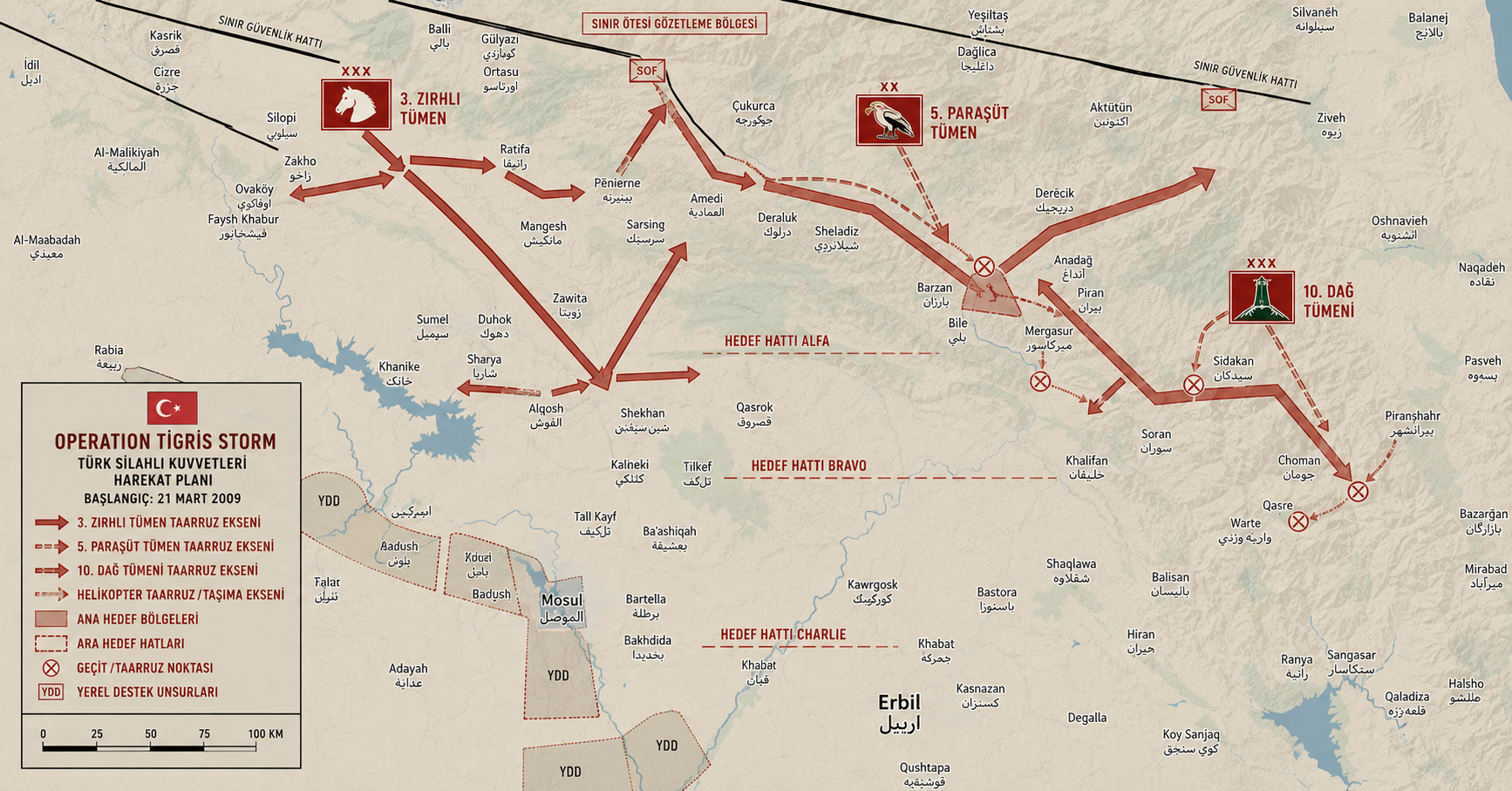
Ayşe looked at the terrain. Red lines ran from the border in three separate directions, converging loosely somewhere in the mountains north of Mosul.
"Before you start," she said, "someone tell me what I'm looking at. In one sentence. Then you can spend the next hour making it complicated." She said with a smile.
Uzun didn't hesitate. "That is Operation Tigris Storm. Madame Prime Minister.” He paused, then showed her the larger operational plan. “This is the ground component. Twenty-eight thousand personnel will be deployed across three divisions. The three divisions, the 3rd, 5th, and 10th, will be operating across three axis of attacks.”
He waited, seeing her nodding before continuing. "Tigris Storm. The whole of it. Though the plans staff insisted on breaking it into pieces, so you'll hear Saber, Storm, and Scale today, and Storm will mean two different things depending on who's talking. I apologize for that in advance."
"I'll try to keep up," Ayşe said as she looked at the map.
Tansu stepped forward, a laser pointer already in hand, and the room's attention shifted to him.
"Tigris Saber is the opening move ground offensive," Tansu said. "Tigris Storm is the airborne envelopment, seeking to break the PKK's ability to reinforce north of Duhok. Tigris Scale is the mountain clearance that comes concurrent with Storm and phase II of Saber, and it's the piece that takes the longest and will be the focus of our ground operation." He traced the pointer along a red line running southeast from the border. "The 3rd Armored Division will be maneuvering across the first main axis going eastward. The 5th Airborne Division will be maneuvering across the second axis, going east-west, then north-south. The 10th Mountain Division will move southward in a single axis. The goal is to cut Duhok off, degrade what's left of the PKK's fixed infrastructure in the pocket, and secure the crossings toward Erbil, Mosul, and Sulaimaniyah.”
"We will have close to twenty thousand combat troops with an additional five thousand support and auxiliary personnel," Yalcinkaya added. "Artillerymen, engineer regiments, military police, a Gendarmerie special operations element attached for detainee handling once we're past the border. Logistics tail behind all of it.”
“I believe it was Napoleon who said, 'An army marches on its stomach."
Özbal let out a small smile and nodded. “Yes, Madame Prime Minister.”
Yalcinkaya continued. “ It's not glamorous, but it's what keeps those twenty-one thousand men fed and fueled once they're forty kilometers into someone else's country."
Tansu moved the pointer to a thick red arrow crossing at the northern edge of the model. "The 3rd Combined Arms Armored Division will move one armored regiment and two mechanized regiments through the Border Crosses at Ibrahim Khalil.” Brig. Gen. Tekeli changed the projector to show the border crossing.
“The goal is for the 3rd Armored to thrust into an eastward axis after taking the working border crossing. Phase One takes the division through Zakho, Dar Huzan, and Hezawa, ending at Mala Arab."
"Why end there?" Ayşe asked.
"Because that's where we expect the PKK will make us stop," Tekeli said. “Zakho, Dar Huzan, Hezawa, none of that is PKK ground in any real sense. There might be some sympathetic Kurds in the population, and some Iraqi peshmerga forces, but there are no fixed defenses to speak of. The PKK’s current positions are in the mountains. “He said as Tansu pointed to them with lasers.
“It will take the PKK at least twelve hours to organize and prepare for battle. We expect token resistance at best, moving through those towns. Our plans expect the 3rd Armored to reach Mala Arab after thirteen hours from go time. It's close enough to the Bahdinan approaches that the PKK has had years to prepare it as a blocking position if they ever needed one. We assess they'll commit to defending it rather than falling back further, because falling back from Mala Arab means giving up the whole northern shelf without a fight.”
"How many of them?" Ayşe asked.
"At Mala Arab specifically, we expect three to four hundred fighters. Some dug in, perhaps mines along the approach roads, probably RPG and anti-tank teams on the high ground either side of the valley. It won't be Grozny. It also won't be a walk in the park either."
"And the town itself. The civilians."
"Small. A few thousand year-round, fewer if word's gotten out we're coming, which it will have by the time the lead elements are through Hezawa. We're planning a warning window ahead of any direct fire into the built-up area, including leaflets, radio, the usual, and a corridor south for anyone who wants to use it."
Sümeyye looked back at Ayşe from the project. "The legal basis for entering Iraqi territory is the inherent right of self-defense against an ongoing and demonstrated threat to Turkish civilians, the same standard we've used for every incursion since the eighties, updated for what we now know from the Izmir investigation. The Ministry's opinion, and the Justice Ministry concurs, is that this holds for the operation under the theory developing in Anglo-American jurisprudence of anticipatory self-defense. Namely, we do not need to wait for an attack to happen so long as the threat is imminent and apparent. It does not automatically extend to prolonged occupation of Iraqi soil beyond what's operationally necessary to secure the objectives in front of you. I want that distinction understood by everyone at this table, because it will matter a great deal in six months when someone in the Hague asks us to explain ourselves."
"Understood, Minister," Uzun said, and meant it, from the way he said it.
"And Phase Two." Tansu's pointer moved again, further southeast. "Once Mala Arab is secured, the division reorganizes and pushes from Batifa to Bamerne, then on to Qadish. That's the harder half of the axis. The terrain closes in, the road quality drops, and it's where we need the airborne piece to already be in place, because otherwise 3rd CAAD is driving into a funnel with its flank exposed the whole way."
Akar leaned forward, elbows on the table. "The division is currently equipped with the BMC Kirpi, Bradley IFV, Leopard 2A6, and behind them, T-155 Fırtına in support of anything dug in that needs persuading to leave. Kirpi mine-resistant vehicles running route clearance ahead of the main column, because Dar Huzan and Hezawa are exactly the kind of corridor where they've had years to seed IEDs, and the PKK will be relying on them to stall us.”
"It's the terrain past Batifa that worries me," Küçükakyüz said, mildly, not contradicting so much as adding weight to a different side of the scale. "Once you're climbing toward Qadish, close air support gets harder, not easier. Ridgelines break the line of sight for laser designation. We'll have F-16s on strip alert at Diyarbakır, but there will be stretches of that road where the division is more alone than anyone likes."
Ayşe wrote something down. Kaan glanced at the page.
"What are the threats to the 3rd Armored going into a significant urban area," she said.
Uzun took this one himself. "5th Airborne Division. Their job is simple to say and hard to do cut the PKK's northern elements off from Erbil and Mosul before 3rd CAAD ever gets to Qadish, so that when the armor does arrive, there's nothing left to reinforce the defense." He nodded to Tansu, who brought up a cluster of markers deep in the high ground.
"The division will air assault four regiments in a staggered deployment," Tansu said. "Black Hawks and Chinooks will put the first regiment into Bahadre Mountain Pass in the first wave, followed by the second regiment, then the third followed by auxiliary reconnaissance and engineering units. T129s and Apaches will be flying escort and standing by for anything that needs immediate suppression on the landing zones. From the pass, the division splits into four."
Ayşe watched as the generals began moving the different regiments on the map.
"Two opposing thrusts first, one element west toward Namrik, one east toward Mrebah. That's the spine of the operation, it's what actually closes the door on Duhok from the north. A third detachment air-assaults into Bakrman, a fourth into Baurki. Between the four of them, every route a PKK element could use to reinforce Batifa from the north or east gets cut before 3rd CAAD's second phase ever starts moving.”
“What happens if Storm fails?” Ayşe asked concerningly.
“Well, if Storm fails to close on time, Operation Saber's and the 3rd Armor will likely face stiffer resistance. To be frank, that is a possibility. However, we are confident that the 5th will accomplish its goals, which are ultimately to cut off the PKK’s axis of attack and retreat and their freedom of movement. Even if a handful of units make it through, that doesn't complicate things."
"What's the resistance picture in the past?" Ayşe then asked taking note of that.
Tekeli again. "Lighter than Mala Arab, we think, but less certain. We have good imagery on fixed positions. We have poor imagery on what's moving through that terrain day to day, because it's exactly the kind of ground where a lot of people move through and we can’t determine whether it is an artery point for militants. The honest answer, Madame Prime Minister, is that the first ninety minutes on those four landing zones is the part where we face the greatest risk. Once we secure the landing zones, Storm becomes a lot more manageable.”
"That's not comforting, General." Ayşe retorted.
"It's not meant to be. It's meant to be true."
"What's the threat to the helicopters themselves?" She looked at Küçükakyüz when she asked it. "Not the ground troops. The aircraft."
"Small arms, RPGs at the landing zones, which is why we're putting the T129s and Apaches in first to work them over before the troop-carrying flights commit. The thing I actually watch for is man-portable air defense, MANPADS. We have no confirmed sightings of the PKK operating anything of that class in this AO. We also had no confirmed sightings of a lot of things three weeks ago that turned out to be true once we went looking properly. It's a low-probability, high-consequence risk, and we're flying the insertion as though it's higher than we think it is rather than lower."
Ayşe filed that away without commenting on it further, and Tekeli, at the far end of the table, did not look up from his folder.”
Tansu then drew the pointer down to the third axis, further east, deeper into the relief of the model where the terrain rose in tight folds. "10th Mountain crosses at Beduhe, proceeds to Kani Masi, then Bere Sile. From there it turns east, Resava, Gunde Site, ending at Dore, where it splits into two assault groups. One toward Ari. One toward Choman."
Uzun added. "The division's whole purpose on this axis is to clear terrain the armor can't use and the airborne can't hold indefinitely. Mountain commando companies, mule and all-terrain-vehicle resupply where the roads give out, mortars and sniper elements attached at company level. Slower. Methodical. And it's the piece of this operation that bleeds us the most, because it's the piece where every ridge is a place to put a machine gun and every trail is a place to put a mine."
"How long before the weather closes that terrain on you," Ayşe asked, looking at the weather section of the report in her briefing.
Uzun glanced at Yalcinkaya, who answered without needing to check a note. "Six weeks, conservatively, before the passes above Choman start getting difficult, eight we believe we’d have to suspend the mountain operation and reorganize. Madame Prime Minister. Every week we lose at the front end of this is a week we don't have at the back end. Before we know it, it will begin snowing in the mountains.”
"As for resistance, there is less fixed infrastructure than in the Duhok pocket," Tekeli said. "However, we expect the most resistance there. We estimate between four and ten thousand PKK fighters are spread across these camps, facilities, and cave systems. We assess six hundred to nine hundred PKK personnel moving through the Ari–Choman corridor at any given time. It is their main mobility hub.”
"And Choman specifically. What do we know about the local Kurdish government? Not ours to simply walk into without someone in Erbil or Baghdad having an opinion about it."
Cem answered that one before the generals could. "The local Kurdish government is split between rival factions, with the KDP based in Erbil and the PUK based in Sulaymaniyah. The main challenge is to convince whatever authority replaces the Kurdish regional authority that maintaining their security and economic arrangement with us is beneficial. I would recommend a Teskilat negotiating team be sent to Erbil in the next few days to gauge the situation in Erbil. It would be prudent to remember that the KRG does not control most of its own territory. In addition to inner Kurdish factionalism between the PKK-YBJ, PUK, and ruling KDP. The current power-sharing arrangement between the PUK and KDP is very tenuous.
The most honest assessment of the Kurdistan Region is that it is effectively two states within a region, ruled by two different parties, armies, and security forces. This bifurcation of the state allows us flexibility to prop up the KDP in any future Kurdish Republic. The KDP and Barzani loyalists are mostly from the north of the region and Bahdini-speakers, while the PUK's support are almost exclusively from the Sorani-speaking area, and based in the city of Sulaymaniyah.”
Ayşe looked at Ağçay, who nodded at the assessment, which was good enough of an endorsement for Ayşe. "What would we have to give the KRG to avoid the Peshmerga getting involved here?" Ayşe repeated.
"It's Erbil, Madame Prime Minister. Everything they offer comes with a price tag, and everything they ask comes with a price tag." Cem responded.
Turhan Tayan spoke again, not looking up from his folder. "This operation is different than our previous ones. We are attacking major urban centers where the PKK has a minimal or limited presence. I don’t think we can pay our way out of this one. The KRG will have to react or it will lose all source of legitimacy”
"Then we will take them out too, Minister," Akar said, an edge in it that hadn't been there a moment before.
"I don’t believe it would be that simple, General," Tayan said and went back to his folder. “The Peshmerga have hundreds of tanks, artillery, and MANPAD systems…they have over a hundred thousand fighters…and they have a population that will be giving them support, assistance, and intelligence.”
“They are carrying legacy systems of the 60s and 70s. For heaven’s sake they are operating T-72s. Their role would not only be inconsequential, it would merely make the campaign easier in destroying the Kurdish infrastructure of northern Iraq.” Akar shot back as Tayan shook his head.
"And detainees," Ayşe said, seeking to get them back on track "We will likely be capturing militants and other combatants all across the three axes. Who takes them, who screens them, and where they end up while someone decides whether they are combatants or civilians?"
Yalcinkaya answered this one. "Gendarmerie personnel will be moving with the main ground divisions specifically for that reason, it keeps the screening function separated from the combat units that did the actual fighting. Once we’ve established our initial foothold, we will have forward collection points near the border, then a proper facility inside Turkish territory within seventy-two hours for anyone held past initial screening." He said with a pause as an aide wheeled in a cart with coffee and glasses of tea.
Akar and Küçükakyüz ended up whispering to each other, cups in hand, not quite facing each other.
"You keep telling me how alone they'll be past Batifa," Akar said, not unkindly. "You’ve also mentioned it here many times. I am not sure I can say I am confident about your vigor for this operation."
"I mention it because it is appropriate for Hulusi. I'm not telling you not to go. I'm telling your division commander not to be surprised when the weather closes a valley and he doesn't have eyes on it for forty minutes. We are going to be fighting long-range engagements against emboldened extremists. We need to be honest that this isn’t a fight we will walk through unscathed."
"My division commander has been surprised by worse than weather. These men need the confidence that the entire military is backing them. That they aren’t being sent into the valley of death with a broken shield and a dull blade."
"I know that." Küçükakyüz drank his tea. "That's why I'm telling him now, in a warm room, instead of over the radio later." He looked back to listen as Yalcinkaya continued the briefing.
"Madame Prime Minister, Phase One, Operation Saber, the drive to Mala Arab, we're planning five to seven days, contingent on how hard they choose to fight for the city. Storm executes concurrently with the tail end of Saber, ideally landing all four elements within a forty-eight-hour window so nothing has time to reinforce between insertions. Once Duhok's cut and Mala Arab's secure, 3rd CAAD's Phase Two to Qadish runs another five to eight days behind that. Scale is the long pole. We're telling you three to four weeks of clearance operations on the mountain axis, with a forty-five-day horizon before we come back to this room and reassess the whole campaign."
"What is the casualty assessment” Ayşe asked.
“For Operation Saber," Tansu said. "We’ve estimated thirty to fifty killed across the division on the drive to Mala Arab, more once the city itself is contested, with casualties to rise to eighty or ninty. For Operation Storm we anticipate fifty casualties across the four insertions, and that number moves a great deal depending on what's actually waiting in that pass that our imagery didn't catch. Scale is where the real cost sits. Three to four weeks of contact in terrain built for ambush. We're telling you to plan for the low hundreds over the course of the clearance, and if Choman or Ari get contested directly instead of yielding, higher than that."
Ayşe didn't write this number down. She looked at it on the screen instead. "So we are estimating at least four to five hundred casualties across the entire operation, is that correct?”
"Yes, that is our assessment, Madame Prime Minister," Uzun said. "The casualty assessment is being done on a worse-case analysis based on the probability of enemy action and the likely result from that action. We wouldn't put a plan like this in front of you if we thought there was a version of this operation that could reduce the casualty numbers. There isn't. There's a version that has a higher CDA, and a version where the CDA is lower, but both come with trade-offs."
“What exactly is the end goal of this operation General,” Ayşe asked almost defeatedly. “We’ve spent a month and billions of liras bombing Northern Iraq. We are now going to spend trillions of liras and another month invading it. What will we be achieving?”
Adnan Özbal answered this one the way he'd answered a version of the same question the first time she'd sat in a room like this. "Duhok, cut off from resupply and reinforcement for as long as we hold the ground we're about to take. Three of their crossing points into Erbil, Mosul, and Sulaimaniyah are under our control instead of theirs. And a mountain pocket that's no longer theirs to move through freely. It is not the end of the PKK, Madame Prime Minister. I told you that the first time, and it hasn't changed. What it is, is the end of the sanctuary they've had since before either of us held these jobs."
Sümeyye Boz shifted in her seat, and Ayşe caught it before she'd said a word, but then Major General Ercan Akinci began to speak.
“Madame Prime Minister,” Akinci said, pulling down his army jacket. “The PKK’s existence has been prolonged because of the very fact we’ve allowed the Kurdish factions to play with us. Let the Kurds kill each other. I care not for them. I care for the blood of the citizens of our Republic being shed by cowardly terrorists.
We have been successful in eradicating the PKK's presence from southeastern Türkiye, systematically driving them from their stronghold in Diyarbakir to Batman, then to Sirnak, and ultimately into Iraq. With the full support of the government, we can execute a comprehensive campaign to neutralize the PKK and its Iraqi affiliates. The proposed operation will commence in Dhokuk, advance to Erbil, and culminate in Sulaymaniyah, aiming to dismantle and incapacitate the organization effectively.
You ask what we are achieving from this operation...not what you want. To achieve your actual goals, the plan would require more than what we’ve currently discussed. We require the deployment of 85,000 ground personnel, comprising 17 combat brigades. These forces will necessitate the support of 5,000 armored fighting vehicles, tanks, and other ground assets. Additionally, air support will be critical, with a requirement for 50 combat aircraft, 200 transport helicopters, and 75 attack helicopters to ensure operational success.
With a six-month timeline for this operation, followed by a sustained military presence to maintain stability. Madame. Prime Minister, I am urging you to find the strength to tackle this challenge. We can not kick it down the road for the next generation of Turks to fight.”
Sümeyye almost looked aghast. “A prolonged military presence. I believe the right term you are looking for is occupation General.”
“How is that any different than what this current plan offers?” Akinci asked. “We will be deploying 28,000 men to fight in Northern Iraq. Hundreds will die. Die for what? Madame Foreign Minister. The reality is that what we have is unsustainable. Fragmented airstrikes will not dent PKK activities. If the PKK continues its campaign or God forbid that Kurdistan becomes an independent nation, and we allow the Americans or Europeans to support them, our national security would be at immense risk. We need to strike and strike decisively.” Akinci said as he banged his finger on the operational plan binder.
“With all due respect, General, you are wrong,” Sümeyye responded. “The KDP has no desire to allow the PUK to rule. This is a material fact. At the moment, what unites the two is a fear of Iraqi encroachment. As a matter of fact, it was Iraqi maneuvers that bound the KDP and PUK in the 1970s and then the 1990s. Kurdistan will become a political reality. This is the trend that the KDP and PUK wish to achieve.
A Turkish military intervention and occupation will provide the grounds for the PKK to not only swell but also bring the KDP and PUK together. I am sorry, but an operation of this scale would not only damage our regional standing, but it would also isolate us completely. It would open the door for more Thai military assistance, invite the Iranians to make a move on Iraq, and undermine the goodwill we have been building across the world. It would push the Americans away from us at a time where we…”
“We what?” Akar said, looking at the Foreign Minister.
“At a time when the global security situation is falling apart, and we are left without a strong deterrence. Don’t be such a naive General. We don’t…“
I am not naive, Minister.” Akar said, cutting her off. “However, to take the Americans at their word? They made promises before. They continue to make promises. Words are cheap, and the Americans have expended all their money elsewhere. What are another hundred dead Turks worth to them?” He asked, looking directly at Sümeyye. “Hmm?” He paused. “The current violence is being spurred by Thailand. No doubt. We’ve all read the briefings. What makes them different is that they are not afraid of the consequences. They are driven by passion and by lust. What are we driven by?” He asked, looking around the room.
“The Kurdistan project.” Akar continued. “The Kurdish vision is one that is a direct threat to all of us in the room. It is a threat to our safety. It is a threat to our economic well-being. It is a threat to our future. I refuse to let that become a reality. The PKK is merely one manifestation of that threat.”
“A political reality that would unleash chaos and destruction for decades to come,” Akinci added. Sümeyye sat there in disbelief, so easily readable from her face as Ayșe tried to process what had just happened.
“I think what the General is trying to get across is that we must take stock of the reality that the current fragmentation of Kurdistan only has one outcome. Instability,” Küçükakyüz interjected. “If a Kurdish Government can not have effective control outside of pockets of towns, then the PKK will continue to flourish and exploit the lawlessness present. If there is a strong Kurdish Government and it is run by separatist nationalists, then the outcome will be exported instability and terrorism. I am not here to doubt that we could get an agreement with the KRG or the government in Baghdad. I am skeptical of their ability to control the Kurds. It is clear that Thailand has lit a spark, and it has reignited the PKK.
The flood gates are open, it doesn’t matter what anybody wants. All across the region, the embattled Kurdish terror groups will resurge. This is the nature of counter-insurgency warfare. They rely on ideals. Ideals which inspire humans to commit the most vile of atrocities. I am not opposed to using inner-Kurdish factionalism to our advantage; however, we also do not know who is in charge, what is happening in Erbil, and is the government in Baghdad even capable of setting down the law.
Before Sümeyye could respond, Admiral Özbal would chime in. “I believe that there must be further negotiations done with Iraq and Erbil. Any prolonged ground offensive will require us to conduct a multi-phase occupation with manpower constraints upwards of 150,000. We’re not just talking about combat brigades but auxiliary support, logistics, and other assets.
If it is possible to fragment the Kurdish government before it begins, then we should exploit that. We should also use this opportunity to develop our position in the region to enhance our bargaining chips. I am certain any successive Kurdish Government will want our forces gone.”
“Or our forces to help suppress their rivals.” General Tural said, having been quiet for a while. “We can also help the KDP reassert its control at the expense of the PKK and PUK.”
Ağçay stepped in. “While I agree this would be to our advantage, I must relish in pointing out the obvious. Instability in northern Iraq does not serve our interests. It helps rogue non-state actors like the PKK thrive and expand. While we need to act and act soon, I do hope we heed caution.”
Sümeyye leaned back for a moment as Akar looked around the room. "I'm not disputing the plan or that we act," Sümeyye said carefully. "I'm asking whether it has to happen now. Is it necessary for us to go on this military incursion when we haven’t even explained to the international community what it is we are doing?"
Cavusoglu spoke before Ayşe could answer, his voice pitched for a room. "Madame Prime Minister, if I may. The President's office shares General Uzun's assessment of the military necessity. What concerns us is the sequencing. Right now, the world's attention is on Thailand and its growing role in this situation with the PKK. Thirty-two thousand men crossing an international border will be on every wire service within forty-eight hours, and we will be having the sovereignty conversation, the refugee conversation, the Kurdish-question conversation, all of it, in front of an international audience we have not yet prepared."
"What is it that the President is asking?" Ayşe asked.
“The President defers to this government to make those decisions, Madame Prime Minister. However, he does encourage this government to take the necessary time to get in front of Washington properly, brief the British and French before they read about it from Reuters, put something in front of the Global Assembly that makes this look like what it is rather than what our critics will say it is. We have an opportunity with Thailand’s fingers being around this to build a coalition of supporters."
"Six weeks," Akar said, not quite under his breath, "is six weeks the PKK gets to finish rebuilding whatever we haven’t already burned down. To hell with that. We go now. We hit them hard. We beat them."
"That is the same strategy that got us embroiled in the Millennium War," Boz said, "do you think the Russians and Swedes, Australians and Brits, and the Americans forgot the last time the Turks went to war?”
Ağçay closed the binder in front of him. "Madame Prime Minister, I'll say plainly what my directorate believes, and you can weigh it against the Minister's caution however you see fit." He opened another folder now, but didn't look down at it as he handed it over. "The network we’ve been going after for weeks now hasn't reconstituted. It's scattering. We have signals intelligence showing at least two of their regional commanders have gone dark in the last ten days, not killed, not captured, just gone, which in our experience means they've been told to disperse and go quiet until the pressure lifts. If we give them six weeks of quiet, they will use every day of it. The PKK we hit in six weeks will not be the PKK sitting in Mala Arab today. It'll be smaller, more dispersed, harder to find, and it will have had six weeks to decide where to hide the parts of itself that matter most."
"You were saying something similar before Izmir," Ayşe said, also with a hint of annoyance with how Hakan had seemingly switched his position.
Hakan didn't flinch from it. "I was. And I was wrong about the timeline, not the methods we employed. The principle hasn't changed because I was wrong once, Madame Prime Minister. They know we're coming in some form. The only question is whether we hit them while they're still distracted enough to hit, or after they've had time to concentrate”
Cavusoglu didn't raise his voice, but something in his posture tensed as he saw that the room was gearing more in favor of unilateral action. "Director, with respect, the choice isn't between acting now and acting never. It's between acting with cover and acting alone."
"There's a third option," İsmail Cem said.
"Go on," Ayşe said.
"You don't need six weeks of a general campaign aimed at the General Assembly," Cem said. "You need one telephone call, made properly, to one government. Washington already knows this is coming. They are not going to be surprised. What they want is to be consulted, formally, before rather than after, so that when their allies raise the alarm the Americans will be able to sell our side.
"And they'll give us that for free," Boz said, not quite believing it.
"Nothing from Washington is free," Cem said. "But the current administration is going out the door and the new one values a military alliance with us. It is time for us to show our hand and offer them their old bases. The Thais are growing more brazen. The PKK is operating with impunity on our borders. The Kurds in Syria are breaking away. Islamist rebels in Syria are fighting one another. This region is not safe. It is time we show our hand and which side we are on.”
Ayşe appreciated the cover Cem was giving her. It often felt like she was a sheep in wolfs clothing whenever she was in these meetings. She listened as Cem continued.
“A phone call to the State Department, I can call the Brits if you want it, and, if you're feeling ambitious, we can have President Gul send a quiet word to Beijing. None of that requires six weeks. It can be done in the time it takes us to get into position for this operation.”
Cavusoglu considered what it would cost the President's office to be seen agreeing with a Deputy Prime Minister's idea. "One week is thin cover for an operation this size."
"One week with the Americans standing next to us is thicker cover than six weeks alone," Cem said. "You know that as well as I do, Mevlut."
"General Akar," Ayşe said. "If I give you one week instead of six, does this still work?"
"The plan survives whatever timeline you give it, Madame Prime Minister. It's not the plan that gets worse with more time. It's the target. It is the risk. We will get it done either way."
"General Tural." She turned to him. "You agree with the Director's read on dispersal."
Tural nodded once. "I do. I think it’ll take us time to get in place either way. The quicker we act gives the PKK less time to respond."
She looked down at the notepad Kaan had set in front of her. "Sümeyye," she said. "I'm not dismissing what you raised. I want it on record that I heard it, and that I think you're right that this will not stay quiet, and that we will pay for however unprepared the world is when it stops being quiet." She looked at Cem. "I think the answer is what İsmail's describing. I’ll speak with the new President and gauge his willingness to help us or at least stand by quietly on our side. As for the others, I think it is best if we call London and ask them about their position and simply leave it at that.”
Boz's jaw tightened, almost imperceptibly, then released. "I'll have our embassy in Washington arrange the call”
"Good." Ayşe turned to Cavusoglu. "Tell the President we’re going to have to meet again to discuss the right way to launch and announce the war.”
Cavusoglu inclined his head. "I'll relay that, Madame Prime Minister."
She looked back to generals. "You have my approval for this operation. Please begin making preparations for the Operation.”
She stood. The room rose with her, chairs scraping again against the tile, and for a moment the whole assembly of stars and folders and terrain lit up in green and brown just stood there, waiting to be dismissed like something out of an older war than the one they were actually planning.
"Thank you," she said. "All of you. I'll expect the finalized timeline in writing by Thursday." She paused at the door, Kaan already a half step ahead of her with his hand on the handle. "General Uzun. Walk with me a moment."
He fell into step beside her as they stepped into the corridor, the noise of the meeting fading behind the heavy door.
"I'd like your honest opinion," she said as they walked toward the exit. "When this operation begins, there will be no shortage of people accusing me of launching a military adventure simply to raise my polling numbers."
She paused to retrieve her secure government phone before slipping it into her jacket pocket.
"I'm here to make difficult decisions, General, not decisions that improve my approval ratings." She turned to meet his gaze. "You have my backing, but I want the truth. What comes of this operation? What happens if Mala Arab doesn't fall within five to seven days? What if the Peshmerga intervenes? What if this entire operation begins to unravel?"
General Uzun drew a slow breath before answering. "General Eisenhower once said, 'Plans are useless, but planning is indispensable.' Madame Prime Minister, we've planned for those contingencies. No operation unfolds exactly as it is drawn on a map. Circumstances change. The enemy adapts. We adapt in return."
"If Mala Arab doesn't fall within our projected timetable, we reassess. If the Peshmerga become involved, we have prepared responses designed to prevent unnecessary escalation. If events unfold differently than expected, we will present you with new options. That is why we plan, not because we expect perfection, but because we expect uncertainty."
"Madame Prime Minister, we are not here to pursue our own agenda. As the Admiral explained, this operation is only one piece of a much larger puzzle. Our responsibility is to give you options, not to make political decisions for you."
"Some officers may disagree with your decisions. They may question your judgment or recommend a different course of action. But they do so as advisers, not as politicians. Their duty is to give you their best military counsel. The decision, however, is yours." His expression softened. "You have earned the confidence of these armed forces. You have our sincere appreciation for all you have done for this country."
The remarks caught both Ayşe and Kaan by surprise. Even the Prime Minister felt warmth rise to her cheeks.
"General, I..."
Uzun gently raised a hand, stopping her before she could continue.
"Whatever questions you have, whatever hour they come, call for me. I will answer."
Ayşe let off a soft smile. “Thank you, General.” She said as she watched Kaan slip away, already speaking quietly to an aide who'd appeared from nowhere with a phone held out, and Ayşe recognized the particular stillness in Kaan's shoulders that meant something else was waiting for her before she'd even left the building.
"That will be all, General," she told Uzun. He saluted and turned back toward the operations center.
She caught Hakan Ağçay coming out the other door as she reached the end of the hall, folder still under his arm, and for a moment neither of them said anything.
"Director."
"Madame Prime Minister."
"I hope I was not harsh in there. It was not my intention," she said. "You were right about the need to be patient with these things…it is just difficult sometimes when I have to be the one to make the decision."
"I was right about the last one too, until I wasn't." Hakan conceded. “I do not envy you and your position. We are working on tracking down the mastermind behind the Izmir bombings. We are making progress and have some good leads.”
She looked at him a moment longer than she needed to. Trying to figure out what he meant. "Keep me posted on the commanders going dark," she said, and walked past him toward the car, and did not tell him it was forgiven, because she wasn't entirely sure yet that it was.
The car was warmer than the building had been, and for the first ten minutes, neither of them spoke. Kaan opened the folder he'd carried and handed it to her. She read the first few lines and let out a sigh. “It is good to know that parliament won’t be my enemy on this.” She said in defeat. Kaan nodded as the car pulled out of the General Staff headquarters and returned to her residence.
This site uses cookies to help personalise content, tailor your experience and to keep you logged in if you register.
By continuing to use this site, you are consenting to our use of cookies.