STATISTICS

Start Year: 1995
Current Year: 2008

Month: April

2 Weeks is 1 Month
Next Month: 22/02/2026

OUR STAFF

Administration Team

Administrators are in-charge of the forums overall, ensuring it remains updated, fresh and constantly growing.

Administrator: Jamie
Administrator: Hollie

Community Support

Moderators support the Administration Team, assisting with a variety of tasks whilst remaining a liason, a link between Roleplayers and the Staff Team.

Moderator: Connor
Moderator: Odinson
Moderator: ManBear


Have a Question?
Open a Support Ticket

AFFILIATIONS

RPG-D

BILLING IN PROGRESS PKK | Operation Sun

Personnel Quantity
54

Jay

Dokkaebi
GA Member
Oct 3, 2018
3,645

500px-Flag_of_Kurdistan_Workers%27_Party.svg.png
OPERATION SUN
Security Classification: TOP SECRET

SITUATION REPORT


OVERVIEW

Over the past year, intensified surveillance and cross-border operations by Turkish forces have steadily constricted the maneuver space available to fighters of the People's Defense Forces and their associated formations. Persistent drone patrols, satellite monitoring, and periodic air strikes have disrupted traditional smuggling routes and safe transit corridors that once allowed personnel and matériel to move between mountain districts with relative ease.

These pressures have forced commanders to reconsider how supplies are brought into operational areas. Weapons, explosives, and communications equipment that once flowed through long-established routes in the Qandil region now move more slowly and with greater risk. The problem is not merely logistical; it also affects the long-term sustainability of armed networks operating across several borders. If movement becomes predictable or confined to a single direction, adversaries can focus resources and eventually sever those routes entirely.

Against this backdrop, regional leadership has sought to broaden its network of partners and staging areas. One potential partner lies across the Iranian frontier: the Kurdistan Free Life Party (PJAK), a Kurdish militant organization active inside Iran and historically linked to the same ideological and organizational ecosystem as the Kurdistan Workers' Party. While relations between the groups have existed for years, cooperation on logistics has remained inconsistent and limited by geography and mutual caution. Both sides operate under heavy pressure from the states surrounding them, and collaboration requires a degree of trust that is difficult to establish without shared operations.

The Benar Valley plan is intended to address this gap. By creating a temporary disruption at an Iranian border outpost, commanders hope to open a brief but viable corridor through which weapons and supplies can be delivered directly to PJAK representatives. If successful, the operation would establish a proof of concept for future transfers and demonstrate that the two movements can coordinate across the frontier when necessary. In practical terms, it would also reduce reliance on routes currently exposed to Turkish surveillance.


BELLIGERENTS
BLUFOROPFOR
500px-Flag_of_Kurdistan_Workers%27_Party.svg.png
Kurdistan Worker's Party
  • 40px-Flag_of_H%C3%AAz%C3%AAn_Parastina_Gel.svg.png
    HPG
  • 40px-Flag_of_YJA-Star.svg.png
    YJA-STAR


Supported By:
500px-Flag_of_Partiya_Jiyana_Azad_a_Kurdistan%C3%AA.svg.png
Kurdistan Free Life Party
  • 40px-Flag_of_H%C3%AAz%C3%AAn_Rojhilata_Kurdistan.svg.png
    YRK
istockphoto-1683975794-612x612-jpg.7810
Kingdom of Èran
  • derafsh_kaviani_flag_of_the_late_sassanid_empire-svg-png.7817
    Armed Forces of the Kingdom of Èran


ORDER OF OPERATIONS


  • People's Defense Forces (HPG)
    • 32 fighters
      • Command Group
        • x 4 fighters
          • x 2 AKM
          • x 1 AK-74
          • x 1 AKS-74U
          • x 2 Portable radios
          • x 2 Medical backpack
          • x 1 Binoculars/map equipment
      • 1st Squad
        • x 9 fighters
          • x 5 AKM
          • x 2 AK-74
          • x 1 PKM
          • x 1 RPG-7
          • x 9 30mm VOG-17 pattern grenade
      • 2nd Squad
        • x 9 fighters
          • x 5 AKM
          • x 2 AK-74
          • x 1 PKM
          • x 1 RPG-7
          • x 9 30mm VOG-17 pattern grenade
      • 1st Recon Team
        • x 5 fighters
          • x 2 AKM
          • x 1 AK-74
          • x 1 AKS-74U
          • x 1 Dragunov SVD
          • x 4 30mm VOG-17 pattern grenade
      • 2nd Support / Weapons Team
        • x 5 fighters
          • x 3 AKM
          • x 1 PKM
          • x 1 AK-74
          • x 10 30mm VOG-17 pattern grenade
  • Free Women's Units (YJA-STAR)
    • 24 fighters
      • Command Group
        • x 3 fighters
          • x 2 AKM
          • x 1 AK-74
          • x 2 Portable radios
          • x 2 Medical backpack
          • x 1 Binoculars/map equipment
      • 3rd Squad
        • x 7 fighters
          • x 4 AKM
          • x 1 AK-74
          • x 1 PKM
          • x 1 RPG-7
          • x 7 30mm VOG-17 pattern grenade
      • 4th Squad
        • x 7 fighters
          • x 4 AKM
          • x 1 AK-74
          • x 1 PKM
          • x 1 RPG-7
          • x 14 30mm VOG-17 pattern grenade
      • 2nd Recon Team
        • x 5 fighters
          • x 2 AKM
          • x 1 AKS-74U
          • x 1 Dragunov SVD
          • x 10 30mm VOG-17 pattern grenade
      • 4th Support / Weapons Team
        • x 3 fighters
          • x 2 PKM
          • x 1 Dragunov SVD
          • x 6 30mm VOG-17 pattern grenade
All fighters are fully loaded and equipped, carrying two weeks' worth of supplies and ammunition.


CONFIDENTIAL
MISSION OPERATION​
The operation centers on a limited-duration strike against an Iranian border outpost positioned along the approaches to the Benar Valley. The position serves as a lightly fortified observation and control point for the Kingdom of Eran Army, monitoring cross-border movement and acting as an early-warning node for Iranian forces operating along the frontier. Its isolation, limited reinforcement options, and dependence on a small garrison make it a viable target for a short, high-intensity engagement.

The objective of the assault is not to permanently seize or destroy the installation but to temporarily disrupt its ability to monitor and respond along the sector. A coordinated attack by fighters from the People's Defense Forces and the Free Women's Units (YJA-STAR) will fix the outpost’s defenders in place and draw any nearby quick-reaction elements toward the engagement area. During this window of distraction, a separate infiltration element will move through the northern approaches of the valley to secure a prearranged drop site where weapons and explosives will be staged.

Once the drop site is secured, representatives from Kurdistan Free Life Party will receive the materiel and begin transferring it to their own networks operating deeper inside Iranian territory. The corridor created by the attack is expected to remain viable only briefly; therefore, the exchange must occur quickly and without additional movement that could draw attention.

The engagement itself is intended to be decisive but short. Heavy weapons and explosives will be used to overwhelm the outpost’s defensive positions and communications infrastructure, creating the impression of a larger offensive action while limiting the duration of direct contact. The assault force will disengage once the transfer has been confirmed and the infiltration team has cleared the valley.

Following disengagement, all participating elements will withdraw along preplanned routes back toward the border regions where terrain and established movement corridors provide concealment. No attempt will be made to pursue Iranian forces or escalate the confrontation beyond the immediate objective.

In strategic terms, the mission is designed to achieve several outcomes simultaneously: to establish a reliable cross-border logistics channel, to deepen operational ties with PJAK forces, and to demonstrate that coordinated action across multiple Kurdish militant networks remains possible despite increasing surveillance and military pressure in the region.


BI NEPENÎ
MÎSYONA OPERASYONÊ
SECRET

Operation Parameters​

Operational Window: 7 days
Participating Forces: Elements of the People's Defense Forces and the Free Women's Units (YJA-STAR)
Strategic Objective: Temporarily disrupt an Iranian frontier observation post operated by the IKingdom of Eran Army to create a short-duration logistics corridor for materiel transfer to the Kurdistan Free Life Party (PJAK).

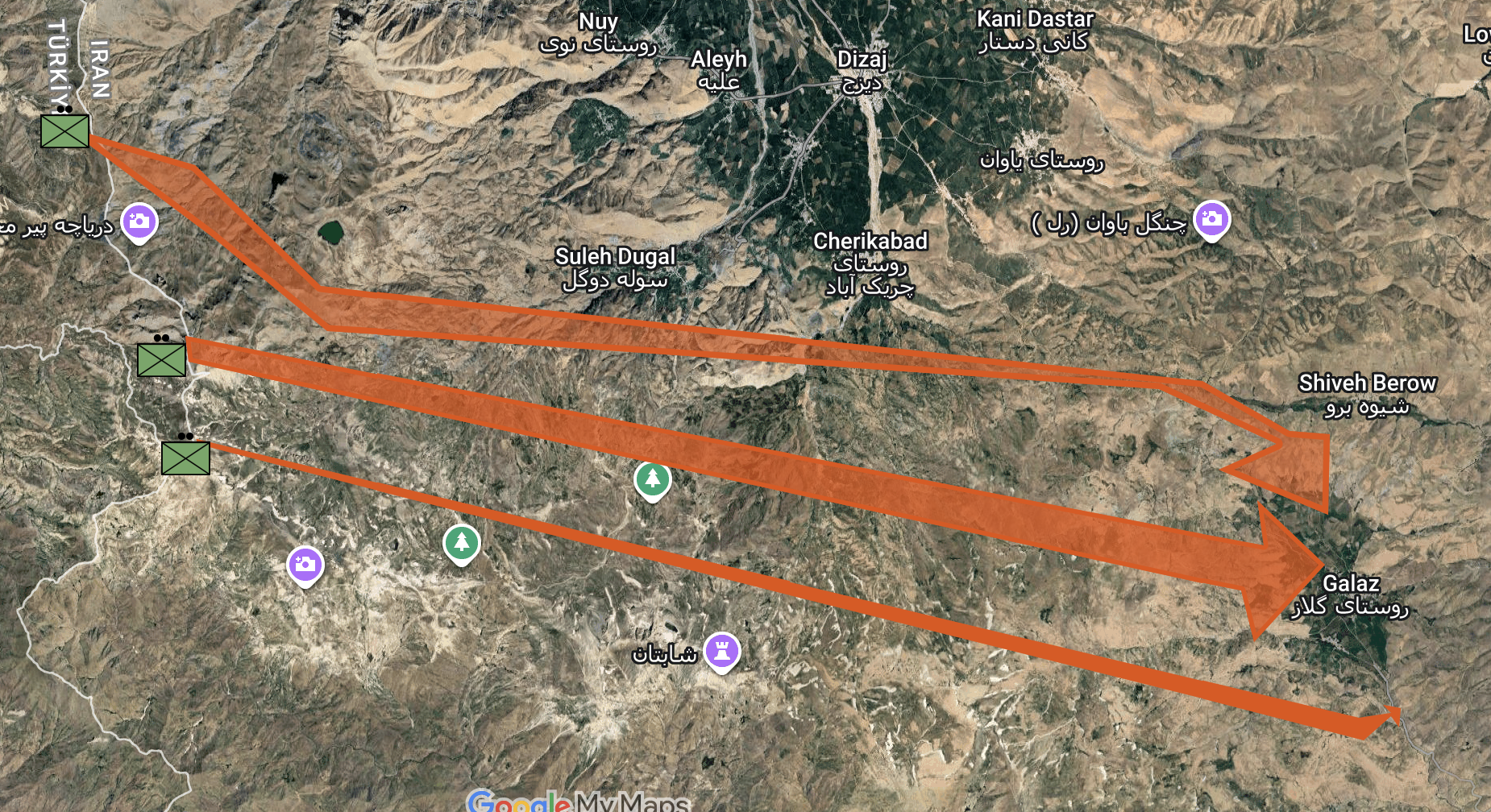
The operation is designed as a coordinated, multi-directional action conducted at night and intended to remain limited in duration. Units will move through the Benar Valley area in dispersed formations, approaching the objective from separate axes to divide the defenders’ attention while a supply transfer is completed nearby. The emphasis throughout the approach phase is stealth, discipline of movement, and avoidance of contact until the planned moment of engagement.

Force Organization
Strike Group 1
Assembly Point: 37.20244, 44.75759
Composition:
1st Squad
1st Recon Team
2nd Weapons Squad

Role: Northern maneuver and containment element.

After staging at the designated coordinate, Strike Group 1 will move east and then south along the ridgeline north of the target position. Recon elements will advance ahead of the formation to monitor patrol routes, confirm the outpost’s activity cycle, and identify any observation posts or early-warning sensors along the approach.
Once in position north of the objective, this group will establish firing positions and remain concealed until the designated attack signal. At zero hour, they will initiate suppressive fire on the northern defensive positions and any elevated observation points, preventing defenders from maneuvering or withdrawing toward the higher terrain.

Strike Group 2

Assembly Point: 37.16354, 44.77811
Composition:
Command Squad
2nd Squad
4th Weapons Squad
Role: Primary assault and logistics element.

Strike Group 2 will approach the objective directly from the west along the most accessible valley route. Movement will occur slowly and primarily after nightfall to minimize detection by aerial observation or local patrols.

The 2nd Squad will carry the weapons and supply packages designated for transfer to PJAK representatives. These materials must remain secured and concealed until the corridor is opened. The command element embedded with this group will coordinate timing between all three strike groups and monitor radio silence protocols.

At zero hour, Strike Group 2 will conduct the main engagement against the outpost’s primary structures and communications nodes. The purpose of this attack is to fix the garrison’s attention and create the conditions necessary for the supply transfer team to move briefly into the designated handoff point.

Strike Group 3

Assembly Point: 37.1469, 44.78339
Composition:
Command Squad
3rd Squad
4th Squad
2nd Recon Team
Role: Southern blocking and reinforcement element.

Strike Group 3 will move north from the staging coordinate and establish concealed positions south of the objective. Their purpose is to observe the southern approach routes and prevent reinforcement from nearby patrols or checkpoints.

Recon personnel will maintain surveillance of nearby roads, footpaths, and any vehicle movement. This group will not initiate contact until Zero Hour unless discovery is unavoidable. When the engagement begins, Strike Group 3 will open fire on southern defensive points and interdict any attempted withdrawal or reinforcement from that direction.
Movement and Approach
All groups will conduct movement exclusively under cover of darkness, halting during daylight hours in concealed terrain. Routes will avoid known villages, roads, and patrol paths whenever possible.
Communications will be kept to the minimum necessary for coordination. Radio transmissions should be brief and coded; runners will be used where feasible to reduce signal exposure.
Avoidance of contact remains a priority during the infiltration phase. Engagement prior to zero hour risks alerting the outpost and compromising the logistics transfer. If patrols are encountered during approach, units are instructed to bypass or withdraw rather than initiate combat unless escape is impossible.

Engagement Phase

The attack will commence at a prearranged Zero Hour once all three strike groups confirm that they are in position. The action is expected to be intense but brief.

Strike Group 2 will initiate the main assault and suppress the communications infrastructure.

Strike Group 1 will deliver supporting fire from the north to restrict defensive movement.

Strike Group 3 will engage southern positions and secure the lower approaches for exfil.

During this period, the logistics team will move the supply packages to the transfer site where PJAK representatives will receive them.

The engagement will last only long enough to complete the transfer and disable the outpost’s ability to immediately pursue.

Withdrawal

Once confirmation of the supply exchange is received, all units will disengage and withdraw along preplanned routes back toward their staging regions. Withdrawal will occur in phases to prevent the appearance of a large retreating force.

Fighters will maintain dispersion during exfiltration and regroup only once clear of the valley and observation corridors.

Contingency Measures

If the operation becomes untenable due to unexpected troop movements, aerial surveillance, or local detection, participating units are instructed to abort the engagement and disperse.

Personnel may temporarily blend into nearby civilian settlements or agricultural areas to avoid pursuit. After the situation stabilizes, fighters will move individually or in small groups back toward base camp using established clandestine routes.

Under no circumstances should the engagement escalate into a prolonged battle with Iranian forces. Preservation of personnel and the secrecy of movement corridors takes priority over completing the attack.

Operational Timeline

Day 1–2: Movement from base camps toward staging areas and reconnaissance of approach routes.
Day 3–4: Establishment of forward hide sites and confirmation of outpost activity patterns.
Day 5: Final coordination between strike groups and positioning around the objective.
Night of Day 5 or 6: Execution of the assault and logistics transfer at zero hour.
Day 6–7: Dispersed withdrawal and return to operational base areas.
END OF DOCUMENT
DAWIYA BELGEYÊ


CAMPAIGN REGISTER

OperationObjectiveStatus
Phase IMove from base camps toward staging areas; conduct initial reconnaissance of approach routes; avoid detection; prepare for forward positioning.In Progress
Phase IIEstablish concealed hide sites near objective; confirm outpost activity patterns; finalize coordination and positioning for Zero Hour assault.Planned
Phase IIIExecute coordinated attack at Zero Hour; fix outpost defenders; suppress communications; complete supply transfer to PJAK; maintain multi-directional pressure.Planned
Phase IVDisengage and exfiltrate along preplanned routes; avoid contact; disperse if necessary; return to base camps.Planned


DukeofBread

GA Member
Nov 2, 2024
294
army-png.7819
ORBAT of Iranian Armed Forces - Border Post 6

> 2nd Platoon + Detachmend
>> 1st Company
>>> 5th Battalion
>>>> 12th Brigade
>>>>> 2nd Korps (HQ Zanjan)


2nd Platoon
├── Command Squad - 5 Personal
│ ├ 5x PC-9 Zoaf
│ ├ 2x FAMAS

├──
1st Squad - 10 Personal
│ ├ 10x PC-9 Zoaf
│ ├ 9x Artesh
│ ├ 1x FAMAS
│ ├ 1x Saegheh
│ ├ 1x M79
│ ├ 5x GS59
├── 2nd Squad - 10 Personal
├ see above

├── 3rd Squad - 10 Personal
├ see above

├── 4th Squad - 10 Personal
├ see above

└── 5th Squad - 10 Personal
├ see above


Detachmend
Battalion dispended Mortar Squad - 10 personal
├ 10x PC-9 Zoaf
├ 5x Artesh
2x HM 16 Mortar

Air Command dispended UAV Squad (1st UAV Brigade) - 2 Drone Operators
├ 2x PC-9 Zoaf
├ 2x Qods Mohajer-4
├ 2x Starting ramps

Logistic Battalion dispended Driving Personal - 8 personal
8x PC-9 Zoaf


Vehicles
1x Tarpan Honker Skorpion 3
4x Gaz-66
2x BTR-80


Overall Personal: 75
 
  • Love
Reactions: Jay

DukeofBread

GA Member
Nov 2, 2024
294
4 Kilometers from the outskirts of Susanabad one of the lasts small villages until the Turkish - Iraq - Iranian border, in the Benar Valley, at the small bridge of the local river lays Border Post 6. Even is its just a small 2m high brick walled encircle with two openings and 3 small towers, it guards the mountains border, 5 kilometers to turkey, since the early 1930s.
The Post is manned, due to the exercise of national security and control, especially for the near by village and continues uncertainty of terrorist, rebels and stateless groups in the region.

While this reason was on paper always seen as a proper one, be it by the old Pahlavi regime, the Theocracy since 1979 and continuing of the new Kingdom of Èran, the troops had not seen combat since almost 13 years now.
So the patrol became a daily routine, void of any perceived thread.
One Tarpan Honker Skorpion 3 would patrol the way to the small village with 4 soldiers in 3 shifts of 6 hours due the day, while a BTR-80 would drive until 1 km towards the Turkish border and back again, with 3 crew and 6 soldiers for patrol, standing just 1km afar from the border, paroling in two 3 soldier groups along the border for roughly 6 kilometers north and south by foot, until to return to the IFV and drive back, conducting these 3 times a day with shift schedules each weak.
Recently the newly stationed drones would also, always just one, conduct surveillance flights in an radius of 80 km around the border post, mostly from early morning until before the last patrol in evening of the BTR-80.

Due to old Qanates originating at the small river in front of the outpost, the "Base" makes use of an underground old school telephone line towards the Brigades advanced command post in Ajabshir, 220 Kilometers on streets away.
Jay
 

Jay

Dokkaebi
GA Member
Oct 3, 2018
3,645
Operation-Sun-Phase-I-and-II.png

The column moved without sound. Fifty-four fighters crossed the dry streambed south of Suleh Dugal just after 2100, picking their way between the pale stones in single file. No torches. No talking. The moon was a sliver behind cloud and the Zagros pressed close on both sides, the ridgelines black against a slightly less black sky. Commander Soran Agid walked near the middle of the column, carrying nothing that rattled.

He had been through this valley twice before, both times years ago and both times in daylight. It looked different at night. Everything looked like the wrong thing at night. At the split in the trail, a flat boulder the size of a truck that the fighters had used as a waypoint for twenty years, the column stopped without being told. The lead scout, a woman named Keje, held up a closed fist, and the men and women behind her went still and crouched and listened.

Forty seconds. Nothing moved. The wind came down from the northeast carrying the smell of cold stone and something faintly chemical, a fire somewhere, far away. Keje dropped her fist and turned back, found Soran in the dark, and made the split signal with two fingers. The column divided here.

Strike Group 1 peeled south along the left fork without ceremony, their boots fading into the gravel. Fifteen fighters, two weapons teams, one recon pair moving fifty meters ahead of the main body. They were headed for Shiveh Berow, a long descending ridge of limestone shelves that would take them south and east until they could swing around behind the high ground north of the objective. It would be an eight-hour walk in the dark if nothing went wrong.

Soran watched them go. He knew the squad leader, a man named Dildar who had been fighting since he was nineteen and was now thirty-four and moved like he was still nineteen. Dildar never looked back when he walked away from a split. He just walked.

The rest of the force continued east toward Galaz. The trail here was better, wider, more worn, less likely to turn an ankle, but that made Soran nervous. Worn trails meant people used them. He pushed the pace slightly, kept the intervals tight enough to maintain contact in the dark but loose enough that a single burst of automatic fire wouldn't take three of them at once.

Halfway to the first hide site, Recon Team 2's lead element, a young fighter named Baran who wore his keffiyeh wrapped across his face, came back along the line with his hand raised palm-out.

Track marks. Fresh ones. Vehicle, probably a light truck or motorcycle, cutting across the path from a shepherd's track that ran down from the higher ground. Soran studied the marks with a small penlight shielded under his palm. The tread was ordinary, nothing military, probably a farmer or smuggler who ran the valley route at night out of habit. But it wasn't certainly.

He made the decision in about four seconds. Continue. Tighten the spacing. No lights at all from here.
The column moved again.

They reached the first concealment position, a fold in the terrain west of Galaz, where a dried irrigation canal cut into the hillside, and old poplar trees had grown close enough together to break any silhouette from above, at 0340.

The fighters went to ground without conversation. Some ate. Some slept immediately. Soran sat with his back against the canal wall and spread the map across his knees, using the red-lensed light clipped to his collar to read it.

Tomorrow, they would push the recon elements forward to within visual range of the outpost. He needed to know the patrol cycle, how many men walked the perimeter at night, how often, whether they used dogs, where the radio antenna was positioned on the structure. Dildar's group, if they had made the ridgeline on schedule, would be doing the same thing from the north.

The supply packages were back with Strike Group 2. He hadn't looked at them and didn't intend to. That was someone else's accounting. His job was in the corridor. Open it, hold it long enough, close it cleanly.

He folded the map and looked at the sky, which had gone from black to dark grey in the east. Dawn was coming. The birds in the poplars began to move before the light did small sounds, brief and restless, and then still again.

In six hours, once the valley was bright enough for aerial observation, nothing would move. The fighters would sleep in the canal bed, and the farmers in Galaz would go about their morning, and the Iranian outpost to the south would post its day watch, and life in the valley would continue as though no one was there.

DukeofBread
 

DukeofBread

GA Member
Nov 2, 2024
294
Post 37 - "in possession, unused" was a former border post out of the times of the Iraq-Iran war.
Long time there even said the regional command, but since one year Ajabshir, better connected and closer to the Korps command in Zanjan, the Brigade had moved away from it.
Ofc the moving was gradual, long time still more than 5 Platoons stayed with there trucks in the Barracks, which where but now empty for some months.
Still the base was property of the army, and as the last logistic crews moved storage around, there was still some regular activity and guards around it.

But now the Post was closed, only some older mattresses, and 167 standard army chest full of used munition shells (7,62 × 51 mm) lay there under simple covers in the otherwise empty Barracks.
An old army colored Paykan Car, as well as a broken Gaz-66 truck still stand on the abandoned parking field. On a concrete pedestal at the closed door a rusty Type 59 Tank stood in its tarnished glory, reminding of the use of Post 37 since 1982.

----

22 Kilometers away the border post 6, manned with its men of 2nd platoon lay quiet in the night. The last BTR-80 patrol, with its night lights on ofc, would just drive back to base as the Turkish column divided itself.
Until morning the Post, as well as the near by Susanabad and also the military void Galaz lay quite, and as the farmers awoke in the day light, 20 kilometers afar the first Drone of Post 6 would start its usual flights over the region, slowly, lazy in its curves, but well trained in its systematic overflight of the region, 40km radius of Post 6.
Jay


Operation-Sun-Phase-I-and-II.jpg
 

Jay

Dokkaebi
GA Member
Oct 3, 2018
3,645
The drone appeared at 0847.

Baran saw it first, or rather heard it, a faint whine, and pressed himself flat into the irrigation ditch without thinking. Ar He lay still and watched it through a gap in the poplar roots. It was small and flew lazy, banking wide in long curves that covered ground systematically rather than reactively. That was important. It wasn't chasing something. There was a difference.

He timed it against the movement of cloud shadows and said nothing. Soran was awake when Baran came back to the canal bed at 0920. Baran crouched beside him and spoke in a low voice without preamble.

"Drone. Out of Post 6. Systematic pattern, forty-kilometer radius, roughly. It flew the valley twice and came back east. Same altitude both passes. They're not looking for anything specific."

"Routine." Soran asked.

"Routine." Baran said with a nod.

Soran thought about this. Routine meant the post hadn't been alerted and that the split at Suleh Dugal had gone unnoticed.

"What else." Soran asked.

During the early morning, from a high scrub position two hundred meters above the valley floor, he had put his binoculars on the old garrison position that the operation had been planned around, the objective, the Iranian frontier observation post they were supposed to suppress.

"It's empty," he said. "Or nearly. The barracks look stripped. There's an old vehicle in the parking area, a Paykan, broken down, and a Gaz truck that hasn't moved in months from the way it sits. Rust lines on the concrete underneath it." He paused. "There's a tank on a plinth near the gate."

"A tank." Soran said looking concerned.

"Type 59. Display piece. It hasn't been operational since the eighties by the look of it.

Soran was quiet for a moment. "Thank God, what about guards?"

"I saw two. Moving without a pattern. They weren't patrolling. Hell they looked like they were waiting to be relieved. Watching their phones." Baran hesitated. "There are supply crates. The radio antenna is still up but I couldn't tell if it was live."

Soran looked at the map again. Post 6 was twenty-two kilometers from the old garrison. That's where the BTR had gone and that's likely where the patrol had come from last night when it crossed the valley road in its lazy arc and turned back east before dawn. Post 6 was the real installation. He sat with this for a long time.


The logistics of the original plan had been built around one assumption that neutralizing the observation post would blind the local command long enough to open the transfer corridor. But if the post had no communications worth suppressing, no meaningful garrison worth fixing, no patrol coverage of the valley then the corridor might already be open.

He pulled the radio handset and held it without transmitting. Dildar's group was somewhere on the limestone shelf above Shiveh Berow. They would have seen what Baran had seen, or more of it, from their higher angle. The question was what they had seen of Post 6, of the drone's origin point, of the BTR patrol's return route, of the actual manned position that could respond.

Until he heard from Dildar, he was working with half a picture.

He set the handset down.

"The drone," he said to Baran. "Same time tomorrow?"

"If it's routine. Yes."

"Then we know its window." He looked at the sky. "We have eighteen hours before it comes back. That's enough time to reposition the recon element and get eyes on Post 6." He paused. "The objective has changed."

Baran nodded once. The empty barracks and the caretaker guards and the rusting ammunition crates under canvas were somebody else's concern.


Dildar knew something was off at the second ridgeline.

He didn't say anything. The column was moving well, the spacing was good, Recon Team 1's lead pair, Hozan and a newer fighter everyone called Tire because of a scar on his chin, were threading the ground ahead with the quiet competence that came from three years of exactly this kind of work. No one was tired yet. The night was cold and clear and the ground underfoot was loose shale that crunched slightly but held.

Not wrong exactly. Rotated. Dildar had navigated by the Zagros ridgelines for fifteen years and the relationship between where you stood and where the high ground sat against the sky was something he read without thinking. And the high ground to his left, which should have been southeast if they were where Kovan the navigator said they were, was sitting more east than south.

He let it go for another thirty minutes. Kovan had been checking his compass and his pace count and his hand-drawn trace of the route and each time he checked them he found that they agreed with each other.

The error was not in his compass or his pace count. The error was in the traced route itself, which he had copied from a photocopy of a photocopy of a Soviet-era military map, and which had a bend in the valley transposed by approximately two kilometers in the original copying.

He was leading them north of Galaz. He didn't know this. At 0130 Hozan came back along the line and found Dildar.

"Lights," he said. "Vehicle. Moving east to west along a track below us, about six hundred meters."

They went forward together, the two of them, and lay in the scrub on the lip of a low escarpment and watched It was a BTR-80. The running lights were on, a narrow amber glow at each corner, and it moved at patrol speed, unhurried, the engine noise a low diesel grumble that rose and fell as the ground changed. The commander's hatch was open, and a figure sat behind the pintle mount in the cold air, scanning without urgency.

Dildar watched it for four minutes. The BTR reached the far end of its traverse, paused, and turned back.

"They're patrolling a fixed route," Hozan said.

"Yes." Kovan.

"They'll lead us somewhere." Dildar said as he looked at the route the BTR was running. "We follow it back," he said. "Keep the high ground. Fifty meters of elevation above the track at all times."


They found Post 6 forty minutes later.

It sat in a shallow bowl of ground where the valley widened, backed against a rise that gave good observation to the south and west. Concrete construction, single story. The vehicle bay was on the eastern end and he could see the BTR pulling back in through the open gate as they watched from the ridge.

A handful of guards on the perimeter wire. A communications mast that was definitely live, the indicator light was blinking in a slow red pulse at the top. A generator shed that hummed faintly even from three hundred meters.

And a drone cradle on a concrete pad near the south wall. Dildar looked at it for a long time. He counted what he could see. Two exterior guards. Driver and commander on the BTR, now dismounting. Three figures moving in the vehicle bay. A figure on the communications roof. Light and movement in two windows of the main block.


He pulled back from the lip and sat against the rock and looked at Hozan, who looked back at him with the particular expression of a man who has understood the situation and is waiting to see if his commander has understood it also.


"This is bigger than us," Hozan said.

"Yes." Dildar said.

"This is also not where we're supposed to be, is it?" Kovan asked.

Dildar didn't answer that immediately. He pulled out the map trace and looked at it and then looked at the terrain and felt the specific humiliation of realizing that the mountain behind him, the one that was supposed to be southeast, was in fact due east, and had been east since before midnight, and Kovan had been wrong for hours, and he himself had known something was wrong and had not stopped the column and checked.

The sun began to show itself at 0542, not as light but as a greying of the eastern sky, a slow erasure of stars from the horizon upward. Dildar looked south. Then he looked north. Then he looked at the map again.

The objective, the one they were supposed to be sitting north of by now, with firing positions established and communications confirmed and Soran's voice on the radio telling him that Strike Group 2 was an hour out, was not north of them.

It was south...He was south of the objective.

He had come around the wrong side of the valley completely. Shiveh Berow was behind him, somewhere in the darkness to the south, which meant that instead of wrapping north of the target he had wrapped south of it, and Strike Group 3 was supposed to be to the south

Hozan and Tire were watching him. The rest of the squad was back in the scrub, resting against their packs, not watching him. Dildar folded the map and put it in his chest pocket.


"We don't move in daylight," he said. "Not with that drone." He looked at the sky, which was getting lighter by the minute. "We go to ground here. We observe the post until last light. We count what they have, we map the patrol schedule, we find the drone's flight window." He paused. "And someone needs to reach Soran."

"On the radio?" Hozan asked.

"Brief. Coded." Dildar thought about it. "Tell him we are in position south of the objective." He paused again on the word south, wearing it. "Tell him we have found a secondary position of significant interest."

"And the navigator?" Dildar looked at Kovan, who was sitting six meters away pretending to organize his equipment and absolutely listening to every word.

"Kovan stays with me," Dildar said. "He's going to spend the day learning how to read a fucking map."


They had been in the scrub for nine hours.


Dildar's legs had gone from aching to numb to something past numb that he had stopped paying attention to. Tire had slept three times in short intervals with his rifle across his chest and woken each time alert and orientated. Hozan had spent the morning cataloguing everything visible at Post 6 in a small notebook, patrol times, personnel movements, the drone's departure at 0847 and its return at 1134, the schedule of the guard rotation at the wire.

Kovan had not slept. He sat slightly apart from the others with his map trace across his knees. The sun crossed the ridge and began to drop west and the light in the valley went from white to amber.

Dildar was thinking about the movement south. They would need two hours minimum to clear the high ground and get back onto the correct axis, longer if they wanted to stay off the valley floor and away from the drone's likely relaunch window at dawn. He was working through the route in his head, not trusting Kovan's trace now, reading the terrain itself instead, when the handset against his chest gave two short static pulses.

The recognition signal. He pressed it to his ear and pulled his jacket over it and listened.

The message was brief and coded and it took him forty seconds to work through it.

Then he lay back against the rock and put his arm over his face laughing. Hozan and Tire exchanged a look.

"Commander," Hozan said carefully.

Dildar lowered his arm. His eyes were wet at the corners, which could have been the cold. He turned and looked at Kovan, who was watching him with the wary expression of a man who has been waiting all day for consequences and is not sure if laughter is better or worse than anger.

"The original objective," Dildar said. "The garrison post."

"Yes," Kovan said.

"Empty. Stripped." He paused, still with something working at the corner of his mouth. Kovan said nothing.

"The objective has changed. Both groups are moving north. New target." Dildar looked at him steadily. Kovan understood what was being said to him. He looked down at his map trace.

"We were going to hold up here," Dildar said. "South of Post 6. Where we are."

Dildar leaned across and put his hand briefly on Kovan's shoulder. "Your mother prayed hard for you," he said. "Very hard. Light a candle when we get back." Tire made a sound into his keffiyeh that was definitely a laugh and converted it badly into a cough.

He pulled out a clean sheet of paper from the inside of his jacket and drew the valley from memory. He marked Post 6. He marked the drone pad. He marked the BTR patrol route that Hozan had logged through the morning.

Then he marked a point two kilometers east where a secondary track ran between two outcrops of limestone, a fold in the ground that would give cover and access to the valley approach from the south without crossing open terrain.

He looked at Hozan. "You know the marker stone on the eastern track. The one with the old paint."

"The red one. Yes." Hozan answered.

"That's the meeting point." He handed Hozan the paper. "Get this to Soran's group and to Strike Group 3. Tell them we are south of the new objective. Tell them I will be at the red stone at last light." He looked at the sky, which was going amber and would go grey within the hour. "They need to know what we found here before anyone makes a plan."

Hozan folded the paper into his palm and was gone into the scrub without another word.

Dildar looked back down at Post 6 one last time. The BTR was sitting in the vehicle bay with its engine off. The guard rotation had just changed.

DukeofBread
 

Latest posts

Todays Birthdays

Forum statistics

Threads
24,105
Messages
116,907
Members
419
Latest member
Saar
Top